

I’ll never forget the sound of twenty-four crystal wine glasses chiming together in a perfect, terrifying harmony as our vintage train car hit a rough patch of track outside of Zurich. I was mid-pour, balancing a heavy tray, and for a split second, gravity felt like a suggestion rather than a law. That was my “welcome to the big leagues” moment in moving catering. It’s one thing to manage the logistics of a 400-person plated dinner in a tent where the ground is solid; it’s an entirely different beast when your kitchen is vibrating at 60 miles per hour or swaying on the Atlantic. If you’ve ever tried to keep a consommé from sloshing onto a white linen tablecloth while traveling at high speeds, you know the particular kind of adrenaline I’m talking about. Today, we’re going to fix the logistical headaches that come with high-end dining on the go. Whether you are mastering corporate event planning secrets to seamless success for a luxury rail journey or hosting a private gala on a yacht, the goals remain the same: precision, timing, and making sure the food actually stays on the plate.
Keep Your Balance When the Floor Won’t Stay Still
Early in my career, I made the amateur mistake of thinking I could plate a delicate, multi-course meal exactly like I would in a ballroom. I spent hours prepping tiny micro-green garnishes and emulsified foams. By the time the yacht left the harbor, the wind had claimed the greens and the motion had turned my foam into a sad, watery soup. I learned the hard way that optimizing server efficiency to enhance event satisfaction on a vessel means simplifying the architecture of your food. You aren’t just a host; you’re a maritime engineer of flavor. The key is in the “grip” of the food. You need sauces with a bit more viscosity and proteins that sit low on the plate to lower the center of gravity. One huge hurdle is temperature control. On a moving train, your power supply is often finicky and unreliable. On a boat, the salty breeze is a constant thief of heat. I remember serving a beautiful main course only to realize that why cold plates are the enemy of a perfect filet mignon applies tenfold when you’re dealing with the ambient humidity of the ocean. If those plates aren’t pre-warmed, your hard work is chilled before it even hits the guest’s lap. You need to adapt your equipment to the environment, utilizing non-slip mats and heavy-bottomed glassware that can withstand a sudden jolt without becoming a projectile.
Will Motion Sickness Ruin the Entire Experience?
It’s the question every host fears. You spend thousands on a premium menu, only for the guests to lose their appetite the moment the engine kicks in. Interestingly, research suggests that environmental factors like engine vibration can actually alter our biology at the table. A study published in Food Quality and Preference notes that high-frequency background noise—common on trains and yachts—can actually suppress our perception of saltiness and sweetness. This means you have to over-deliver on flavor to compensate for the environmental “white noise.” Have you ever had a catering disaster because the venue decided to move? I want to hear about it—share your stories in the comments so we can all learn from the chaos. We are going to dive into the specific gear you need and how to brief a team that can walk a straight line while the room is tilting.
Nail the Logistics Before the Engine Starts
Moving catering is essentially a game of physics where your biggest enemy is momentum. To survive a transit-based event, you must rethink your entire prep phase. Every container in the galley needs to be airtight and low-profile. I’ve found that using square containers rather than round ones prevents rolling and optimizes every inch of limited shelf space. This level of organization is the backbone of the ultimate guide to corporate event catering logistics in mobile environments. In these tight quarters, your staff needs to know exactly where every garnish and utensil is located without looking. You are essentially operating a high-stakes puzzle where one misplaced box of silverware can cause a literal landslide if the ship hits a swell.
Build Your Plates for Stability
Architecture is everything when the floor is moving. Stop thinking about height and start thinking about the footprint. If you are serving a seared scallop, don’t perch it on a tall bed of micro-greens; nestle it into a thick pea purée or a stable risotto. The purée acts as an edible adhesive, keeping the protein centered even when the train car leans into a sharp curve. I learned this lesson the hard way during a corporate retreat on a private rail line through the Rockies in 2019. We had a sudden, jarring stop, and three perfectly plated soups launched toward the guests. Since then, I’ve sworn by “damp-towel anchoring.” We place a tiny, damp cocktail napkin under every plate on the tray. It creates just enough friction to keep the china from sliding. This is one of those effective catering strategies for corporate event impressiveness that guests never see but always benefit from. 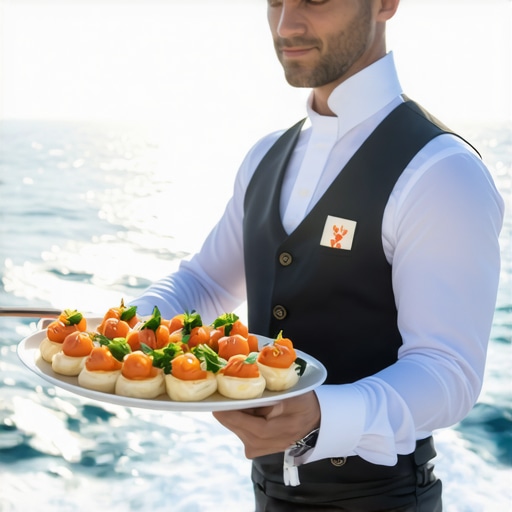
Train Your Team to Pivot on a Moving Deck
Serving on a boat or train requires a completely different physical gait. I tell my servers to keep a slightly wider stance and to never lock their knees. They need to absorb the vibration of the engine with their joints. When hiring, I look for server skills that make every event stand out, specifically spatial awareness and a sense of rhythm. You aren’t just walking; you are timing your steps to the rhythm of the waves or the tracks. For larger groups, how to choose the right staffing ratio for a vip event changes significantly. You need more hands on deck because every movement takes longer and carries more risk. It is also vital that why your server team needs a designated captain for every 50 guests becomes a non-negotiable rule. The captain acts as the eyes and ears, watching the horizon or the track ahead to warn the kitchen of upcoming turbulence.
Fight the Heat Loss in High Winds
On a yacht, the breeze is your constant companion, and it is a master at stealing heat from your food. You cannot rely on standard chafing dishes; you need heavy-duty, induction-based warming systems that aren’t affected by the wind. If you are serving delicate proteins, you must know the secret to keeping fish from drying out in a warming drawer, which usually involves a shallow bath of aromatic liquid or butter. We once hosted a gala on a clipper ship where the sea spray was so aggressive it threatened to season the steaks with unwanted salt. We had to pivot to using cloches for every single plate. Not only did it look incredibly elegant, but it also created a pressurized heat dome that kept the food at the perfect temperature until the very second it reached the guest’s fork.Most hosts assume that throwing more bodies at a difficult event is the ultimate solution for a seamless experience. However, in the cramped galley of a yacht or the narrow corridor of a vintage rail car, the hidden risks of hiring student servers for high-end events become painfully obvious. In these environments, extra staff members often just become extra obstacles. Success isn’t about the quantity of your team; it is about specialized movement. In my experience, the advantage of hiring servers who specialize in french service is not merely about the prestige it brings to the table; it is about the fact that these professionals possess a deep understanding of weight distribution and spatial economy. They know how to pivot their entire center of gravity when the floor shifts, a skill that top-server-tips-to-elevate-your-event-experience rarely cover for stationary venues. Have you ever fallen into the trap of over-staffing a small space only to have the service feel more like a collision course? Let me know in the comments.
Does Engine Vibration Actually Change the Flavor of Your Wine?
It might sound like an elitist myth, but the physics of a moving environment fundamentally alters the guest’s sensory experience. Beyond just the risk of spills, constant vibration and high-frequency background noise—whether from a jet engine or a marine diesel motor—can significantly dampen our ability to perceive saltiness and sweetness. According to research by Professor Charles Spence, author of Gastrophysics: The New Science of Eating, environmental ‘white noise’ can suppress our taste buds by up to 30 percent. This means that how to match your drink menu to your main course flavors requires a much bolder approach than in a static ballroom. You need high-acid wines and robust, umami-forward profiles that can punch through the atmospheric interference. If you serve a delicate, subtle vintage while a yacht is cruising at twenty knots, your guests might as well be drinking water. 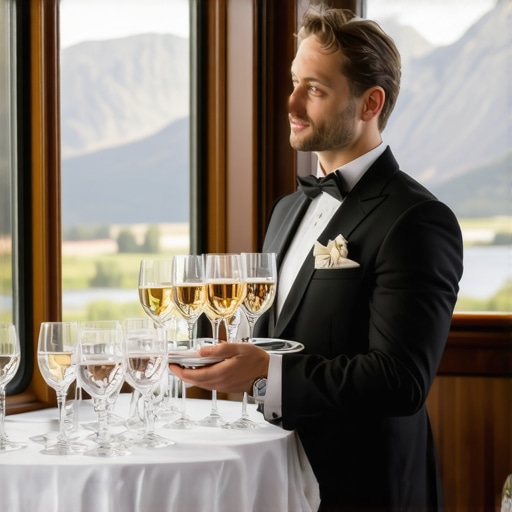
The Scented Candle Trap You Should Always Avoid
One of the most frequent ‘oops’ factors I see in mobile luxury events is the misuse of decor. While you might want to create an atmosphere, the problem with using scented candles on dining tables is magnified tenfold in an enclosed, moving space. When you combine heavy floral or musk scents with the inevitable smell of sea salt or engine exhaust, you create a sensory ‘mud’ that can actually trigger motion sickness. Instead of scent, focus on stability and why high-quality napkins matter for guest perception in high-motion settings. A heavy, high-thread-count napkin can be used as a stabilizer under glassware or as a quick grip for a sliding plate. Furthermore, you must adhere strictly to why your catering contract needs a firm headcount deadline. In a mobile environment, there is no ‘running to the store’ for extra supplies. Every gram of weight and every inch of storage is calculated before the engine even turns over. To ensure everything runs perfectly, remember that why a lead server should never be assigned a single table is a non-negotiable rule on the move. Your lead must be the ‘eyes on the horizon,’ anticipating the next curve or swell and signaling the team to pause service before the soup leaves the bowl. Integrating effective catering strategies for corporate event impressiveness in these scenarios means being three steps ahead of the terrain itself.
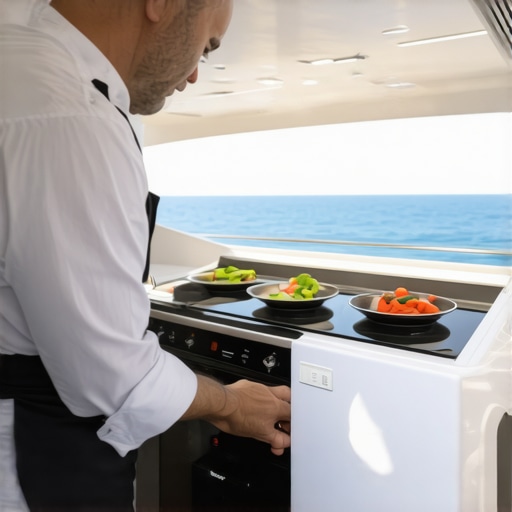
Beyond the sensory experience and the staff’s physical rhythm, the literal nuts and bolts of your mobile galley determine whether you finish the night with a standing ovation or a logistical nightmare. When you are catering in motion, your equipment needs to be as adaptable as your team. I have moved away from traditional butane burners entirely for these events. Not only are they a fire hazard in the tight quarters of a vintage rail car, but the International Convention for the Safety of Life at Sea (SOLAS) Chapter II-2 provides strict regulations on open flames in galleys for a reason—safety is paramount when you are miles from the nearest fire station. Instead, I rely on heavy-duty, commercial-grade induction plates. They provide instant heat without the ambient temperature spike, which is crucial because a hot kitchen on a small yacht is a recipe for a miserable crew. This level of technical planning is a core part of an essential checklist for successful corporate event catering in unconventional spaces.
Ditch the Gas and Embrace Induction for Better Safety
The beauty of induction is precision. When I am working on a moving vessel, I need to know exactly how much power I am drawing from the onboard generator. I’ve personally used the Vollrath Mirage Pro series for years because its 100 power levels allow me to simmer a delicate reduction without it breaking when the boat hits a swell. If you are still using open flames, you are playing a dangerous game with the wind and the motion of the room. This equipment choice isn’t just about safety; it’s about optimizing server efficiency to enhance event satisfaction. When the kitchen isn’t a 110-degree sauna, your team stays sharper, moves faster, and makes fewer mistakes. I also swear by magnetic silicone mats on my prep surfaces; they keep my mixing bowls and pans from migrating across the counter while I am busy garnishing.
Software and Lists Prevent Mid-Ocean Panics
In mobile catering, you cannot afford to forget a single peeler or a spare box of napkins. I’ve transitioned my entire prep workflow to a cloud-based inventory system that requires a double-blind check before the truck is even loaded. This ensures we audit your rental order for missing water glasses long before we lose cell service on the water. For long-term success, I maintain a ‘Mobile Bible’—a digital document that records the specific quirks of every train car or yacht we service, from the location of the breaker box to the exact width of the service door. This knowledge allows us to boost your corporate event with expert server techniques that are tailored to the environment, ensuring the team never looks like they are struggling with the architecture of the venue.
How do I maintain high service standards over years of mobile events?
The secret to longevity in this niche is the post-event debrief. Every time we return to land, my captains and I spend thirty minutes documenting every ‘near-miss’—every glass that almost slid, every plate that felt too heavy for the corridor. We use these notes to refine our corporate event catering strategies for success for the next season. Looking forward, I predict we will see an even greater shift toward modular, battery-powered kitchen technology, allowing us to cook in even more remote and ‘off-grid’ mobile locations without relying on the host’s power supply. Before your next high-motion event, I challenge you to try the ‘damp-towel anchoring’ method under every prep station bowl; it is the simplest, most effective way to gain immediate control over your moving environment. Keeping your tools in peak condition and your checklists updated is how you move from being a ‘caterer on a boat’ to a master of maritime hospitality.
Hard Truths from the Galley and the Rails
After decades of chasing horizons on luxury yachts and vintage train cars, I have learned that the greatest tool in a chef’s kit isn’t a knife—it is anticipation. The ‘hardest lesson’ is realizing that you are no longer just a cook; you are a physics manager. If you don’t hear the engine pitch change before a big wave, or feel the train lean into a curve before you plate that delicate jus, you’ve already lost the battle. My lightbulb moment came when I stopped fighting the motion and started using it. I realized that top server tips to elevate your event experience often boil down to physical awareness. I began training my team to listen to the vessel as much as the guests. We also learned that redundancy is your only friend; if you have one of something, you have none. In the middle of the Atlantic, there is no overnight delivery for a broken immersion blender.
The Mobile Professional’s Essential Arsenal
To succeed where the ground is constantly shifting, you need a very specific set of resources that prioritize stability and science. First, I never leave the dock without the Vollrath Mirage Pro induction burner; its precision is unmatched when you are dealing with finicky onboard power grids. For those wanting to understand the ‘why’ behind flavor shifts at high altitudes or high speeds, I cannot recommend Gastrophysics: The New Science of Eating by Charles Spence enough; it changed how I season food for transit. I also rely heavily on digital inventory tools to ensure we best corporate event servers for 2025 are never caught without the basics. Finally, for my team’s coordination, we use shared digital ‘bibles’ that document the specific layout and breaker-box locations of every regular venue, which is a key part of corporate event catering strategies for success.
#IMAGE_PLACEHOLDER_E#
Take the Leap into Mobile Luxury
Catering in motion is the ultimate test of a professional’s skill, but it is also the most rewarding way to serve. There is a specific kind of magic in delivering a flawless, multi-course meal while the Swiss Alps or the Caribbean Sea drift past the window. It requires a blend of technical precision and the ability to how to manage a catering team during a sudden rain storm or a rogue wave with total grace. Don’t let the logistics intimidate you. Start with stable menus, invest in the right induction gear, and always keep your center of gravity low. The world of mobile luxury is waiting for those brave enough to leave the solid ground behind. Have you ever tried to serve a meal in a space that wouldn’t stop shaking? Tell me your wildest story in the comments below!