

The sun was beating down on a gorgeous June afternoon, and I was staring at three hundred pounds of crushed ice that was melting faster than the bride’s composure. We had five hundred oysters to shuck, and the ‘shucking station’ I’d meticulously planned was slowly turning into a lukewarm puddle of seawater and regret. In my early days as a caterer, I thought a raw bar was the height of luxury—a way to really plan the ultimate wedding reception meal that guests would talk about for years. I was right about the talking part, but for all the wrong reasons. I learned the hard way that when you’re managing a high-volume event, ‘fresh’ and ‘raw’ are two of the scariest words in the kitchen. Today, I’m pulling back the curtain on why raw oysters are a massive liability for your big day and how you can still offer that ‘wow’ factor without the 2 a.m. phone calls from sick guests. Have you ever stood in a buffet line and wondered if those oysters were actually as cold as they should be? Let me know, because that intuition usually saves lives.
Why Raw Shellfish and Large Crowds Just Don’t Mix
Serving raw seafood at a small dinner party is a delight; serving it to 250 people in a drafty ballroom or a sun-drenched garden is an extreme sport. When I first started out, I made the mistake of assuming our server efficiency would overcome any temperature issues. I didn’t realize that even the best team can’t fight physics. If your venue lacks a temperature-controlled prep space, you are essentially gambling with your guests’ health. It isn’t just a matter of taste; it is a matter of biology. According to the CDC, Vibrio bacteria—which naturally inhabit coastal waters where oysters live—cause an estimated 80,000 illnesses and 100 deaths in the United States every year. When you scale up to a high-volume wedding, the margin for error shrinks to zero. I remember one specific wedding where the ice delivery was delayed by hours. We had to make a choice: serve the oysters and hope for the best, or pull the plug. We pulled the plug, and while the couple was disappointed, it was the best decision I ever made for their safety. High-volume service means items sit out longer, the staff is under more pressure, and the ‘cold chain’ of food safety is incredibly easy to break. If you aren’t careful, you aren’t just serving an appetizer; you’re serving a potential lawsuit. I remember the blisters on my thumb from shucking at a 300-person gala early in my career. I was slow, the crowd was restless, and the heat in that tent was rising. That was the moment I realized that high-volume raw service requires a level of infrastructure most weddings just can’t provide. You need specialized staff who do nothing but shuck, a constant replenishment of ice that doesn’t just sit in a bag, and a way to discard the shells immediately so you don’t attract flies or create a stinking mess.
Is the Risk of Food Poisoning Really That High?
It’s the question every couple asks me when they see the ‘Raw Bar’ line item on a menu. The short answer is yes, especially when you consider the logistics of a typical wedding timeline. Between the ceremony, the cocktail hour, and the transition to the reception, food often sits out much longer than intended. When you’re following wedding catering tips from industry experts, you’ll find that safety should always trump aesthetics. It’s not just about the oysters being ‘bad’ from the supplier; it’s about the cumulative time they spend in the ‘danger zone’ (40°F to 140°F) while a server struggles to shuck them fast enough for a line of fifty hungry guests. If your wedding servers aren’t trained specifically in high-stakes seafood handling, a single drop of cross-contamination can turn a celebration into a catastrophe. We will explore how to manage these risks—or what to serve instead—to ensure your wedding is memorable for the right reasons.
Fix the Infrastructure Before You Buy the Seafood
Maintaining a strict cold chain is like trying to keep an ice cube from melting in a sauna; it requires constant, aggressive intervention. If you are set on a raw bar, your first step isn’t picking the oyster variety; it is ensuring your venue has the bones to support it. You need to verify that there is a temperature-controlled prep space within twenty feet of the service area. I once managed a 400-person tented wedding where the ‘kitchen’ was a hundred yards away across a gravel path. By the time the shucked oysters reached the guests, they were already sweating. We had to implement an emergency ‘ice relay’ just to keep the internal temperatures below 40°F. If your venue lacks this, you are better off following an essential checklist for successful catering and pivoting to a safer menu. Real-world execution requires a dedicated ‘Ice Captain’—one staff member whose sole responsibility is monitoring drainage and replenishment so the shellfish never sits in a pool of lukewarm water.
Swap the Ice for a Wood-Fire Grill
One of the most effective wedding catering tips from industry experts is to lean into the ‘Hot Bar’ concept. Instead of raw oysters, serve them grilled with roasted garlic butter and charred lemon. This approach provides the same luxury aesthetic but uses heat to eliminate the biological risks that keep caterers awake at night. At a recent high-end event, we replaced the traditional raw station with a live-action oyster grilling station. The guests loved the visual of the flames, and it allowed us to maintain server efficiency because we could prep batches of twelve at a time rather than shucking to order. This is a staple among innovative wedding themes that wow guests because it feels more like a culinary performance than a food safety gamble.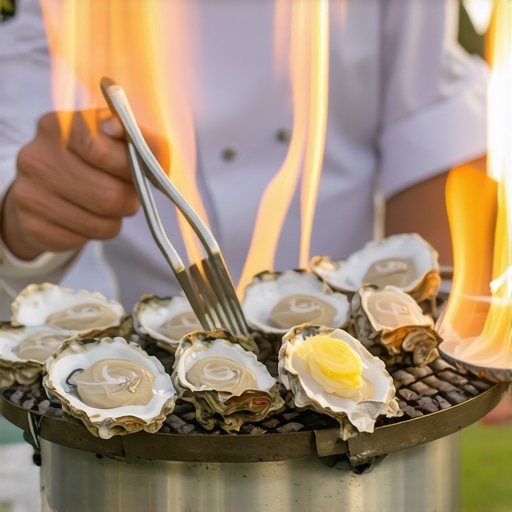
Build a Shell Management System
The biggest logistical failure I see is the ‘Pile Up.’ Guests don’t know what to do with empty shells, and if you don’t have a plan, they end up on the floor, in planters, or hidden in the folds of your expensive linens. To avoid this, your appetizer tray needs a designated discard station. I learned this the hard way at a black-tie gala where a guest tripped on a discarded shell and nearly took down the entire champagne tower. Now, we use a 2:1 staffing ratio: for every two wedding servers passing appetizers, there is one ‘sweeper’ whose only job is to collect shells and napkins. This keeps the environment pristine and prevents the ‘seaside’ smell from becoming overwhelming in a small space. When you elevate your wedding with professional servers, they should be trained to anticipate the exact moment a guest finishes their bite, whisking the shell away before it ever touches a table. This level of detail is what separates a chaotic buffet from a fairytale atmosphere.It’s easy to look at a chaotic service and think, ‘I just need more hands.’ In my experience, that’s where the real trouble starts. Most planners believe that padding the headcount is an insurance policy, but in high-stakes catering, it’s often a recipe for a physical bottleneck. If you have ten servers trying to push through a single narrow doorway, you haven’t bought safety; you’ve bought a traffic jam that slows down the kitchen. The nuance most beginners miss is that optimizing server efficiency is about flow, not just numbers.
The Lead Server Trap You’re Likely Falling For
This brings me to the ‘Oops’ factor that even seasoned coordinators miss: the Lead Server assignment. I’ve seen countless events fail because a lead server was assigned a single table. It sounds like a great idea to give your best person the VIPs, but the second that person picks up a water pitcher, they lose their bird’s-eye view of the room. A leader who is ‘in the weeds’ cannot see that the buffet is running low or that the champagne toast is falling behind. When your lead is busy shucking an oyster or pouring wine, who is managing the timing between the kitchen and the floor? This lack of oversight creates a vacuum where servers begin to wander without direction—a phenomenon I call ‘ghosting.’ 
Can You Really Overstaff a High-End Event?
The answer is a resounding yes. Research published in the Journal of Culinary Science & Technology indicates that after a certain threshold, adding labor to a fixed service space actually decreases total output. This ‘law of diminishing returns’ hits hard when you’re working in tight venue footprints. Instead of just hiring more people, you need to focus on server skills that make every event stand out, like the ability to anticipate guest needs without being told. I’ve managed galas where we cut the staff by 10% and actually saw the food get to the tables five minutes faster because the kitchen path was clear.
Audit Your Ratio Before the First Course Hits the Table
This is why you should always audit your server-to-guest ratio for VIP dinners before the contract is signed. For a truly high-end experience, I recommend a 1:8 ratio for plated service, but those eight people must be a synchronized unit, not just a group of individuals. The mental load of a lead server is immense. They are calculating the ‘drift’—the time difference between when a plate leaves the heat and when it reaches the guest. When you tether that person to a specific table, you’re cutting off the ‘brain’ of the operation. I’ve seen this mistake cost corporate hosts thousands in overtime fees because the service ran forty minutes late. One simple way to gain back twenty minutes of service time is to remember that pre-pouring water is the secret to a fast service start. It sounds basic, but it removes one of the biggest initial hurdles for the team and allows them to focus on the main course immediately. Have you ever fallen into this trap of thinking more is always better? Let me know in the comments.If you are still carrying around a crumpled piece of paper as your master plan, you are one spilled glass of red wine away from a total blackout. I have transitioned my entire workflow to digital BEOs that sync in real-time across the team’s tablets. This is non-negotiable for corporate event catering strategies for success because when a VIP guest suddenly reveals a nut allergy ten minutes before the first course, every server needs to know instantly, not after the plate is served. My tool of choice for the floor is a cloud-based logistics platform because it allows me to update the ultimate guide to corporate event catering logistics on the fly. To keep the kitchen running with surgical precision, I use Bluetooth-enabled temperature probes that log data directly to my phone. It is the only way to prove to a nervous bride that her seafood stayed within the safe zone for the entire six-hour window.
How do I maintain consistent service quality at scale?
Maintaining excellence isn’t about one-off wins; it is about the boring stuff—the repetition. I treat every event like a post-flight debrief. We use a standardized audit where we grade the team on server skills that make every event stand out immediately after the guests leave. Research from the Cornell School of Hotel Administration suggests that immediate feedback in hospitality environments can increase staff retention and service accuracy by up to 15% when metrics are shared transparently. I do not just tell them they did a good job; I show them the data on plate-clearance times and guest feedback.  As we look toward the future, I see the wedding catering trends to impress guests in 2025 shifting toward ‘smart catering’—think AI-driven prep lists that predict waste based on past guest demographics. It is about working smarter, not harder. My best advice for those looking to scale is to contact us to talk through your specific venue layout before you book your next gala. Start by digitizing just one part of your workflow—your prep list—this week, and see how much mental bandwidth you gain back.
Everything I Learned When the Ice Finally Melted
Looking back at two decades in the kitchen, the most profound realization wasn’t about a recipe—it was about the weight of trust. When a couple hires you for their big day, they aren’t just buying a menu; they are trusting you with the safety of their grandmother and the reputation of their family. I’ve learned that spotting a professional server in an interview often comes down to their respect for the ‘cold chain’ rather than their ability to carry a heavy tray. Another hard truth? Sometimes the most luxurious choice is the simplest one. I now frequently steer clients toward the hidden benefit of choosing an all-inclusive venue because they usually possess the permanent walk-in refrigeration that a pop-up tent simply lacks. Finally, remember that silence is your enemy on a busy floor; if your team isn’t communicating, they are already falling behind.
What Stays in My Catering Flight Bag
To survive a 500-person gala, I rely on a few non-negotiable tools. First, a digital BEO system is the only way to manage corporate event catering strategies for success without losing your mind to paper trails. I also look to industry-standard hospitality research from institutions like Cornell to stay ahead of labor trends and guest psychology. Before every major shift, I run through the 5-step process for vetting a new event venue checklist to ensure there are no surprises with the power grid or the plumbing at the eleventh hour. And of course, I never start a service without knowing how to organize a staff meeting before a 500-person dinner—it’s the anchor that keeps the team from drifting when the rush begins.
Build a Legacy One Plate at a Time
Catering is a high-wire act where the stakes are as high as the rewards. By focusing on optimizing server efficiency and prioritizing safety over spectacle, you can create a business that guests rave about for years. Don’t be afraid to pull the plug on a risky idea if the infrastructure isn’t there to support it properly. If you’re feeling overwhelmed by the logistics of your upcoming event, contact us today to see how we can streamline your vision into a seamless reality. High-volume wedding catering doesn’t have to be a gamble when you have the right systems in place. Have you ever seen a raw bar go south at a wedding? Let me know in the comments below!