

I’ll never forget the first time I set up a massive six-tier champagne tower for a high-stakes corporate gala. We had the premium bubbly, the crystal-clear coupes, and a team of the best corporate event servers for 2025 ready to go. But when the corks popped and the liquid started to flow, the whole thing looked… grey. Under the harsh overhead fluorescents, the tower didn’t shimmer; it looked like a stack of forgotten glassware at a yard sale. I realized then that a champagne tower isn’t about the drink—it’s a light show. If you don’t nail the illumination, you’re just pouring expensive juice into a precarious pile of glass. Today, I’m going to share exactly how I fixed that mistake and how you can make your next tower the absolute star of the room.
Stop Relying on Your Venue’s Overhead Lights
If you think the standard ballroom dimmers are going to do your tower justice, you’re in for a disappointment. You need to treat this like a theatrical performance. I used to make the mistake of thinking light is light, but I quickly learned that choosing the right lighting for a high-stakes board dinner or a wedding reception requires a much more surgical approach. You want the light to hit the bubbles from multiple angles to create that diamond effect. According to the Illumination Engineering Society, the angle of light significantly affects how we perceive the texture and life of liquids, which is why a single flat light source will always fail you.
Is All This Extra Equipment Actually Worth the Hassle?
I know what you’re thinking: I’ve already got a million things to worry about, do I really need to buy specialized spotlights? The short answer is yes, but the long answer is that it doesn’t have to be complicated. You aren’t building a movie set; you’re just strategically placing a few key pieces. If you want to create a fairytale atmosphere, the sparkle of the champagne is your most cost-effective tool. Have you ever had a stunning centerpiece completely disappear once the sun went down? Drop a comment and tell me I’m not the only one who has felt that oops moment!
Bring the Sparkle From the Bottom Up
One of the best tricks I ever learned—and one I wish I’d known before that disastrous gala—is to light the tower from the base. When you place a soft, waterproof LED puck under the bottom layer of glasses, the light travels up through the liquid like a fiber-optic cable. This creates a glow that seems to come from within the champagne itself. When you combine this with photographing a champagne toast without glare, you get those magazine-quality shots that clients dream of. It’s about creating depth and making sure the sparkle follows the liquid as it pours down each level. [image_placeholder]
Stop the Flat Look with Cross-Lighting
Base lighting is only the beginning. Think of your tower as a diamond sitting on a jeweler’s velvet pad. You wouldn’t just light a diamond from underneath; you need light hitting the facets from the sides to make it ‘fire.’ This is where cross-lighting comes in. I always position two small pin-spots at 45-degree angles from the front of the tower. This ensures every bubble caught in the pour reflects light back toward the guests’ cameras. I remember a winter wedding where the lighting tech used cold, 5000K daylight bulbs. Instead of a golden, celebratory tower, the champagne looked like it was being served in a sterile laboratory. The photos were salvageable, but the vibe in the room was completely killed. This is exactly why you should test your event lighting during the day and night to see how shadows shift as the sun goes down.
Angle Your Spots Like a Pro
Position your spotlights high and aim them down at the top tier. As the liquid cascades, it creates a moving curtain of light. If the spots are too low, you’ll blind the person pouring the bottle. You want the light to follow the path of the champagne, acting like a spotlight for the liquid gold. This isn’t just about aesthetics; it’s about making sure your server skills that make every event stand out are fully visible to the crowd. 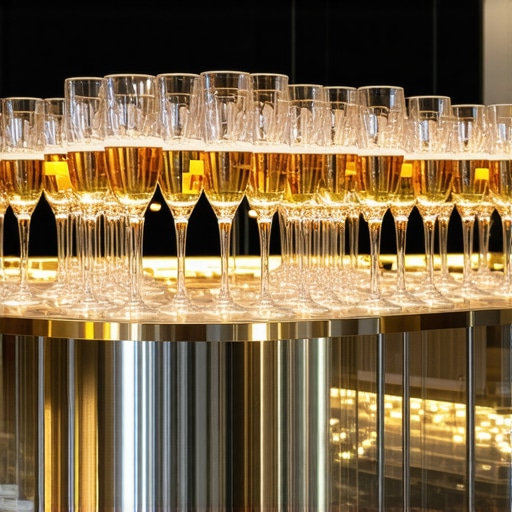
Choose a Warm Glow Over Sterile Blue
The color of your light is just as important as the direction. Champagne has a natural amber hue. To enhance this, you need to use ‘warm’ light, typically around 2700K to 3000K on the Kelvin scale. If you use cool white or blue light, the yellow of the champagne and the blue of the light will mix to create a sickly greenish tint. I’ve seen beautiful vintage coupes look like they were filled with pond water because the DJ’s uplights were set to a harsh ‘cool white.’
Why 2700K is Your Magic Number
Warm light mimics candlelight, which is the most flattering light for both food and people. When that warm glow hits the carbonation, it creates a ‘sparkle’ that feels expensive. If you are using LEDs, make sure they have a high Color Rendering Index (CRI). A low CRI light will make even the most expensive vintage look dull and flat.
Secure the Base Before the Pour Starts
A six-tier tower is essentially a giant, fragile puzzle. Before a single drop is poured, you must ensure the physical setup is as secure as the lighting. Just as a ballroom floor plan needs a three-foot safety buffer to prevent accidents, your champagne tower needs a ‘no-fly zone.’ I once saw a guest try to lean in for a selfie and nearly topple a 60-glass structure because we hadn’t marked out the perimeter clearly enough.
Keep the Flow Under Control
When the music starts and the bottles are popped, it’s easy for the timeline to slip. Knowing how to keep your event schedule on track without rushing guests is a fine art. You want the lighting to build anticipation. Start with the base LEDs at 20% brightness while the tower is empty, and ramp them up to 100% the moment the first bottle touches the top glass. It signals to the entire room that the main event has begun without anyone having to say a word.
Throw Away the More Light is Better Rule
Most planners assume that flooding a room with light makes it feel high-end. In my experience, this is a classic amateur mistake. If you want the champagne to actually shimmer, you need the shadows to do the heavy lifting. When you use too much ambient light, you wash out the internal reflections within the glass. Think of it like a theater; you don’t turn on the house lights to see the star of the show. By keeping the room slightly dimmer and focusing only on your specific tower lighting, you create high-contrast points of light. This is one of those effective catering strategies for corporate event impressiveness that separates a standard party from a luxury experience. When the room is dark and the tower is glowing, the liquid gold becomes the only thing the guests can see. Have you ever fallen into the trap of over-lighting your venue? Let me know in the comments!
Watch Out for the Hidden Vibration Trap
Here is the ‘oops’ factor that almost no one discusses until it’s too late: floor resonance. I’ve seen a perfectly balanced five-tier tower collapse not because someone touched it, but because the bass from the DJ’s speakers hit the exact resonant frequency of the glass stack. If your tower is on a portable stage or a wooden ballroom floor, every footstep nearby is a potential disaster. When you are choosing the right staffing ratio for a VIP event, make sure you have a server whose only job is to ‘guard the perimeter’ during the high-energy parts of the night. This is also why I always suggest that your event budget needs a 10 percent contingency fund specifically for site-specific stabilization tools, like heavy-duty rubberized levelers hidden under the tablecloth. 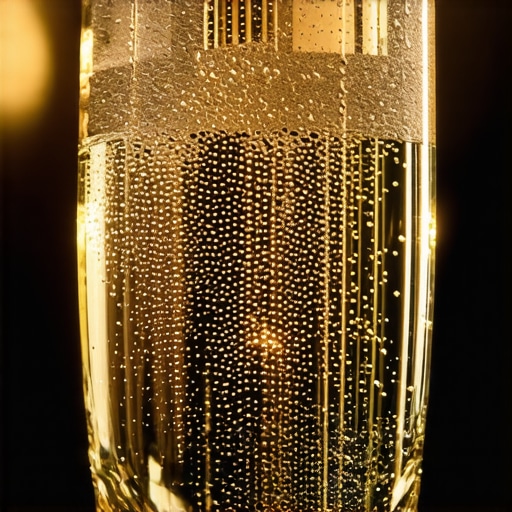
Is Acrylic Ever Better Than Real Crystal?
This is a question I get from high-end clients who are terrified of a mess. While purists will tell you crystal is the only way to go, the physics of light tells a different story. According to a study published in the Journal of Light & Visual Environment, the refractive index of your container determines the ‘sparkle factor’—crystal has a higher index, meaning it bends light more sharply than glass or acrylic. However, at a distance of twenty feet, the difference is negligible if your lighting is correct. The real nuance is weight; crystal is heavier and more stable. If you’re opting for the ‘safer’ acrylic route, you must double your lighting intensity to make up for the lack of natural fire in the material. This kind of technical detail is part of the top server tips to elevate your event experience that we train our lead captains on. It isn’t just about carrying a tray; it’s about understanding the environment you’re building. By mastering these small, scientific details, you ensure that the tower doesn’t just stand there—it performs.
Ditch the Detergent and Use a Handheld Steamer
If you want that surgical precision in your sparkle, you have to talk about residue. Most catering teams pull glasses straight from the rack and give them a quick wipe with a standard linen. That is a recipe for a flat drink. I personally carry a Jiffy J-2000 handheld steamer to every site. Why? Because even the most ‘spot-free’ commercial dishwashers leave a microscopic film of surfactant. According to a study in the Journal of Food Engineering, surface tension is the primary driver of CO2 bubble formation; even a trace amount of soap residue can cause your champagne to degas 30% faster than it should. By using pure steam and a 70/30 polyester-polyamide microfiber cloth, I ensure the glass is ‘beer clean’—a term we borrow from the brewing world to describe a surface totally free of oils. When you audit your rental order for missing water glasses or coupes, always request an extra 10% just to account for those with permanent scratches that no amount of steaming can fix.
How do I keep the tower stable through a five-hour event?
Maintaining the physical integrity of a tower over a long evening is about more than just a level table; it’s about managing the environment. I’ve learned the hard way that a tower set up at 4:00 PM for a 9:00 PM pour will settle as the tablecloth fibers compress under the weight. This is where wedding catering tips from industry experts really come into play. I use thin, high-density rubber shims—the kind used for cabinetry—hidden beneath the primary tray. This allows for micro-adjustments if the floor begins to shift. During the cocktail hour, when you are planning the ultimate wedding reception meal, assign a ‘tower captain.’ This isn’t just about optimizing server efficiency to enhance event satisfaction; it’s a security measure. That captain’s only job is to monitor guest proximity and check the base level every thirty minutes. If you are choosing the right staffing ratio for a VIP event, this dedicated role is non-negotiable for a structure over four tiers high. 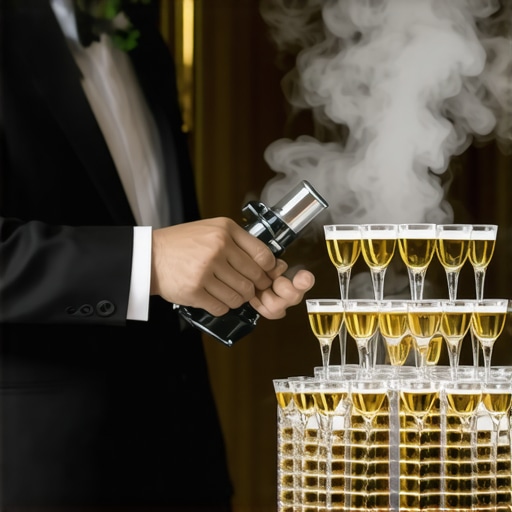
The Future of Liquid Architecture is Digitally Synced
Looking ahead to 2025 and beyond, we are moving away from static lighting toward ‘smart towers.’ I’m already seeing high-end corporate galas using DMX-controlled LED bases that sync with the venue’s audio system. Imagine the tower changing from a soft amber to a pulsing gold the exact moment the bass drops during the celebratory toast. This tech allows you to boost your corporate event with expert server techniques by timing the pour to a programmed light show. We’re also seeing the rise of laser-etched glassware where the client’s logo is ‘nucleated’—meaning the bubbles actually form in the shape of a brand or a monogram as the glass fills. It’s an incredible way to scale a traditional centerpiece into a high-tech branding moment. If you want to stay ahead of the curve, stop thinking of the tower as a piece of furniture and start thinking of it as an interactive installation. My big advice? Next time you’re prepping a tower, swap your polishing cloth for a high-output handheld steamer; the difference in bubble longevity and clarity will stun your clients and make your photos pop like never before.
What My Messiest Tower Collapse Taught Me
Experience is a brutal but effective teacher. I’ve learned that a tower isn’t static; it lives and breathes with the room’s energy. One detail I never ignore now is the weight of the liquid—once you start pouring, the pressure on the bottom glasses increases exponentially, and even the smallest imperfection in the table level can become a pivot point for disaster. This is why having the best corporate event servers for 2025 on hand is vital; they don’t just pour, they watch for the subtle shifts that signal a tilt. I also stopped trusting “level” floors. I now carry a literal spirit level to every setup because ballrooms are notorious for having slight slopes toward drainage or because of thick carpeting.
The Non-Negotiable Gear in My Catering Kit
If you want to move beyond the amateur stage, you need tools that solve invisible problems. First, the Jiffy J-2000 Steamer is my secret weapon for removing fingerprints without adding lint. Second, I always have a pack of high-density rubber shims for stabilization. I’ve integrated these costs into my planning because I know that an event budget needs a 10 percent contingency fund for these small but crucial structural supports. Finally, I recommend the Illumination Engineering Society’s Handbook for anyone serious about the science of light; it changed how I perceive reflectivity and liquid depth. For the actual sparkle, I trust Aputure’s small accent LEDs because of their high CRI, ensuring the champagne never looks muddy. [image_placeholder]
Take the Leap and Let the Bubbly Flow
Building a champagne tower is an act of bravery and art. It’s the centerpiece that defines a luxury experience and creates a shared moment of wonder that guests will remember long after the last glass is washed. When you combine technical precision with the right wedding catering tips from industry experts, you aren’t just serving a drink; you’re orchestrating a memory. Don’t be afraid to dream big with your designs to create a fairytale atmosphere that feels truly bespoke. You have the lighting, the stability, and the science down—now go out there and make it shimmer. Have you ever had a centerpiece nearly end in disaster? Let me know your close calls in the comments below!