

I’ll never forget the sinking feeling in my gut when I watched a server at a high-end corporate gala shrug his shoulders after a guest asked if the sauce had gluten. He didn’t just look confused; he looked terrified. He actually started squinting at the plate as if the ingredients were written in the garnish. That was a massive lightbulb moment for me. It didn’t matter how much the host had spent on the Wagyu or the vintage wine—the lack of a proper briefing turned a luxury experience into a liability in seconds. Today, I’m going to show you exactly how to spot these red flags before they derail your event, and more importantly, how to ensure your team is ready to impress. Have you ever sat through a dinner where the staff seemed like they were seeing the food for the first time? Drop your most awkward dining story in the comments—I’d love to hear how you handled it.
The High Cost of a Server Who Can’t Describe the Plate
Early in my career, I made the amateur mistake of assuming that if I hired a reputable catering company, they would naturally handle the pre-shift details. I learned the hard way that without confirming that [your server lead needs a copy of the event script](https://gourmetcateringsco.com/why-your-server-lead-needs-a-copy-of-the-event-script), vital information often vanishes. When a guest asks about the catch of the day and gets a blank stare, the professional veneer of your entire function cracks. You aren’t just paying for food runners; you are paying for ambassadors of your brand. According to research from the Cornell School of Hotel Administration, server competence is the single most significant factor in guest satisfaction, even outweighing the actual taste of the food in some high-pressure environments. If you want to avoid these pitfalls, you have to [boost your corporate event with expert server techniques](https://gourmetcateringsco.com/boost-your-corporate-event-with-expert-server-techniques) that emphasize product knowledge over just carrying trays.
Is Menu Knowledge Actually Worth the Hype?
You might think I’m being a bit of a stickler here. After all, if the food is good, who cares if the server knows it’s a reduction or a coulis? But it’s not about the culinary jargon; it’s about confidence and safety. A server who isn’t briefed is a server who makes guesses, and in a world of severe allergies, guessing is dangerous. I once watched a server tell a guest a dish was vegan when it was clearly finished with butter. That kind of error happens when you don’t prioritize [optimizing server efficiency to enhance event satisfaction](https://gourmetcateringsco.com/optimizing-server-efficiency-to-enhance-event-satisfaction). If you aren’t sure if your current team is up to the task, you need to learn [how to spot a professional server in an interview](https://gourmetcateringsco.com/how-to-spot-a-professional-server-in-an-interview) so you can build a crew that actually adds value to the room. We’re going to dig into the specific body language cues and verbal slips that give an unbriefed server away.
Stop Guessing and Start Briefing
Think of your server briefing as a pilot’s pre-flight checklist. You wouldn’t want a captain ‘winging it’ at 30,000 feet, and you don’t want a server winging it during a 500-person gala. I learned this the hard way during a tech launch where I skipped the huddle because we were behind schedule. When the CEO asked about the glaze on the duck, the server guessed it was ‘sweet soy.’ It was actually a honey-balsamic reduction with a high allergen count. The fallout was messy and entirely preventable. To avoid this, you must organize a staff meeting before a 500-person dinner that lasts at least fifteen minutes. This isn’t just a pep talk; it’s a tactical download. You need to ensure your server lead needs a copy of the event script to track the flow of service perfectly.
Let the Team Taste the Menu
You can describe a ‘velvety mouthfeel’ until you’re blue in the face, but nothing beats actual experience. If a server hasn’t tasted the dish, they are just reciting a script, and guests can smell a script from a mile away. When you request a tasting before finalizing your menu, make sure a representative of the service staff is there. During the actual event, the kitchen should provide a ‘tasting plate’ for the staff. This allows them to use descriptive, sensory language that sells the experience.
Build a Real Protocol for Dietary Needs
Allergies aren’t just a preference; they are a legal and ethical landmine. I always tell my teams that if they don’t know the answer 100%, they must say ‘Let me check with the chef.’ This honesty builds more trust than a confident-sounding guess that ends in a medical emergency. You can boost your corporate event with expert server techniques by implementing a ‘red flag’ system where certain servers are designated as the point of contact for all dietary questions. This level of optimizing server efficiency to enhance event satisfaction ensures that no one is left guessing when the stakes are high.
Focus on the Hand-Off
In the world of high-volume service, the ‘hand-off’ between the kitchen and the server is where most details die. I once watched a beautiful plate of sea bass sit under a heat lamp for six minutes because the runner didn’t know which table it belonged to. To stop this, you need server skills that make every event stand out, specifically ‘silent service’ techniques where the server knows the seat positions before the food even leaves the window. This isn’t just about speed; it’s about the precision that separates a standard meal from a luxury experience.
Why Throwing More Bodies at the Room Won’t Save Your Service
Most planners think that if they have a ‘VIP’ crowd, the solution is simply to flood the floor with staff. I’ve seen events with a 1:8 server-to-guest ratio that felt chaotic and slow, while a 1:15 ratio with elite pros felt like a choreographed ballet. The common belief is that more staff equals faster service, but in reality, overcrowding the floor creates physical bottlenecks and communication breakdowns. When you audit your server-to-guest ratio for VIP dinners, you have to look at the flow of the room, not just the headcount. A study by the Journal of Hospitality & Tourism Research indicates that ‘perceived crowding’ by staff can actually lower guest satisfaction scores, as guests feel the service is intrusive rather than intuitive. Finding that sweet spot requires you to choose the right staffing ratio for a VIP event based on the complexity of the menu rather than a generic industry standard.
Can Your Staffing Ratio Actually Hurt Guest Perception?
If you’ve ever felt like three different people asked if you were finished with your appetizer while you still had a fork in your hand, you’ve experienced the ‘over-staffing’ trap. This happens when there is no clear hierarchy or zone management. It’s the primary difference between a staffing agency and a service partner; a partner builds a system, while an agency just provides warm bodies. Have you ever fallen into this trap of over-hiring only to have the service feel more cluttered? Let me know in the comments.
The Lead Server Trap You’re Probably Falling Into
Here is a mistake I see even seasoned planners make: assigning your strongest server to the ‘VIP’ table. It sounds logical, right? You want the CEO or the bride’s parents to have the best person. But here is the nuance: if your lead server is busy pouring wine for Table 1, they aren’t watching the other twenty tables. This is exactly why a lead server should never be assigned a single table. Their job is to be the ‘air traffic controller,’ spotting the guest who needs a refill or the runner who looks lost before a mistake ever happens. This bird’s-eye view is one of those top server tips to elevate your event experience that shifts the dynamic from reactive to proactive. When the lead is untethered, they can implement effective catering strategies for corporate event impressiveness by ensuring the entire room moves at the same pace. Professional service isn’t about one person being great; it’s about a system that doesn’t allow anyone to be mediocre.To keep a high-performing team from burning out or slipping into bad habits, I’ve had to embrace a specific tech stack. Gone are the days of paper floor plans taped to the kitchen door. I now swear by digital mapping tools like Social Tables because they allow for real-time changes that sync instantly to every department. If a guest at Table 14 suddenly remembers a shellfish allergy, I can flag that seat digitally, and the kitchen sees it before the server even walks back. This level of corporate event catering logistics is the difference between a panicked scramble and a silent, professional pivot.
The Digital Brain Behind a 500-Plate Dinner
I’ve also found that physical tools, like high-quality, discreet earpieces, are non-negotiable for scaling. In the past, I’ve seen leads waving their arms like they’re directing traffic on a runway. It looks amateur and distracts the guests. Using a ‘whisper’ channel allows the lead server to give cues—like ‘Clear Table 5’ or ‘Wine service beginning on the North side’—without anyone in the room being the wiser. It’s one of the most effective catering strategies for corporate event impressiveness because the service feels like it’s happening by magic. According to Kevin Baltazar, a renowned logistics consultant for Michelin-starred pop-ups, ‘The invisibility of the mechanism is the hallmark of luxury.’ 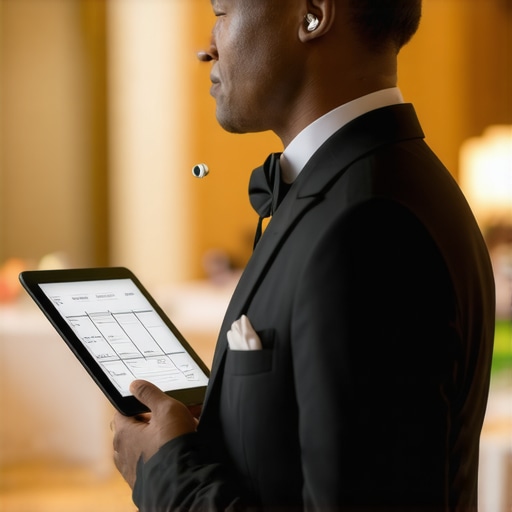
Why Your Team Needs Stealthy Communication
Beyond the gadgets, you have to think about the physical environment. I’ve learned that the impact of floor-length linens on server safety is a real factor in long-term results. If your staff is constantly tripping or worrying about snagging a tray on a poorly fitted cloth, their focus isn’t on the guest. It’s on their feet. I always ensure we use heavy, high-quality fabrics that stay put. This attention to detail is how you start optimizing server efficiency to enhance event satisfaction from the ground up.
How do I keep my team sharp for every single event?
Consistency is the hardest part of this business. My secret weapon is a ‘Post-Mortem’ folder. After every major gala or wedding, we spend ten minutes discussing what went wrong. We don’t blame; we just document. If we found that the bar placement caused a bottleneck, we note it so we never make that mistake again. This habit is an essential checklist for successful corporate event catering that evolves with you. I predict that as AI integrates more into hospitality, we will see predictive staffing models that tell us exactly when a guest is likely to want their next drink based on past event data, but for now, human intuition and a solid debrief are your best tools. Try this: For your next event, give your server lead a ‘no-table’ mandate. Let them purely observe and direct for just one hour, and watch how the overall guest energy shifts. I bet you’ll never go back to the old way.
Hard-Won Truths from a Decade in the Dining Room
Over the years, I’ve realized that the best servers don’t just carry plates; they carry the mood of the room. One major lightbulb moment was discovering that silence isn’t always golden. If a server is too quiet during a briefing, they might be masking confusion. I always look for the staff member who asks the ‘stupid’ question—they are usually the ones who save the night. Another lesson? Never underestimate how physical comfort impacts performance. I’ve seen great service falter because of tripping hazards, which is why I’ve become obsessed with the impact of floor-length linens on server safety. Finally, remember that your staff needs a reset; why your event staff should have a dedicated break room is a topic I champion because a rested server is a sharp server.
The Tools That Keep My Events Running Seamlessly
To stay organized, I rely on a few non-negotiables that move beyond simple clipboards. First, I use digital floor plans that allow for instant seating updates. Second, I always carry a printed essential checklist for successful corporate event catering to ensure no detail, from water carafes to allergy flags, is missed. For communication, I trust high-fidelity ‘whisper’ earpieces that allow my leads to coordinate without disturbing the guests. I also recommend checking out the best corporate event servers for 2025 to see how industry standards for training are evolving to include more technical proficiency.
Build a Team That Guests Will Remember for Years
Ultimately, professional service is an act of empathy. When you focus on optimizing server efficiency to enhance event satisfaction, you are giving your guests the gift of a worry-free evening. These top server tips to elevate your event experience aren’t just about rules; they are about creating a culture where every staff member feels like a stakeholder in the event’s success. Don’t be afraid to demand excellence—your guests will notice the difference the moment the first course is served. Have you ever had an event saved by a server who caught a mistake before you did? I’d love to hear your stories in the comments!