

Imagine the scene: you’ve spent forty-five minutes in a networking line, your stomach is growling louder than the bass at a wedding reception, and you finally reach the silver chafing dishes. You lift the lid, steam rises, and you scoop out what looks like a glorious portion of chicken piccata. But the moment it hits your tongue? It’s tepid. It’s sad. It’s a culinary betrayal. I’ve lived this nightmare more times than I care to admit—not just as a hungry guest, but as an embarrassed organizer who once watched 300 executives pick at lukewarm salmon because I didn’t respect the laws of thermodynamics.
The Hidden Physics of Why Your Buffet Is Cooling Down
It’s not just about the fuel cans under the pans. In fact, most temperature failures happen long before the food even hits the table. When I first started out, I made the amateur mistake of focusing entirely on the menu and completely ignoring the room’s airflow. I quickly learned that mastering the complex dance of corporate event catering logistics requires more than just a good chef; it requires a strategy for heat retention. According to the FDA Food Code, keeping hot food at or above 135°F isn’t just about safety—it’s the bare minimum for flavor preservation. When food drops below that threshold, the fats begin to congeal and the textures get weird. This usually happens because organizers forget that why cold plates are basically the kryptonite of a good meal is a real phenomenon; a cold ceramic plate can sap 10 degrees from your food in under sixty seconds.
Is keeping food hot for 500 people actually possible?
I know what you’re thinking. You’ve seen enough lukewarm rubbery chicken to believe that ‘buffet’ is just a synonym for ‘room temperature.’ It’s a valid fear. But the truth is that temperature control is a solvable problem, even if you are trying to figure out how to pull off a hot meal even when the venue doesn’t have a kitchen. It takes a mix of the right hardware and, more importantly, a team that knows how to pivot when the keynote speech runs twenty minutes long. I’ve had to scramble to save a dinner service more times than I can count, and those ‘battle scars’ are exactly why I’m writing this. I want to save you from that sinking feeling of seeing your VIP guests reach for their napkins to hide a bite of cold steak. Have you ever been the person at a high-stakes gala who had to smile through a mouthful of chilly mashed potatoes? Tell me about your worst ‘cold food’ experience, because today we are going to make sure it never happens at one of your events again.
Turning Your Buffet Line Into a Thermal Fortress
To keep food at that “just out of the oven” quality, you have to treat your buffet line like a living organism that needs a constant supply of energy. Most people light the chafing fuel and walk away, but that’s like starting a marathon without stretching.
Why pre-heating is the non-negotiable first move
You should never put hot food into a cold pan. I learned this the hard way at a tech summit in 2019. We had a gorgeous braised short rib, but because the pans were ice-cold when we plated, the bottom layer of sauce congealed instantly, turning a luxury meal into something that looked like it came from a school cafeteria. Now, my essential checklist for successful corporate event catering always includes a mandatory 30-minute “boil-off.” We get the water in the chafing dishes steaming vigorously before a single scrap of food arrives. This creates a protective steam jacket that prevents the food from losing energy to the metal. Think of it as a battery: if you start with a cold pan, the food has to “charge” the metal with its own heat. By the time the metal is hot, the food is already dipping into the danger zone.
The science of pan depth and thermal mass
In the world of high-volume service, mass is your best friend. A single chicken breast loses heat in seconds, but a deep pan of five-alarm chili stays hot for an hour. This is why the secret to keeping mini sliders juicy on a buffet line involves more than just fire; it is about moisture management. We use shallow two-inch pans for delicate items like salmon to prevent them from overcooking in their own steam, but for heavy starches like garlic mashed potatoes, we go deep to maximize thermal retention. 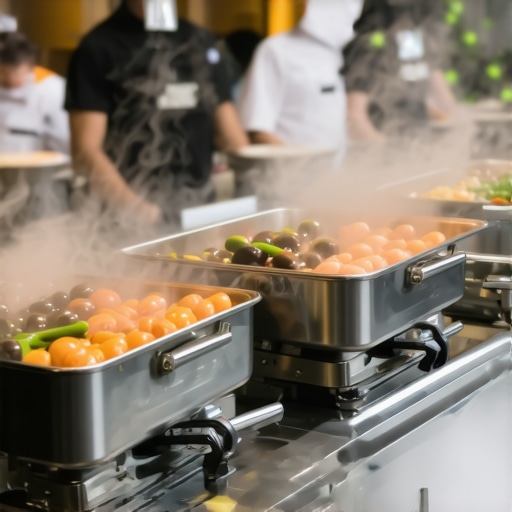
Battle the HVAC before it kills your service
Air conditioning is the silent killer of great catering. I’ve seen $50,000 dinners ruined because the venue’s industrial-sized vents were pointed directly at the carving station. If you feel a breeze on your neck, your food is already dying. When we are managing the logistics of a 400-person plated dinner in a tent, we use specialized wind guards for the chafing fuel and position the tables specifically to avoid cross-drafts from kitchen doors. In one particularly chaotic winter gala, the venue’s heater broke. We had to rely on portable units that blew dry, cold air. This created “evaporative cooling” where the steam from the water pans was actually pulling heat away from the food. We had to double-stack the Sterno cans and keep the lids on between every single guest to survive the night.
Strategic replenishment beats the massive pile-up
It is incredibly tempting to dump all 300 portions of food into the pans at once to be done with it, but that is a rookie error. We use a staggered approach, keeping the bulk of the food in insulated “hot boxes” and only bringing it to the floor in small, manageable batches. This ensures that the guest who arrives at the tail end of the line gets the same quality as the person who was first. This level of coordination requires that your server team needs a clear chain of command on site to monitor pan levels and temperature every fifteen minutes. I once worked a wedding where the schedule was pushed up by forty minutes without warning. Because we had a system for staggered replenishment, we were able to pivot and serve a hot meal instead of panicking with a kitchen full of cold plates.Despite all the heating equipment in the world, the biggest hurdle to a perfect meal isn’t physics—it’s psychology. There’s a common belief that a massive menu is a sign of a high-end event, but I’ve found the opposite to be true. In my experience, the ‘Variety Fallacy’ is what kills more buffets than a broken burner. When you offer too many options, guests spend more time deciding than eating, which causes the line to stall and the food to cool. A study by the Journal of Consumer Research indicates that ‘choice overload’ can lead to lower satisfaction; in a catering context, this means your guests feel rushed and the kitchen gets overwhelmed. I’ve learned that effective catering strategies for corporate event impressiveness are built on a foundation of fewer, better-executed items.
Can your server team handle a sudden pivot in total silence?
This is where the amateurs are separated from the pros. During a high-stakes keynote, you can’t have plates clinking or servers whispering. One of the most nuanced skills we train for is how to handle plate clearing during a seated executive presentation without breaking the speaker’s flow. It requires a specific ‘stealth service’ technique that isn’t taught in basic hospitality schools. You need to know how to spot a server who has not been trained in french service or high-end logistics before the event starts, because once the lights go down, it’s too late. 
The ‘Steak Trap’ and other high-volume mistakes
Another classic mistake is choosing a menu that is ‘temperature-fragile.’ For instance, the problem with serving steak at a 500-person business lunch is that steak waits for no one. If the CEO’s opening remarks go five minutes over, those medium-rare steaks are now well-done or cold. I always steer my clients toward braised dishes or components that hold their ‘thermal mass’ longer. To ensure your team is ready for these variables, you need to know how to brief your server team on complex dietary restrictions in minutes so they aren’t running back to the kitchen while guests are waiting. Have you ever fallen into this trap of choosing a ‘fancy’ menu item that was a nightmare to actually serve? Let me know in the comments.To avoid these traps, you need a toolkit that functions like a surgical unit. I don’t rely on the built-in thermometers on old holding cabinets because they are notoriously inaccurate. Instead, I equip my leads with the Thermapen ONE. Why? Because when you are optimizing server efficiency to enhance event satisfaction, waiting ten seconds for a thermometer to stabilize is ten seconds too long. You need a one-second reading to know if that sea bass is flirting with the danger zone. Mastering corporate event planning secrets to seamless success means knowing exactly when to pull a tray before the guest even notices a drop in quality. It’s about being proactive rather than reactive.
How do I maintain consistent food quality over a four-hour gala?
Longevity in catering comes down to the ‘thermal chain.’ We use high-density expanded polypropylene (EPP) carriers—specifically the Cambro GoBox—which can hold heat for four hours with less than a two-degree loss per hour. It’s a game-changer for corporate event catering strategies for success. By the time the food reaches the table, it’s still at peak temperature because we never let it sit in the open air for more than ninety seconds. According to the 2022 FDA Food Code (Section 3-501.16), while 135°F is the legal minimum for safety, I have found that keeping protein at 142°F is the ‘sweet spot’ for maintaining cellular moisture without drying out the edges. To keep this running for hours, we implement a ‘Zone Defense’ system where specific server skills that make every event stand out include a rotating thermal audit. Every 20 minutes, a designated staff member logs the temperature of every active pan. 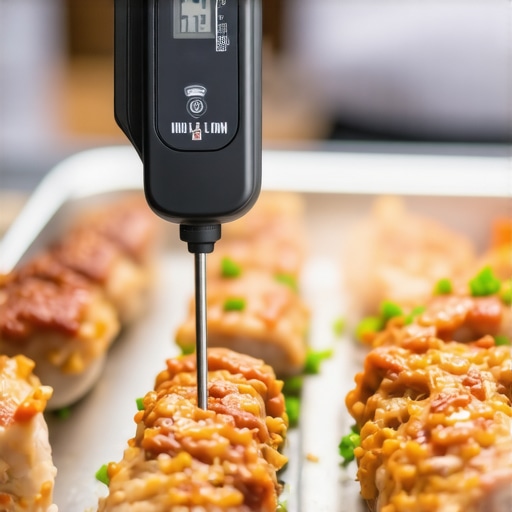 This level of scrutiny might seem like overkill, but it’s the only way to catch a failing burner before the sauce congeals or the meat gets rubbery. We also pay close attention to the ‘replenishment lag.’ If the kitchen is 200 feet away, that’s a 30-second walk through a cold hallway. We use pre-heated lids for the transport pans to ensure that the trip doesn’t sap the heat. These top-server tips to elevate your event experience are what we drill into our team during the pre-shift briefing.
What the next five years of catering technology looks like
I’m already seeing a shift toward IoT-enabled buffet systems. Imagine a world where every chafing dish sends a push notification to the kitchen’s tablet when the water level is low or the temperature dips. We are moving away from manual checks and toward ‘active’ feedback loops that allow the best corporate event servers for 2025 to focus on the guests rather than the equipment. The future isn’t just better food; it’s better data about the food. I want you to try this next time: instead of just feeling the steam, use a digital probe to check the core temperature of your starch versus your protein. You’ll be shocked at the 15-degree variance between the two. Use that data to adjust your heat levels. Start measuring, stop guessing, and you’ll never serve a lukewarm meal again.
The Most Expensive Mistakes I Made on the Buffet Line
It took me years to realize that a fancy menu is worthless if the delivery is tepid. One of my biggest lightbulb moments was realizing that the team’s communication is just as vital as the sterno fuel. If the floor staff isn’t synchronized, the food sits. I always make sure my team knows how to spot a server who hasn’t been briefed on the menu so that every guest gets a hot plate, not a cold shrug. Another hard-won lesson: always carry backup fuel. You would be surprised how many ‘wind-proof’ setups fail in a drafty ballroom. Keeping the lids closed isn’t just about heat; it’s about preserving the culinary integrity of the sauce.
The Gear That Actually Saves a Gilded Dinner
To keep your standards high, you need a toolkit that doesn’t quit. I swear by the Thermapen ONE for instant accuracy; it is the difference between guessing and knowing. For transport, the Cambro GoBox is my go-to for maintaining the thermal chain over long distances. When I am mastering corporate event planning secrets to seamless success, I also rely on infrared heat lamps for carving stations—they add a visual flair while providing consistent top-down heat. Finally, investing in the best corporate event servers for 2025 ensures your hardware is operated by people who actually care about the final temperature. #IMAGE_PLACEHOLDER_E#
Your Journey Toward Perfect Event Execution
Serving a hot meal to hundreds of people isn’t just a logistical task; it is an act of care. By focusing on thermal mass, room physics, and a well-trained team, you turn a standard meal into a memorable experience. Implementing these corporate event catering strategies for success will set your events apart from the sea of lukewarm buffets. Don’t be afraid to be the ‘temperature police’ on-site—your guests will thank you with every warm, delicious bite. If you need help planning your next high-stakes gathering, feel free to contact us to ensure every detail is handled with precision. What is the one dish you find most difficult to keep at the perfect temperature during a long event? Share your buffet battles in the comments below!