

I’ll never forget the sound of 400 heavy ceramic plates clinking in rhythm as a sudden July downpour hammered against the vinyl roof of a wedding tent in the middle of a literal cow pasture. I was young, overconfident, and hadn’t accounted for the fact that a 50-yard sprint from the ‘kitchen’ tent to the guest tables meant the prime rib would be ice cold by the time it hit the linens. It was a visceral disaster that taught me more about physics than four years of college ever could. If you are planning a massive outdoor event, you aren’t just choosing a menu; you are designing a mobile field hospital for food. Today, we are going to break down the sheer madness of serving a high-end meal in a field and how you can avoid the ‘lukewarm chicken’ reputation once and for all. Have you ever tried to coordinate a massive dinner and felt like every single detail was slipping through your fingers?
Is a plated dinner in a tent actually worth the headache?
Skeptics will tell you to just do a buffet and call it a day. They aren’t entirely wrong, but there is an undeniable magic to a synchronized plated service under the stars that a buffet line just can’t touch. The trick is knowing that you are fighting against the elements, the distance, and the clock. It is a high-stakes performance where the stakes are edible. According to the International Caterers Association, off-premise events often require 40% more labor and logistics planning than indoor venues due to the lack of built-in infrastructure.
The kitchen tent should never be an afterthought
Early in my career, I made the mistake of letting the tent company place the prep area ‘wherever it fit’ to keep it out of sight. That ended up being behind a small, muddy hill. Watching my servers navigate a 5% grade with heavy trays of soup was painful to witness. You need to treat your event catering logistics like a military operation. This means understanding the secret to maintaining food temperature at outdoor events, which usually involves specialized warming cabinets rather than just a few flickering Sternos. If your kitchen isn’t within a stone’s throw of the seating, you’re already losing the battle. You also have to consider the ‘kickoff’ moment. I’ve found that pre-pouring water is the secret to a fast service start, giving your team a five-minute head start that they will desperately need when the first course begins. Using effective strategies to keep your event schedule on track is the only way to ensure 400 people eat at the same time without the kitchen collapsing into chaos.
Run Your Kitchen Tent Like a Formula 1 Pit Crew
To execute a flawless 400-person dinner in a field, you have to abandon the idea of ‘cooking’ and embrace the concept of ‘assembly.’ In a traditional kitchen, a chef might plate a dish from start to finish. In a tent, that is a recipe for cold food and angry guests. You need a linear plating line where each person has one job: protein, starch, veg, sauce, garnish. This assembly line approach ensures that plates move from the warming cabinet to the server’s tray in under fifteen seconds. You cannot wing this on the day of the event; you must know how to organize a staff meeting before a 500-person dinner to assign these roles clearly. If everyone isn’t synchronized, the first plate is cold by the time the tenth plate is ready for the tray. 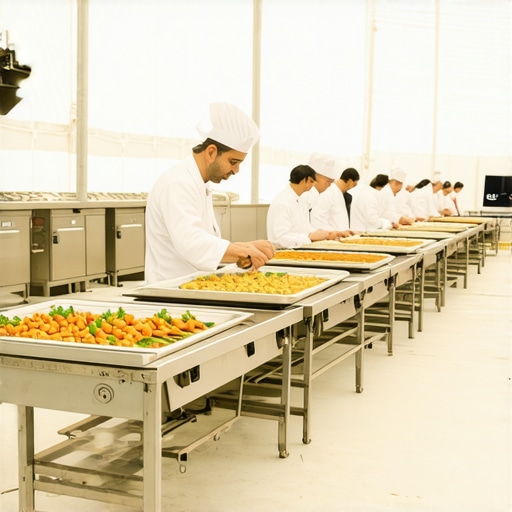
The Hot Box Dance That Saves Your Main Course
Temperature control is your biggest enemy outdoors. Ambient air, wind, and even the humidity from a summer storm will strip the heat from a plate faster than you can blink. This is where ‘hot boxes’ or insulated warming cabinets become your best friend. I have seen caterers try to use ovens for holding, but ovens dry out the food. You need to master the secret to keeping fish from drying out in a warming drawer, which involves moisture control and precise timing. We once handled a gala where the keynote speaker went twenty minutes over. Because we had a dedicated ‘box captain’ monitoring the internal humidity of our holding units, the sea bass stayed buttery and moist instead of turning into expensive rubber.
Your Lead Server is a Conductor Not a Violinist
One of the most common mistakes I see in large-scale events is the lead server trying to take orders or clear plates. When you are managing a massive crowd, the lead server needs to be a free agent who sees the whole floor. They are the ones who notice that Table 14 is finished while Table 2 is still on their first course. To do this effectively, why your server lead needs a copy of the event script becomes obvious; they need to anticipate the toasts and the first dance before they happen. I learned this the hard way at a mountain-top wedding where my lead server got stuck helping a guest with a dietary restriction. While they were occupied, a bottle of champagne corked prematurely at the head table, and no one was there to swap it out for three minutes. That is why why a lead server should never be assigned a single table is a rule we live by.
Get the Math Right or Watch the Service Sink
In a controlled ballroom, you might get away with a 1:20 server-to-guest ratio. In a tent, that is a death wish. The distance between the kitchen and the tables is usually double or triple what it would be in a hotel. You have to account for ‘travel time.’ This is why you should why you should audit your server to guest ratio for vip dinners before the contract is signed. For a high-end plated outdoor meal, we aim for 1:10. This allows for a ‘sweep’ method where servers move in a wave, clearing and serving in unison. It looks like a choreographed dance rather than a frantic scramble, and it ensures that no guest is left staring at an empty wine glass while their neighbor is already on dessert.People often assume that throwing more bodies at a problem creates a better experience. They think if a 1:10 ratio is good, a 1:5 must be legendary. In reality, over-staffing a tight tent or ballroom creates ‘server traffic jams’ that actually slow down the meal. The real nuance isn’t the number of people; it’s understanding the difference between a staffing agency and a service partner. A staffing agency gives you warm bodies; a service partner gives you a synchronized team that knows how to read the room. According to research from the Cornell School of Hotel Administration, service quality is more closely tied to ‘perceived empathy’ and ‘responsiveness’ than raw headcount. If your team is bumping into each other, that responsiveness vanishes. You need to know how to choose the right staffing ratio for a vip event based on the physical layout, not just the guest list.
Does an all-inclusive venue actually save you money in the long run?
This is the million-dollar question for corporate planners and couples alike. While the hidden benefit of choosing an all-inclusive venue is the convenience of bundled pricing, you have to watch out for the ‘preferred vendor’ trap. I’ve seen clients realize too late the hidden cost of only using preferred vendors at popular venues, where lack of competition can lead to complacent service or inflated equipment rentals. The biggest mistake? Assuming the venue coordinator is *your* coordinator. They work for the house, not for your specific vision. This is why the importance of having a dedicated point of contact for vendors cannot be overstated. Without a neutral advocate, your ‘custom’ event can quickly become a cookie-cutter assembly line.  One final nuance that veterans know: the ‘invisible server’ isn’t actually invisible. If you want a truly high-end feel, stop looking for people who disappear. Look for optimizing server efficiency to enhance event satisfaction through proactive engagement—like noticing a guest is left-handed and swapping their cutlery without being asked. That’s the level of detail that separates a ‘catered meal’ from a ‘hospitality experience.’ Have you ever fallen into the trap of hiring for quantity over quality? Let me know in the comments.If you are serious about mastering corporate event planning secrets to seamless success, you have to stop thinking like a cook and start thinking like a logistics engineer. I used to believe that a dedicated team and a few heavy-duty vans were the ceiling for a boutique catering operation, but scaling to 500+ guest counts requires a fundamental shift in your toolkit. You can have the most talented chefs in the world, but if your thermal holding strategy is weak, your reputation will eventually melt away in a humid tent. I always include a rigorous thermal audit in my essential checklist for successful corporate event catering because the distance between the ‘fire’ and the ‘fork’ is your biggest liability.
The Tech That Keeps My Ribeye from Turning into Leather
I have moved away from traditional dry-heat cabinets entirely for long-hold outdoor events. Instead, I rely on Winston Industries’ CVap (Controlled Vapor Technology) units. According to Winston’s technical white paper on Vapor Pressure and Food Quality, maintaining a specific equilibrium between the water reservoir temperature and the air temperature is the only scientific way to prevent cellular collapse and moisture loss in proteins over time. This is literally the secret to keeping fish from drying out in a warming drawer; you aren’t just keeping it hot, you are managing the atmospheric pressure around the fillet. When you hire the best corporate event servers for 2025, they expect to work with this level of equipment because it gives them the confidence to serve a plate that looks exactly as the chef intended, even if the keynote speaker just added ten minutes to their set.
How do I maintain this level of service for fifty events a year?
Consistency isn’t born in the kitchen; it is born in the maintenance shop. We treat our ‘Hot Boxes’ like flight crews treat jet engines. Every three months, we do a deep-scale descale and a probe calibration. If your sensors are off by even five degrees, you’re either serving lukewarm chicken or rubbery beef. Beyond the hardware, I’ve found that the human element requires just as much maintenance. When you train your team on top server tips to elevate your event experience, you have to bake those standards into a repeatable ‘Pre-Flight’ briefing. We use digital floor plan software that syncs to every lead server’s tablet in real-time. If a guest at Table 4 swaps their seat with Table 12, the system updates instantly. This prevents that awkward ‘searching’ look that ruins the flow of a high-end meal.
Why the Future of Catering is Digital and Thermal
I predict that within the next three years, we will see a massive shift toward AI-driven load-balancing for event staff and autonomous thermal delivery systems. Imagine a kitchen tent that uses sensors to track exactly how many plates are leaving the line and automatically signals the server ‘wave’ to slow down or speed up based on the actual pace of the guests’ consumption. We are already experimenting with ‘smart’ heat-strips that alert a lead server’s smartwatch if a tray has been sitting in the pass for more than 45 seconds. If you’re still wondering how to choose the perfect servers for your wedding or corporate gala, look for the ones who embrace these tools rather than fear them. The old-school ‘gut feeling’ is great, but gut feelings don’t survive a July heatwave in a cow pasture. Try this for your next event: perform a ‘dry run’ of your plating line with empty plates and a stopwatch. You will be shocked at how much time is wasted in the hand-off between the ‘plater’ and the ‘runner,’ and fixing that one bottleneck can save your entire service.
Battlefield Realities You Only Learn After 1,000 Plates
Experience is the only teacher that gives the test before the lesson. Over years of working in remote pastures and tented estates, I have discovered that the smallest oversight can cause the largest ripple effect.
- The ‘Walking the Path’ Audit: Before service starts, I personally walk the route from the plating line to the furthest table. If there is a soft patch of grass or a loose cable ramp, it needs to be fixed before a server hits it with a tray of soup. This is the foundation of the ultimate guide to corporate event catering logistics.
- The Weather Pivot: You must have a ‘Condition Red’ plan for wind or rain. When the skies open up, knowing how to manage a catering team during a sudden rain storm is what separates the professionals from the amateurs. High-end food stops being impressive the moment it gets diluted by rainwater.
- The Silent Signal Language: In a loud tent, verbal communication breaks down. We use specific hand signals for ‘more water needed’ or ‘fire the next course.’ It keeps the atmosphere elegant and the service fluid.
- The ‘Surprise’ Dietary Buffer: No matter how many times you check the headcount, there will always be a few guests with unannounced restrictions. We always prep 5% extra ‘universal’ plates to ensure no guest feels like an afterthought.
#IMAGE_PLACEHOLDER_E#
The Tools That Saved My Sanity in the Field
If you want to execute at this level, you need more than just passion; you need the right infrastructure. These are the resources I never go into a field without:
1. Winston CVap Holding Cabinets: These are non-negotiable for me. While others use standard warmers, these units allow us to control the dew point, which is the secret to keeping fish from drying out in a warming drawer during long keynote speeches. It is a game-changer for protein quality.
2. Dynamic Seating Software: I use digital tools to map out service zones. Visualizing the layout helps me avoid the most common mistakes in corporate event seating charts, such as creating bottlenecks near the kitchen entrance.
3. Custom Briefing Templates: I have developed a specific ‘pre-flight’ checklist for every server. By implementing effective catering strategies for corporate event impressiveness, we ensure that every staff member knows the exact flavor profile of the menu before the first plate is served.
Build a Reputation That Lasts
Catering a 400-person dinner in a tent is one of the hardest things you can do in the hospitality world. It requires a blend of culinary art and military-grade logistics. However, when the sun sets and you see guests enjoying a perfectly timed, hot meal in the middle of nowhere, the payoff is incredible. By focusing on the small details and mastering corporate event planning secrets to seamless success, you aren’t just serving food; you are creating a memory that will be talked about for years. Have you ever faced a total logistical meltdown at an event? Let me know in the comments how you handled it.