

I still remember the heat of that July wedding in a tent where I learned my lesson the hard way. It was a 250-person affair, and I thought I had everything under control with a handful of great servers. But halfway through the main course, the flow just… stopped. One table was halfway through their steak while the table next to them hadn’t even seen a salad. I was running around like a headless chicken, trying to manage the kitchen and the floor at the same time. It was a mess. That night, I realized that why a lead server should never be assigned a single table isn’t just a suggestion—it’s a survival rule.
The Management Gap That Ruins Great Menus
You can have the best food in the world, but if the delivery is disjointed, your guests will only remember the wait. When you hit that 50-guest mark, the complexity of service scales exponentially. It’s no longer about just carrying plates; it’s about air traffic control. I used to think I could handle 100 people solo. I was wrong. Early in my career, I made the mistake of trying to be the “everything person,” which meant I was actually the “nothing person.” I wasn’t watching the room because I was busy polishing silverware. Now, I insist on a dedicated captain for every 50-guest block because it creates a clear line of communication.
This captain acts as the eyes and ears for that specific group. They aren’t just another body on the floor; they are the buffer between the kitchen’s chaos and the guest’s calm. According to the National Association for Catering and Events, the ideal ratio for high-end service often hovers around 1 server per 10 to 12 guests, but without a captain to anchor them, those servers are just individuals without a plan. By choosing the right staffing ratio for a VIP event, you ensure that every guest feels like the only guest in the room.
Does This Extra Layer of Management Really Pay Off?
I get it. Adding more leadership roles feels like you’re just bloating the payroll. But think about the cost of a bad review or a disgruntled client. When a captain is focused on just 50 people, they notice the small stuff—the empty wine glass, the guest with the hidden nut allergy, or the table that’s shivering under an AC vent. It allows the rest of the team to focus on optimizing server efficiency to enhance event satisfaction. Have you ever been to an event where you felt totally ignored despite seeing dozens of waiters? That’s a leadership failure, not a labor shortage.
Have you ever had a moment where your event service felt like it was spinning out of control? I’d love to hear how you handled it—or if you’ve seen the captain system work its magic firsthand. Before you even think about the menu, you need to think about the command structure.
Setting the Stage for a Flawless Floor Plan
To really get this right, you have to look at how these captains interact with the kitchen. It’s a dance that starts long before the first guest arrives. I’ve found that organizing a staff meeting before a 500-person dinner is the only way to ensure everyone knows who their captain is. It creates accountability. If Table 4 is unhappy, I know exactly which captain to talk to. This isn’t about micromanaging; it’s about empowering your team to succeed.
Give Your Lead a Copy of the Script
You cannot expect a server to read your mind, yet many planners treat the event timeline like a state secret. To run a tight ship, you must ensure why your server lead needs a copy of the event script is your top priority during the morning brief. I remember a high-stakes corporate gala where the CEO decided to move the awards ceremony up by twenty minutes while guests were still finishing their salads. Because my lead had the script and a radio, we pivoted the entire service team in seconds. We cleared plates in a silent wave just as the lights dimmed. Without that script, we would have been clanking silverware during the opening remarks, which is the fastest way to lose a client’s trust.
Divide the Ballroom into Independent Republics
Think of your event space like a map of small, independent territories. When you are managing the logistics of a 400-person plated dinner in a tent, you can’t have servers drifting aimlessly from one side to the other. I assign each captain a ‘republic’ of 50 guests. They are the governors of that space. They don’t leave it, and they don’t look past its borders. This localized focus is what allows for top server tips to elevate your event experience to actually take root. When a guest in Zone A drops a fork, the captain for Zone A sees it before the guest even looks up. In my early days, I tried to have everyone cover everywhere—it was a disaster of ‘I thought you had that table’ excuses.
Pre-Pour Your Way to a Faster Start
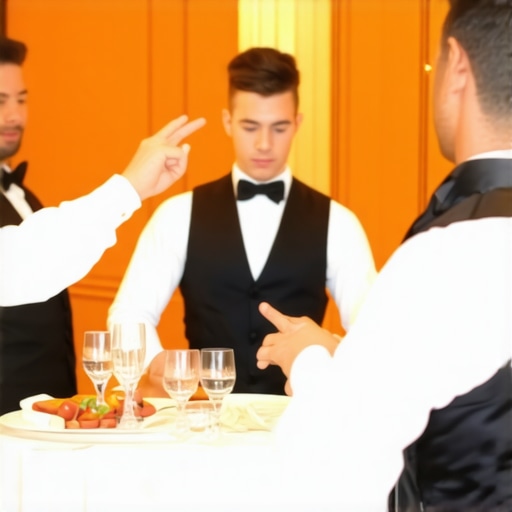
The first fifteen minutes of any sit-down dinner are the most dangerous for your schedule. If you wait until guests are seated to begin water and wine service, you’ve already lost the battle against the clock. This is why pre-pouring water is the secret to a fast service start. By the time the first guest pulls out their chair, every glass should be filled. It sets a tone of preparedness that calms the room. I once worked a wedding where we skipped this step to save on ‘sweating’ glasses in the heat. The result? A bottleneck at the service station that delayed the first course by nearly half an hour, cascading into a late cake cutting that frustrated the couple.
Silence the Kitchen During the Big Speech
There is nothing more amateur than a heartfelt toast being drowned out by the sound of industrial dishwashers or clattering sheet pans. You have to know how to keep the kitchen noise from ruining your keynote speech by heart. Five minutes before a speaker hits the stage, your captains should signal a total ‘hot zone’ lockdown. Trash stops being pulled, plates stop being stacked, and the kitchen staff stays behind the swinging doors. This level of discipline is how you distinguish a professional operation from a backyard party. It’s about respect for the moment, and it requires a captain who isn’t afraid to be the ‘bad guy’ in the back of the house to keep the front of the house pristine.
Maintain the Rhythm Without Rushing
Finding the balance between efficient service and a rushed atmosphere is an art form. You want the plates to disappear quickly, but you don’t want guests to feel like they are on a conveyor belt. By mastering how to keep your event schedule on track without rushing guests, you use subtle cues—like clearing bread plates only when the entire table is finished—to signal progress. It’s about optimizing server efficiency to enhance event satisfaction without sacrificing the luxury of a slow meal. I’ve found that when the staff moves with a calm, purposeful energy, the guests naturally mirror that relaxation, even if the kitchen is secretly sweating to get the next 200 steaks out the door.
A common misconception I see among even seasoned planners is the belief that throwing more bodies at a problem will fix a lagging service. In reality, over-staffing without a strict command structure often leads to what social psychologists call ‘social loafing,’ where individuals in a large group contribute less effort because they assume someone else has it covered. This is the biggest myth in catering: that volume equals quality. I’ve seen 20 disorganized servers provide worse service than 10 highly-trained pros who understand the difference between a staffing agency and a service partner. When you hire just for ‘heads,’ you aren’t getting hospitality; you’re getting logistics.
Stop Assuming Your Venue Manager Is Your Personal Planner
One of the most dangerous traps for couples and corporate leads is the ‘Venue Manager’ fallacy. Everyone says the venue comes with a coordinator, but in my experience, that person is there to protect the building, not your timeline. They care if the floors get scratched or the doors are locked, but they aren’t the ones ensuring your CEO gets a fresh drink before her speech. This is why your venue manager should not be your day-of coordinator. I once saw a venue manager shut down a kitchen early because it hit the ‘contracted time,’ while the lead server was still trying to get dessert out. If those roles aren’t distinct, your event will suffer from a conflict of interest.
Why Does Your Waitstaff Look Lost Even With a Full House?
Have you ever noticed a group of servers standing in a corner while guests are looking for water? It’s rarely a sign of laziness; it’s almost always a failure of the brief. If you haven’t mastered how to spot a professional server in an interview, you might end up with a team that lacks ‘situational awareness.’ A study published in the Journal of Hospitality & Tourism Research highlights that guest satisfaction isn’t just about the speed of food delivery; it’s about ‘perceived responsiveness.’ This means the server isn’t just waiting for a command; they are actively scanning for the ‘silent cues’ of a guest’s needs. If they aren’t trained to look for those cues during the morning huddle, they’ll spend the whole night waiting to be told what to do.
Another nuance that experts know—but beginners miss—is the hidden cost of the ‘all-you-can-eat’ mentality. There is a specific reason why most buffets waste 30 percent of the food produced. It’s not just about the volume of food; it’s about the psychology of the line. A long buffet line kills the energy of a room faster than a bad DJ. When guests spend 20 minutes standing in a queue, they aren’t networking or dancing; they are growing resentful. For high-stakes events, I always steer clients toward the ultimate guide to corporate event catering logistics which prioritizes multi-point service stations over a single massive buffet. It keeps the room moving and the energy high.
Have you ever fallen into the trap of thinking more servers would fix a slow kitchen, only to find them tripping over each other? Let me know in the comments how you handled a service bottleneck. Success in this industry isn’t about the menu—it’s about the invisible infrastructure you build before the first guest arrives. By mastering corporate event planning secrets to seamless success, you transition from being a host who is ‘surviving’ the night to a leader who is actually enjoying it.
I’ve seen too many planners spend months on floral designs only to have the event crumble because they didn’t invest in decent communication gear. If you want to move from ‘getting lucky’ to ‘being consistent,’ you need to stop relying on hand signals and shouting across a busy kitchen. I personally never run an event without discrete earpieces and Motorola digital radios. Why? Because the moment a server lead has to leave the floor to ask the kitchen about a dietary restriction, the rhythm of the room breaks. You need the ability to whisper a request for more sparkling water without a single guest noticing. This is the foundation of corporate event catering strategies for success—it is about the tech that stays out of sight.
Why Your Team Needs Discrete Earbuds and Not Just Shouts
Communication is the invisible thread of any high-stakes event. I’ve found that using professional-grade headsets allows my captains to coordinate plate drops with the precision of a Swiss watch. When you are optimizing server efficiency to enhance event satisfaction, you aren’t just moving faster; you are moving smarter. I remember a wedding where the father of the bride decided to start his toast early. Because my lead had a radio, they halted the entire soup course in ten seconds flat. Without that link, we would have been clinking bowls while he was getting teary-eyed. This isn’t just about convenience; it’s about respect for the client’s timeline.

Stop Fighting the Elements with Better Insulation
If you are working outdoors or in a tent, the weather is your greatest enemy, but your equipment shouldn’t be. I live and die by high-quality insulated food carriers, like the Cambro Ultra Pan Carrier series. These aren’t just boxes; they are your insurance policy. They keep proteins at safe temperatures for hours without a power source, which is the secret to maintaining food temperature at outdoor events. I’ve seen amateurs try to use foil and ‘hope’ for the best, only to serve lukewarm chicken that ruins the evening. Professionalism means having the right hardware to ensure the last table gets the same quality of food as the first.
How do I keep my catering standards high during the busy season?
The biggest challenge isn’t one great event; it’s the tenth event in a row during a peak June wedding season. To maintain quality, you have to implement a strict audit system. Every Monday, we do a deep dive into our inventory and how to audit your rental order for missing water glasses or damaged linens. If you don’t catch the small stuff during the week, it will bite you on Saturday night. I also insist on a ‘service post-mortem’ after every gala. We sit down for fifteen minutes and ask: What was the bottleneck? Did the kitchen noise bleed into the ballroom? This constant feedback loop is what builds server skills that make every event stand out over the long haul.
The Future of Event Logistics and Real-Time Management
I predict we are heading toward a world where AI-integrated kitchen management and real-time floor mapping become the norm. Imagine a tablet that alerts a captain when a guest’s glass has been empty for more than three minutes based on sensor data. While that might sound sci-fi, the data-driven approach to hospitality is already here. The International Live Events Association (ILEA) recently highlighted in their ‘Catering and Decor Safety’ technical brief that data-informed staffing ratios are the only way to scale without losing the personal touch. If you want to stay ahead, you need to start treating your floor plan like a data map. I highly recommend you try this one thing at your next event: give your lead server a dedicated radio channel that is separate from the kitchen staff. It creates a ‘cone of silence’ for logistics that prevents the service team from getting overwhelmed by back-of-house chatter. When you have the importance of having a dedicated point of contact for vendors and a clear line for your leads, the entire operation feels lighter.
What the Most Stressful Shifts Taught Me About Teamwork
Over the years, I’ve realized that the difference between a good caterer and a great one isn’t the seasoning on the steak; it’s the silence in the room. When you choose the perfect servers for your wedding or gala, you aren’t just hiring muscle; you’re hiring an insurance policy against chaos. I used to think I needed to be everywhere at once, but my biggest lightbulb moment was realizing that my absence from the kitchen was actually a sign that the system was working. Trusting your team to own their territories is the only way to scale without burning out.
Developing server skills that make every event stand out takes time, but it starts with a culture of accountability. I’ve found that the best servers aren’t the ones with the fastest feet, but the ones with the sharpest eyes. They notice the guest who is looking around for a napkin before the guest even realizes they need one. That proactive mindset is something you can’t teach on the fly—it has to be part of your DNA from the first interview to the final toast.
The Gear That Keeps My Sanity Intact
To keep everything running smoothly, I never walk onto a floor without my Directors Kit. First, I rely heavily on an essential checklist for successful corporate event catering that covers everything from backup linens to the exact location of the breaker box. I also swear by the Motorola BPR40 Mag One radios; they are rugged, simple, and the battery lasts through even the longest double-shift days. Finally, I always recommend the Event Managers Bible by Des Conway for anyone looking to understand the deeper logistics of large-scale hospitality. These tools are why I sleep well the night before a 500-person gala.
Take the Lead on Your Next Big Event
Hospitality is a marathon, not a sprint. It’s easy to get overwhelmed by the sheer volume of moving parts, but remember that every great event is just a series of small, well-managed moments. When you elevate your wedding with professional servers and a clear command structure, you aren’t just serving dinner—you’re creating a memory that isn’t marred by delays or cold food. Stick to these corporate event catering strategies for success, and you’ll find that the floor starts to run itself, leaving you free to actually connect with your guests.
What was the one moment where your event service felt most out of control, and how did you fix it? Let me know in the comments below!