

I will never forget the ‘Cinnamon Incident’ of 2018. I was hosting a group of old friends, and I had prepared a beautiful, light Mediterranean-style sea bass. In my quest for the perfect ‘vibe,’ I lit a large, multi-wick cinnamon-apple candle right in the center of the table. I thought I was being a great host. I wasn’t. By the third bite, my best friend leaned over and whispered, ‘This fish tastes like a craft store.’ I was mortified. It was a classic rookie mistake, but one I see people make constantly at everything from casual Friday night dinners to high-end weddings. We put so much effort into planning the ultimate wedding reception meal only to let a $15 jar of wax sabotage the whole experience. Today, I’m going to show you exactly why that scented candle is your menu’s worst enemy and how you can create an amazing atmosphere without confusing your guests’ palates. Trust me, even the best wedding catering tips from industry experts won’t save a meal if the room smells like a synthetic pine forest. Much like the problem with using tall centerpieces at dinner tables, scent is an invisible barrier to true connection.
Stop Smothering Your Dinner Guests with Fake Vanilla
Fragrance is powerful. It’s the first thing people notice when they walk into a room, and it lingers longer than conversation. When you’re choosing a catering style, you are curating a sensory journey. If that journey is interrupted by a heavy ‘Midnight Jasmine’ scent, the brain gets confused. I learned the hard way that a complex wine or a delicate sauce cannot compete with a heavy perfume. You want your guests to focus on the aroma of the garlic, the fresh herbs, and the searing meat, not a chemical cocktail. This is especially vital when you consider why your menu needs to balance heavy and light options; a heavy scent makes even light food feel suffocating. Have you ever sat down for a meal and felt like you were actually tasting the candle on the table? It’s a jarring experience that shifts the focus away from the hospitality you’ve worked so hard to provide.
Does a Little Fragrance Really Ruin the Food?
You might think I’m being a bit dramatic. It’s just a candle, right? Wrong. Science is actually on my side here. According to researchers at the University of Oxford, approximately 80% of what we perceive as flavor actually comes from our sense of smell, not our taste buds. This means that if the air is saturated with artificial vanilla, your brain is essentially telling your mouth that the steak you’re chewing is vanilla-flavored. It’s a sensory mismatch. I’ve seen this happen at corporate events where the decor team wasn’t talking to the catering team, resulting in a beautiful meal that nobody finished because the room smelled like a department store. Setting the stage for a meal requires a clean slate for the nose. We want to enhance the experience, not overwhelm it.
Neutralize Your Venue Air for Better Flavor Perception
To get your environment right, you must treat the air in your venue like a blank canvas. You wouldn’t invite a screaming toddler to a high-stakes board dinner, so why invite a screaming scent? I remember one specific corporate event planning nightmare where the client insisted on ‘Ocean Breeze’ plug-ins throughout the ballroom. By the time our Mediterranean meal arrived, the natural saltiness of the olives and feta clashed so violently with the synthetic ‘ozone’ fragrance that guests were actually wincing between bites. We had to unplug every single unit and open the windows in forty-degree weather just to salvage the evening. It was a logistical mess, but it proved that air control is just as vital as optimizing server efficiency.
Strip Away the Artificial Fragrance
Your first step is a total audit of the space at least three hours before guests arrive. This means coordinating with the venue manager to ensure no heavy cleaning chemicals or industrial air fresheners are used right before doors open. If you are planning the ultimate wedding reception meal, you must insist on unscented tea lights or high-quality LED candles. Even the most expensive ‘natural’ soy candles can emit a cloying sweetness that lingers in the fabric of the linens. If you want a flicker, go for paraffin-free, unscented pillars.
Let the Kitchen Provide the Natural Bouquet
Instead of a candle, let the actual food do the heavy lifting. When you are choosing a catering style, consider how the aroma of fresh rosemary, seared beef, or warm bread can serve as your ‘scented’ element. This is why wedding catering tips from industry experts often emphasize open-air kitchens or passing warm appetizers immediately; those scents trigger the salivary glands and prepare the stomach for the meal. 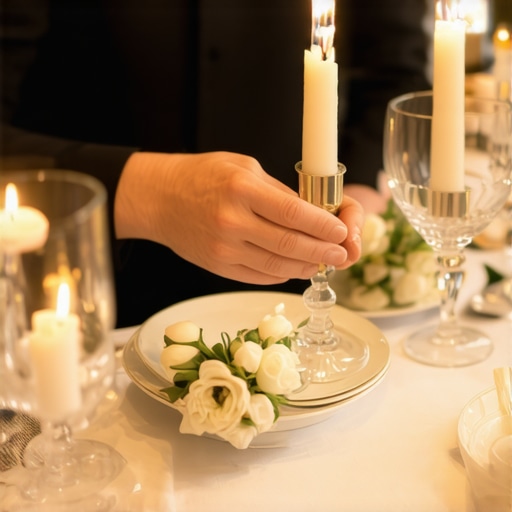
Replace Smell with Visual and Tactical Atmosphere
If you feel the room lacks ‘warmth’ without a scented candle, you need to pivot your strategy to lighting and texture. Fragrance is often used as a crutch for poor lighting. You can use lighting to guide guests through a venue much more effectively than a trail of vanilla scent. Warm-toned ambers and soft dimmers create the same ‘cozy’ feeling people crave from candles without the olfactory interference.
Brief Your Service Team on Olfactory Etiquette
Your staff shouldn’t be part of the problem. A server wearing heavy cologne can ruin a guest’s experience the moment they lean in to set down a plate. Part of server skills that make every event stand out includes maintaining a scent-neutral presence. I once had a lead server who loved a specific citrus perfume; every time she walked past the soup course, the guests thought we had added lemon zest to a creamy mushroom bisque. We now implement a strict ‘no-fragrance’ policy for all front-of-house staff.
Balance Your Menu to Counteract Environmental Smells
If you know you are stuck in a venue that has a naturally musty or distinct smell—like an old wine cellar or a library—you must adjust your food. This is why your menu needs to balance heavy and light options. In a space with heavy, woodsy natural scents, a very light and airy citrus salad provides the necessary contrast to keep the palate from becoming fatigued. You aren’t just fighting candles; you’re fighting the architecture itself.The most common myth I hear in the industry is that ‘more is always better.’ More servers, more decor, more artificial ‘vibe.’ In reality, the most sophisticated events are an exercise in restraint and surgical precision. If you think that throwing twenty extra bodies into a room will automatically lead to optimizing server efficiency to enhance event satisfaction, you’re in for a chaotic surprise. True expertise lies in the subtle nuances that most planners overlook, from the psychological impact of the room’s lighting to the specific organizational structure of the waitstaff.
Stop Equating a High Headcount with Superior Hospitality
It is a classic mistake: a client wants a ‘VIP feel’ and insists on a one-to-eight server-to-guest ratio, but then fails to appoint a hierarchy. I’ve seen ballrooms with forty servers where guests still waited twenty minutes for a water refill because no one was actually in charge of the floor. In my experience, a lean, well-drilled team outperforms a bloated, unmanaged one every single time. This is why why your server team needs a designated captain for every 50 guests. Without that central point of command, the ‘luxury’ experience quickly dissolves into a game of ‘not my table.’ Sophisticated service is about invisible choreography, not just having a lot of people in vests standing around.
Does Your Venue Lighting Actually Change How the Food Tastes?
This sounds like a reach, but it’s a proven scientific reality. Professor Charles Spence at the University of Oxford has pioneered research into ‘gastrophysics,’ demonstrating that environmental cues like color, lighting, and sound significantly alter our perception of flavor. For example, red lighting can make food seem sweeter, while harsh, bright lights can actually make a dish taste more bitter or acidic. When you how to choose the right lighting for a high-stakes board dinner, you aren’t just setting a mood; you are literally seasoning the meal with photons. If your lighting is too clinical, the most expensive Wagyu in the world will taste like a cafeteria tray. #IMAGE_PLACE_HOLDER_C#
The Critical Trap of the Over-Tasked Lead Server
Here is the ‘Oops’ factor that even seasoned pros get wrong: they assign their best person as the ‘Lead Server’ and then give them a section of tables to wait on. This is a recipe for disaster. A true lead must be a ‘floater.’ This is why a lead server should never be assigned a single table; their entire job is to keep their head up, watching for a guest who needs a fork or a server who is falling behind. When your best person is stuck pouring wine for Table 4, they can’t see the kitchen fire (literal or figurative) starting at Table 12. Developing server skills that make every event stand out requires teaching staff to think two steps ahead of the guest. Have you ever fallen into the trap of over-complicating your event only to have it backfire? Let me know in the comments below! If you’re ready to see how a truly professional team handles these high-level logistics, contact us today to start planning your next seamless experience.Scaling an event from a fifty-person intimate dinner to a five-hundred-person gala requires more than just adding more food; it requires a structural shift in how you maintain the environment. I used to rely on a tattered paper clipboard and a hope that the AV guy knew his stuff, but those days are long gone. Today, my ‘war room’ consists of digital floor-planning software and real-time communication loops. If you want to keep the quality high as the headcount grows, you have to treat maintenance as a proactive discipline rather than a reactive fix. One of the biggest logistical hurdles is organizing a staff meeting before a 500-person dinner that actually sticks. I’ve found that using digital tablets for every lead server—pre-loaded with dietary restriction alerts and the exact seating chart—reduces the typical ‘information decay’ that happens in large venues.
Beyond the Clipboard: The Digital Gear That Saves My Sanity
For the technical side, I now refuse to work a venue without a dedicated RF (Radio Frequency) sweep if we are using more than four wireless mics. This might sound like overkill for a corporate lunch, but understanding the hidden risks of using wireless microphones near heavy wi-fi usage is a technical must in the 5G era. According to the Shure Wireless Workbench 7 technical documentation, ‘coordinated frequency management is the only way to ensure 100% link reliability in hostile RF environments.’ If the keynote speaker’s voice cuts out during the most important slide, your meticulously planned menu won’t be what they remember. I also recommend ‘Social Tables’ for floor plans because it allows you to visualize the guest flow in 3D, helping you realize why your ballroom floor plan needs a three-foot safety buffer for the serving staff to actually do their jobs. 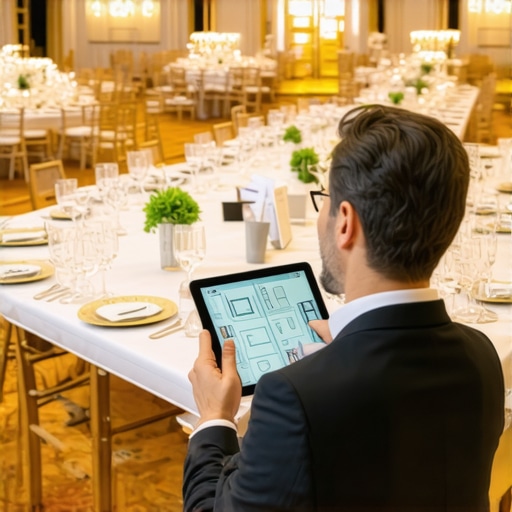
How can I maintain high energy and service quality during a long corporate event?
The answer lies in the ‘Red Zone’ huddle. About twenty minutes before the main course is cleared, I pull my captains aside for a five-minute check-in. This isn’t a time for casual chat; it’s a surgical strike to identify which tables are lagging and which wine bottles need to be staged for the next course. Maintaining consistency over an eight-hour shift is exhausting, which is why your designated clean-up crew should be fresh and distinct from the dinner service team. This separation of duties ensures that the staff interacting with your VIPs isn’t the same staff dragging heavy trash bins across the floor an hour later.
The Future of Service Involves Predictive Guest Flow
Looking ahead, I predict that ‘Sensory Syncing’ will become the standard for luxury events by 2026. We are already seeing the emergence of smart-sensor technology that adjusts venue lighting and temperature based on real-time guest density and the specific course being served. Imagine the room temperature dropping two degrees the moment the hot steaks hit the table, or the lighting shifting to a crisp blue the second the espresso is poured. To keep your logistics sharp, you must also stay firm on your backend details; this is precisely why your catering contract needs a firm headcount deadline to prevent the ‘scaling scramble’ that ruins margins. Try this: For your next event, implement a ‘No-Fly Zone’ for your lead server—a 15-minute window where they are forbidden from touching a plate and must only observe the room for bottlenecks. You’ll be shocked at what you’ve been missing.
What Five-Star Planners Won’t Tell You About Sensory Design
After years in the trenches, I’ve realized that the most expensive decor is worthless if you haven’t mastered the invisible elements. First, silence is a tool. We often focus so much on the music that we forget how to keep the kitchen noise from ruining your keynote speech. A well-placed heavy curtain or a strategically timed dish-clearing break is worth more than a thousand-dollar floral arrangement. Second, your staff is your greatest marketing asset or your biggest liability. Learning how to choose the perfect servers for your wedding isn’t about finding people to carry trays; it’s about finding people who can read a room’s energy before a guest even opens their mouth. Finally, remember that the ‘flow’ of an event is a physical thing you can manipulate. A ballroom floor plan needs a three-foot safety buffer not just for safety, but to allow servers to glide rather than push, maintaining that effortless luxury feel.
Gear That Transformed My Approach to Venue Management
Consistency doesn’t happen by accident; it’s a result of the tools you use to bridge the gap between planning and execution. I swear by Social Tables for 3D guest flow visualization—it’s the only way to catch bottlenecks before they happen. For large-scale coordination, I rely on the Shure Wireless Workbench to manage RF frequencies, ensuring we avoid the hidden risks of using wireless microphones near heavy wi-fi usage. Additionally, I never start a shift without a digital briefing sheet that outlines top server tips to elevate your event experience. These resources aren’t just ‘nice to have’; they are the foundation of a professional essential checklist for successful corporate event catering.
Stepping Into Your New Role as a Logistics Visionary
Every event you plan is an opportunity to refine your craft and create a truly immersive world for your guests. It’s about more than just avoiding the ‘Cinnamon Incident’ or ensuring the steaks are hot; it’s about the intentionality you bring to every corner of the room. When you focus on these high-level logistics, you aren’t just a caterer or a planner—you are a curator of memories. Don’t be afraid to experiment with ‘Sensory Syncing’ or to enforce strict protocols to protect the guest experience. The future of hospitality belongs to those who see the details others miss. Have you ever had a specific scent or lighting choice completely change the mood of your event for better or worse? Let me know in the comments below!