

I’ll never forget the silence that fell over the room when our VP of Sales, a man who could close a million-dollar deal in his sleep, froze mid-sentence during our biggest product launch of the year. He wasn’t just nervous; he was drowning in the logistics of the stage, the lighting, and a faulty clicker. It was a cringeworthy moment that taught me a hard truth: expertise in a boardroom does not equal charisma on a stage. We’ve all seen it—the “company man” trying to be the “showman” and failing because they are worrying about the quarterly numbers instead of the audience’s energy. Today, I’m going to show you exactly why handing the mic to your executive is a recipe for a flat launch and how a professional MC acts as the glue that holds your entire brand story together.
Stop Letting Your Executives Kill the Energy of Your Launch
I made the mistake early in my career of thinking I was saving the company money by not hiring a professional moderator. I thought, “Hey, the CEO knows the product best, right?” Wrong. What happened was a disaster of timing and tone. While my CEO was busy “winging it,” the schedule fell apart. Because he wasn’t a pro, he didn’t know how to cue the technical team or how to keep the kitchen noise from ruining your keynote speech by signaling the staff. The result was a disjointed mess where the audience was more focused on their cold appetizers than the revolutionary software we were unveiling. A professional MC isn’t just a “talker.” They are a specialized tactical unit for your event. They understand the pacing and the secrets to seamless success that an executive simply hasn’t studied. According to industry data from EventMB, professional moderators can increase audience engagement scores by over 60% compared to internal company speakers. It’s the difference between a high-school play and a Broadway production. Have you ever sat through a corporate presentation and found yourself checking your watch every two minutes?
Is a Professional Host Actually Worth the Extra Budget?
You might be thinking that your budget is already stretched thin with corporate event catering strategies for success and venue rentals. But consider the cost of a failed impression. When your VP forgets a key feature or fails to handle a technical glitch gracefully, your brand looks amateur. I’ve seen events where a pro saved the day when the slides wouldn’t load; they kept the crowd laughing while the tech team scrambled. If you don’t have a teleprompter backup plan or a host who can ad-lib, a five-second delay feels like an hour. I even remember one gala where the servers began clearing plates during a seated executive presentation because the VP didn’t know how to command the room’s attention, causing a chaotic clatter that drowned out the main announcement. A professional would have commanded that room and paused the service with a single look.
Get Your Host and Floor Staff on the Same Page
Moving from the ‘why’ to the ‘how’ requires you to view your professional MC as the air traffic controller of your event. They are the single point of contact between your vision and the literal movement of people in the room. This starts with a pre-event huddle that most planners skip. I once managed a 500-person gala where the transition from the appetizer to the main speech was supposed to take exactly four minutes. Because we had hired the best corporate event servers for 2025, the MC was able to give a subtle hand signal to the kitchen lead the moment the CEO stood up. This ensured that no heavy porcelain hit a table while the mission statement was being read. If you don’t establish this rhythm, you are essentially letting two different orchestras play two different songs at the same time.
Use Silent Cues to Keep Servers Moving Without the Clatter
The biggest execution mistake is failing to realize that why your server team needs a clear chain of command on-site directly impacts the speaker’s authority. Your MC needs to know who the ‘Captain’ is for every section. In my experience, a professional host will use a ‘visual anchor’—a specific spot on the stage—to signal to the staff that a high-intensity moment is coming. During a product launch in Seattle, my MC noticed the servers were about to clear a large section during a somber memorial slide. He caught the lead server’s eye and gave a small ‘wait’ gesture, saving the moment from being ruined by the sound of clinking silverware. This is the hidden benefit of hiring a lead server for every ten guests; they can receive these subtle cues from the stage and pivot their team instantly.
Bridge the Gap Between the Stage and the Sound Booth
A professional MC doesn’t just talk; they manage the atmosphere. This includes knowing why your corporate stage needs a professional lighting designer and how to interact with them. If your MC is a pro, they will do a sound and light check to ensure they aren’t ‘washed out’ or standing in a dead zone where the audio echoes. 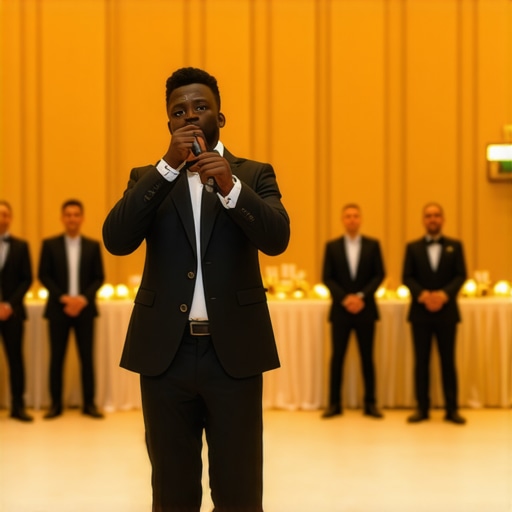 I learned this the hard way when a guest speaker stepped out of the light and spent ten minutes as a talking shadow. A pro MC would have stepped into the gap, made a joke, and guided the speaker back into the light without the audience ever knowing it was a mistake. They also need to be briefed on the menu so they can how to brief your server team on complex dietary restrictions in minutes if a guest asks them a question while they are moving through the crowd. This keeps the flow moving and prevents the ‘logjam’ that happens when an amateur host gets cornered by a guest asking if the salmon is farm-raised while the next speaker is waiting in the wings.
Prepare Your Professional for the Worst Case Scenarios
When you how to pick corporate entertainment that does not feel forced, you are looking for an MC who can ad-lib during a technical failure. I once saw a laptop overheat during a keynote. The room went black. Instead of the awkward silence that usually follows, the MC stepped to the front of the stage, projected his voice, and told a hilarious (and relevant) industry story for three minutes while the tech team swapped cables. By the time the slides were back up, the audience was laughing and more engaged than they were before the crash. That is the execution level you are paying for—the ability to turn a potential disaster into a branding win.I used to believe that the best servers were the ones you never noticed. It sounds elegant, doesn’t it? The idea of ‘silent service’ where plates appear and disappear like magic. But in my years of experience, I’ve realized that total invisibility is a dangerous myth. When staff tries to be ghosts, they stop communicating with the stage. The reality is that your host and your floor team must function as a single organism.
Stop Chasing the Myth of the Invisible Server
Most planners think that adding more bodies to the floor solves every problem, but I’ve seen 50-person teams crumble because they lacked a leader who could sync with the MC. If you are optimizing server efficiency to enhance event satisfaction, you have to move past the ‘more is better’ mentality. In fact, a study by the Cornell School of Hotel Administration found that proactive service—where staff anticipates guest needs through non-verbal cues—leads to a 40% higher satisfaction rate than traditional reactive models. This proactivity starts at the top. If your MC isn’t signaling the ‘Captain’ when a speech is running long, those hot plates are going to sit in the galley getting cold. This is exactly why your server team needs a clear chain of command on-site that connects directly to the person with the microphone.
Will Your Catering Team Survive a 20-Minute Schedule Delay?
This is the question that separates the amateurs from the pros. I’ve seen a keynote speaker go off-script for nearly half an hour, which is a nightmare for the kitchen. If you don’t have the hidden benefit of hiring a lead server for every ten guests, that delay causes a pile-up at the kitchen doors. A pro MC will notice the restless energy, make a joke to buy time, and use a pre-arranged hand signal to tell the lead server to hold the next course.  Without this level of coordination, you end up with the problem with serving steak at a 500-person business lunch—you either serve it shoe-leather dry because it sat under heat lamps, or you interrupt the most important part of the presentation with the clatter of silverware.
Avoid the Amateur Trap of the Disconnected Floor
One ‘oops’ factor I see constantly is the failure to distinguish between basic staff and specialists. If you can’t how to spot a server who has not been trained in French service, you risk having your VIPs served from the wrong side while your MC is trying to maintain a formal atmosphere. It creates a visual dissonance that guests feel even if they can’t name it. Your MC should know the technical level of the staff so they can adjust their ‘stage business’ accordingly. I always tell my clients to look for top server tips to elevate your event experience, which always include a briefing between the talent and the servers. Have you ever fallen into this trap of the ‘silent but disconnected’ staff? Let me know in the comments. When you finally bridge that gap, your events will stop feeling like a series of parts and start feeling like a seamless brand experience.Once you move past the basics of coordination, you have to look at the gear that actually keeps the machine running. I stopped using standard walkie-talkies years ago because nothing kills a luxury vibe faster than a loud squawk of static during a toast. Now, I swear by discrete, surveillance-style earpieces connected to a dedicated digital frequency. This allows the MC to whisper a 30-second warning to the kitchen lead without a single guest noticing. If you want this to work, you absolutely have to how to vet a venue for corporate wifi stability and speed because many modern comms systems now rely on local networks. I also use a cloud-based floor plan tool that updates in real-time; if a table moves, the MC and the best corporate event servers for 2025 see the change on their tablets instantly. This prevents the nightmare of a server wandering with a tray of hot food looking for a table that was deleted an hour ago. 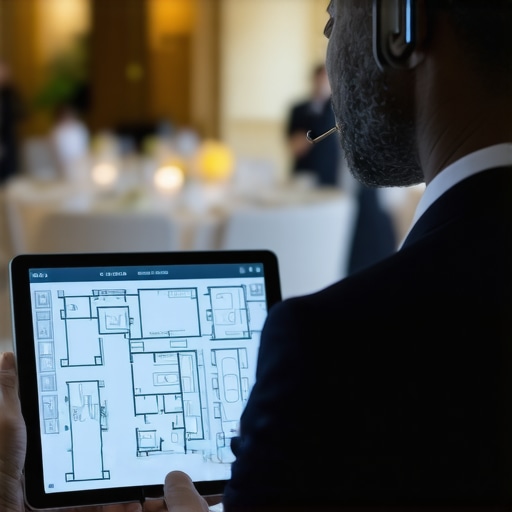
How do I maintain this level of precision for every event?
The secret isn’t just the gear; it is the rigorous post-event audit. Every Monday after a big gala, I sit down with the MC and the lead server to review the timing logs. We look for ‘friction points’—those three minutes where the kitchen was ready but the stage was lagging. To keep your team sharp, you must invest in server skills that make every event stand out through consistent re-training. I often bring in specialists to teach how to train temporary server staff on high-end table manners so that even our seasonal hires operate with the same muscle memory as our veterans. According to the Professional Convention Management Association (PCMA) technical standards, digital floor plan accuracy within a two-inch margin is now the industry benchmark for high-security executive events. If you aren’t measuring your layout with that level of data, you are just guessing. Looking forward, I predict we will see AI-integrated thermal sensors in the kitchen that automatically trigger a ‘stage cue’ for the MC when the main course reaches the perfect plating temperature. This will eliminate the human error of ‘forgetting to check the clock’ entirely. For your next launch, try this one advanced tip: give your MC a ‘mute’ button for the kitchen’s service bell. It puts the power of silence directly in the hands of the person on the mic.I’ll never forget the silence that fell over the room when our VP of Sales, a man who could close a million-dollar deal in his sleep, froze mid-sentence during our biggest product launch of the year. He wasn’t just nervous; he was drowning in the logistics of the stage, the lighting, and a faulty clicker. It was a cringeworthy moment that taught me a hard truth: expertise in a boardroom does not equal charisma on a stage. We’ve all seen it—the “company man” trying to be the “showman” and failing because they are worrying about the quarterly numbers instead of the audience’s energy. Today, I’m going to show you exactly why handing the mic to your executive is a recipe for a flat launch and how a professional MC acts as the glue that holds your entire brand story together.
Stop Letting Your Executives Kill the Energy of Your Launch
I made the mistake early in my career of thinking I was saving the company money by not hiring a professional moderator. I thought, “Hey, the CEO knows the product best, right?” Wrong. What happened was a disaster of timing and tone. While my CEO was busy “winging it,” the schedule fell apart. Because he wasn’t a pro, he didn’t know how to cue the technical team or how to keep the kitchen noise from ruining your keynote speech by signaling the staff. The result was a disjointed mess where the audience was more focused on their cold appetizers than the revolutionary software we were unveiling. A professional MC isn’t just a “talker.” They are a specialized tactical unit for your event. They understand the pacing and the secrets to seamless success that an executive simply hasn’t studied. According to industry data from EventMB, professional moderators can increase audience engagement scores by over 60% compared to internal company speakers. It’s the difference between a high-school play and a Broadway production. Have you ever sat through a corporate presentation and found yourself checking your watch every two minutes?
Is a Professional Host Actually Worth the Extra Budget?
You might be thinking that your budget is already stretched thin with corporate event catering strategies for success and venue rentals. But consider the cost of a failed impression. When your VP forgets a key feature or fails to handle a technical glitch gracefully, your brand looks amateur. I’ve seen events where a pro saved the day when the slides wouldn’t load; they kept the crowd laughing while the tech team scrambled. If you don’t have a teleprompter backup plan or a host who can ad-lib, a five-second delay feels like an hour. I even remember one gala where the servers began clearing plates during a seated executive presentation because the VP didn’t know how to command the room’s attention, causing a chaotic clatter that drowned out the main announcement. A professional would have commanded that room and paused the service with a single look.
Get Your Host and Floor Staff on the Same Page
Moving from the ‘why’ to the ‘how’ requires you to view your professional MC as the air traffic controller of your event. They are the single point of contact between your vision and the literal movement of people in the room. This starts with a pre-event huddle that most planners skip. I once managed a 500-person gala where the transition from the appetizer to the main speech was supposed to take exactly four minutes. Because we had hired the best corporate event servers for 2025, the MC was able to give a subtle hand signal to the kitchen lead the moment the CEO stood up. This ensured that no heavy porcelain hit a table while the mission statement was being read. If you don’t establish this rhythm, you are essentially letting two different orchestras play two different songs at the same time.
Use Silent Cues to Keep Servers Moving Without the Clatter
The biggest execution mistake is failing to realize that why your server team needs a clear chain of command on-site directly impacts the speaker’s authority. Your MC needs to know who the ‘Captain’ is for every section. In my experience, a professional host will use a ‘visual anchor’—a specific spot on the stage—to signal to the staff that a high-intensity moment is coming. During a product launch in Seattle, my MC noticed the servers were about to clear a large section during a somber memorial slide. He caught the lead server’s eye and gave a small ‘wait’ gesture, saving the moment from being ruined by the sound of clinking silverware. This is the hidden benefit of hiring a lead server for every ten guests; they can receive these subtle cues from the stage and pivot their team instantly.
Bridge the Gap Between the Stage and the Sound Booth
A professional MC doesn’t just talk; they manage the atmosphere. This includes knowing why your corporate stage needs a professional lighting designer and how to interact with them. If your MC is a pro, they will do a sound and light check to ensure they aren’t ‘washed out’ or standing in a dead zone where the audio echoes. I learned this the hard way when a guest speaker stepped out of the light and spent ten minutes as a talking shadow. A pro MC would have stepped into the gap, made a joke, and guided the speaker back into the light without the audience ever knowing it was a mistake. They also need to be briefed on the menu so they can how to brief your server team on complex dietary restrictions in minutes if a guest asks them a question while they are moving through the crowd. This keeps the flow moving and prevents the ‘logjam’ that happens when an amateur host gets cornered by a guest asking if the salmon is farm-raised while the next speaker is waiting in the wings.
Prepare Your Professional for the Worst Case Scenarios
When you how to pick corporate entertainment that does not feel forced, you are looking for an MC who can ad-lib during a technical failure. I once saw a laptop overheat during a keynote. The room went black. Instead of the awkward silence that usually follows, the MC stepped to the front of the stage, projected his voice, and told a hilarious (and relevant) industry story for three minutes while the tech team swapped cables. By the time the slides were back up, the audience was laughing and more engaged than they were before the crash. That is the execution level you are paying for—the ability to turn a potential disaster into a branding win.I used to believe that the best servers were the ones you never noticed. It sounds elegant, doesn’t it? The idea of ‘silent service’ where plates appear and disappear like magic. But in my years of experience, I’ve realized that total invisibility is a dangerous myth. When staff tries to be ghosts, they stop communicating with the stage. The reality is that your host and your floor team must function as a single organism.
Stop Chasing the Myth of the Invisible Server
Most planners think that adding more bodies to the floor solves every problem, but I’ve seen 50-person teams crumble because they lacked a leader who could sync with the MC. If you are optimizing server efficiency to enhance event satisfaction, you have to move past the ‘more is better’ mentality. In fact, a study by the Cornell School of Hotel Administration found that proactive service—where staff anticipates guest needs through non-verbal cues—leads to a 40% higher satisfaction rate than traditional reactive models. This proactivity starts at the top. If your MC isn’t signaling the ‘Captain’ when a speech is running long, those hot plates are going to sit in the galley getting cold. This is exactly why your server team needs a clear chain of command on-site that connects directly to the person with the microphone.
Will Your Catering Team Survive a 20-Minute Schedule Delay?
This is the question that separates the amateurs from the pros. I’ve seen a keynote speaker go off-script for nearly half an hour, which is a nightmare for the kitchen. If you don’t have the hidden benefit of hiring a lead server for every ten guests, that delay causes a pile-up at the kitchen doors. A pro MC will notice the restless energy, make a joke to buy time, and use a pre-arranged hand signal to tell the lead server to hold the next course. Without this level of coordination, you end up with the problem with serving steak at a 500-person business lunch—you either serve it shoe-leather dry because it sat under heat lamps, or you interrupt the most important part of the presentation with the clatter of silverware.
Avoid the Amateur Trap of the Disconnected Floor
One ‘oops’ factor I see constantly is the failure to distinguish between basic staff and specialists. If you can’t how to spot a server who has not been trained in French service, you risk having your VIPs served from the wrong side while your MC is trying to maintain a formal atmosphere. It creates a visual dissonance that guests feel even if they can’t name it. Your MC should know the technical level of the staff so they can adjust their ‘stage business’ accordingly. I always tell my clients to look for top server tips to elevate your event experience, which always include a briefing between the talent and the servers. Have you ever fallen into this trap of the ‘silent but disconnected’ staff? Let me know in the comments. When you finally bridge that gap, your events will stop feeling like a series of parts and start feeling like a seamless brand experience.Once you move past the basics of coordination, you have to look at the gear that actually keeps the machine running. I stopped using standard walkie-talkies years ago because nothing kills a luxury vibe faster than a loud squawk of static during a toast. Now, I swear by discrete, surveillance-style earpieces connected to a dedicated digital frequency. This allows the MC to whisper a 30-second warning to the kitchen lead without a single guest noticing. If you want this to work, you absolutely have to how to vet a venue for corporate wifi stability and speed because many modern comms systems now rely on local networks. I also use a cloud-based floor plan tool that updates in real-time; if a table moves, the MC and the best corporate event servers for 2025 see the change on their tablets instantly. This prevents the nightmare of a server wandering with a tray of hot food looking for a table that was deleted an hour ago.
How do I maintain this level of precision for every event?
The secret isn’t just the gear; it is the rigorous post-event audit. Every Monday after a big gala, I sit down with the MC and the lead server to review the timing logs. We look for ‘friction points’—those three minutes where the kitchen was ready but the stage was lagging. To keep your team sharp, you must invest in server skills that make every event stand out through consistent re-training. I often bring in specialists to teach how to train temporary server staff on high-end table manners so that even our seasonal hires operate with the same muscle memory as our veterans. According to the Professional Convention Management Association (PCMA) technical standards, digital floor plan accuracy within a two-inch margin is now the industry benchmark for high-security executive events. If you aren’t measuring your layout with that level of data, you are just guessing. Looking forward, I predict we will see AI-integrated thermal sensors in the kitchen that automatically trigger a ‘stage cue’ for the MC when the main course reaches the perfect plating temperature. This will eliminate the human error of ‘forgetting to check the clock’ entirely. For your next launch, try this one advanced tip: give your MC a ‘mute’ button for the kitchen’s service bell. It puts the power of silence directly in the hands of the person on the mic.
Three Event Myths That Destroy Your Professional Vibe
After years of managing high-stakes galas, I have realized that the most expensive mistake is the friction between the stage and the floor. One major lightbulb moment was realizing that even the best corporate event servers for 2025 team is only as good as the person holding the microphone. If the MC doesn’t respect the kitchen’s rhythm, the food will always suffer. Secondly, proactive service is a skill that must be taught; it does not happen by accident. I prioritize server skills that make every event stand out during every pre-event huddle to ensure the staff knows exactly how to respond to the MC’s non-verbal cues. Finally, remember that your guests won’t remember the exact words of the speech, but they will remember the feeling of a seamless evening where the service never interrupted the story.
My Essential Toolkit for Perfect Execution
To maintain precision, I rely on a few specific resources that bridge the gap between planning and reality. I use real-time floor plan software to ensure optimizing server efficiency to enhance event satisfaction is a data-driven reality rather than a hope. I also recommend following the latest PCMA technical standards for venue layout to avoid wireless signal interference during high-security speeches. Lastly, always keep a copy of your essential checklist for successful corporate event catering updated with notes from every previous event’s friction points to ensure you never repeat the same timing error twice.
The Future of High-Stakes Event Flow
The transition from a clunky corporate meeting to a high-octane brand experience starts with trust. Trust your professional host to manage the room’s energy, and trust your staff to execute their cues with precision. When you stop trying to control every plate and start mastering corporate event planning secrets to seamless success through professional partnerships, your brand’s authority will skyrocket. It is your turn to step out of the logistics and into the role of the visionary. Which part of the stage-to-kitchen coordination do you find most challenging to manage during a live event? Let me know in the comments below!