

I still remember the heat rising in my neck at a 200-person gala three years ago. I watched, helpless, as a temporary server reached directly across the CEO of a Fortune 500 company to grab a stray bread plate. It was a slow-motion car crash in a tuxedo. That moment taught me a hard lesson: your event is only as sophisticated as its least-trained staff member. We often spend months obsessing over the menu, but if the person delivering the plate doesn’t know their left from their right, the luxury illusion shatters. Today, I am going to show you how to turn a group of fresh faces into a synchronized team that would make a Michelin-starred captain proud.
The Brutal Truth About Service and First Impressions
It is easy to blame the staffing agency when things go south, but the reality is that high-end service is a language. If you do not teach your team the vocabulary, you cannot expect them to speak it properly. I have learned the hard way that spotting a server who hasn’t been briefed is painfully obvious to your guests. Early in my career, I made the mistake of assuming that professional attire automatically meant professional skills. It does not. You have to be the one to set the standard, even if you only have thirty minutes before the doors open. Luxury is not just about expensive ingredients; it is about the invisible choreography of the room. When you embrace white-glove service techniques, you are not just being fancy—you are removing distractions so the guests can focus on the occasion. According to research from the Journal of Hospitality and Tourism Research, guests perceive food as higher quality when the service is seamless and unobtrusive. Bad manners actually make the steak taste cheaper.
Can you really teach grace in twenty minutes?
You might be thinking that true table manners take years to master. You are right, they do. But for a four-hour event, you do not need a masterclass; you need a sharp cheat sheet of non-negotiable rules. I will show you how to brief your server team in minutes so they look like they have been with you for years. We are going to focus on the high-impact movements that signal luxury to a guest: the silent clear, the open-arm service, and the art of the refill. Have you ever had a beautiful event dampened by a server’s awkward mistake? I would love to hear your stories or the one tip that saved your sanity in the comments below. Let us get into the specifics of how we bridge the gap between temporary and top-tier.
Run a High-Impact Briefing Before the Doors Open
You cannot teach a lifetime of hospitality in a single afternoon, but you can build a defensive perimeter against basic errors. I start every event with a mandatory huddle. If you are organizing a staff meeting before a 500-person dinner, you have to realize that information overload is your enemy. Pick three non-negotiables. For me, it is always: proactive eye contact, the open-arm service method, and the “never empty” rule for water. I once managed a high-stakes gala where I skipped the briefing because the flower delivery was three hours late. By the second course, I found three servers huddled in the corner debating which fork was for the salad while guests waited for their wine. It was a disaster that nearly cost us a long-term contract. Now, I use those twenty minutes to brief your server team on complex dietary restrictions so they can answer guest questions without running back to the kitchen every five minutes.
Master the Open-Arm Service Technique
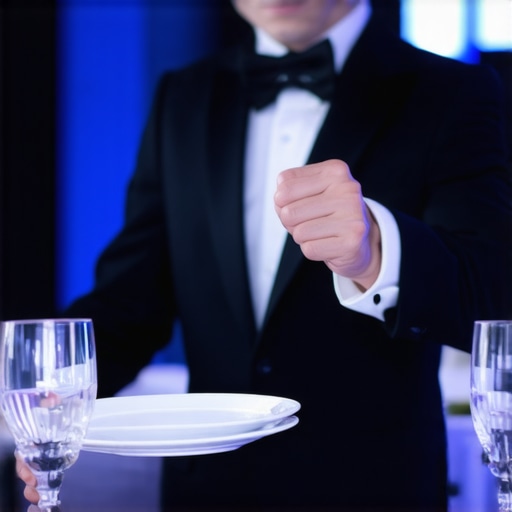
Think of your server’s arms like the wings of a plane—they should never cross the guest’s line of sight or personal space. The “open-arm” rule means you always serve with the arm furthest from the guest. If you are standing on their right, you serve with your right hand. This keeps your chest open to the guest and prevents the “awkward elbow” from passing directly in front of their face. It’s a small mechanical shift that instantly separates a professional from an amateur. To keep the flow moving, you also need to ensure pre-pouring water is the secret to a fast service start. This removes the first frantic ten minutes of service and lets the team focus on the choreography of the appetizers rather than struggling with heavy pitchers.
Structure the Room for Maximum Vigilance
Communication in a loud ballroom is impossible without a clear hierarchy. This is why your server team needs a designated captain for every 50 guests. This person acts as the quarterback. They don’t carry plates; they watch the “temperature” of the tables. Are the wine glasses low? Is Table 12 waiting too long for their steak? When you choose the right staffing ratio for a VIP event, you aren’t just paying for hands; you are paying for eyes. I remember a wedding in a remote vineyard where the captain spotted a guest having a subtle allergic reaction before the guest even realized what was happening. That level of vigilance only happens when your lead servers aren’t bogged down by clearing bread crumbs or refilling butter ramekins.
The Art of the Silent Clear
Nothing kills a sophisticated atmosphere faster than the clattering of silverware. I tell my teams that they should be like ninjas—unseen and unheard. You never stack plates at the table. It’s loud, it looks messy, and it’s a hallmark of a casual diner. Instead, use the “two-plate carry” out of the guest’s sightline. If you want to prevent plate stacking at high-end charity auctions, you must provide enough bus tubs in the “dead zones”—those hidden areas behind screens or floral arrangements. This keeps the dining room looking like a curated experience rather than a clearing house. By optimizing server efficiency through these specific, small movements, you create a sense of calm that guests subconsciously associate with high luxury.
Let’s dig deeper into the mechanics of what actually makes a room feel expensive. Most planners believe that the solution to a slow service is simply throwing more bodies at the problem. I have seen this backfire spectacularly. In my experience, a bloated staff without a rigid hierarchy creates a ‘bystander effect’ where everyone assumes someone else is refilling the water carafes. This is why a lead server should never be assigned a single table. They need the mental bandwidth to see the entire landscape. When everyone is in the weeds, you need one person on the shore with a megaphone and a map. According to a study by the Cornell School of Hotel Administration, over-staffing can actually decrease guest satisfaction by creating a ‘cluttered’ environment where the staff becomes a physical obstacle rather than a service asset. The focus should always be on optimizing server efficiency rather than sheer volume.
When does a high staffing ratio start hurting your event?
There is a tipping point where another server actually slows down the kitchen pass. I once worked a corporate gala where the client insisted on a 1:6 ratio for 500 guests. The service corridor became a mosh pit. To avoid this, you must choose the right staffing ratio for a VIP event based on the complexity of the menu, not just the guest count. If you are serving a six-course meal, you need precision, not a crowd. Another common pitfall is the ‘budget-friendly’ trap. Many organizers think they can save by using entry-level labor for the heavy lifting, but the hidden risks of hiring student servers for high-end events often manifest as broken glassware and misinterpreted guest requests. Luxury is fragile; it requires server skills that make every event stand out, which only comes with repetitive, high-stakes experience.
One of the most overlooked nuances is the ‘dead zone’ logistics. If your team has to walk 200 feet to reach a bus tub, they will inevitably start stacking plates at the table to save trips. I always insist that my clients prevent plate stacking at high-end charity auctions by creating hidden satellite stations. It’s about the ‘oops’ factor: if a server has to choose between an ugly stack or a long walk, they’ll choose the stack every time unless you’ve designed the room for their success. These effective catering strategies for corporate event impressiveness are what separate a polished gala from a chaotic banquet hall. Have you ever fallen into the ‘more is better’ trap and ended up with a crowded dining room? Let me know in the comments below.
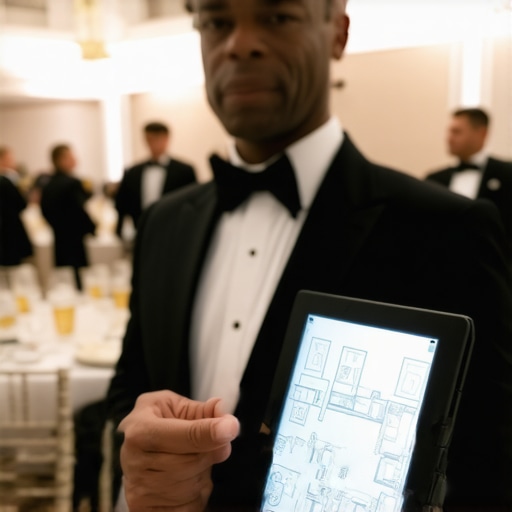
Maintaining this level of precision isn’t just about the four hours of the event; it is about the systems you build during the other forty hours of the week. I have found that the most organized teams rely on digital clarity before they ever step foot on a marble floor. I personally swear by digital floor planning software like Allseated or Social Tables to layout a corporate ballroom for maximum networking. When you can visualize the exact flow of traffic and the ‘dead zones’ where plates might accumulate, you can solve service bottlenecks before they happen. It turns the venue from a mystery into a map. This technical approach allows you to manage corporate event catering logistics with the same precision as a military operation.
How do I keep my team at this level of polish forever?
Consistency is the ghost that haunts the catering industry. You have a great event on Saturday, and then Tuesday’s lunch is a mess. To fix this, I implemented a ‘Post-Event Audit’ for every single booking. We don’t just talk about what went well; we look at the friction points. Did the essential checklist for successful corporate event catering actually get checked, or did we just wing it? According to the National Association of Catering & Events (NACE) in their latest operations efficiency study, teams that conduct formal post-event reviews see a 22% increase in staff retention and a significant drop in avoidable equipment breakage. It is about creating a culture where server skills that make every event stand out are treated as a craft, not just a paycheck.
As we scale to massive gatherings, the tools change but the principles don’t. When you are tasked with managing a coat check for 1000 winter guests or a 500-person gala, you need to rely on specialized roles. I always bring in a ‘Float Lead’ whose only job is to handle ‘the unexpected.’ Whether it is a broken glass or a guest with a sudden allergy, the Float Lead keeps the rest of the team from breaking their rhythm. I predict that in the next five years, we will see the integration of real-time sensor data in high-end venues to track ‘wait times’ at tables, allowing captains to redirect staff via earpieces before a guest even looks around for more water. The future of luxury is predictive, not just reactive. I want you to try this at your next event: conduct a five-minute ‘debrief’ immediately after the last guest leaves while the experience is still fresh. It is the single fastest way to optimize server efficiency for the long haul.
The Invisible Mistakes That Cost Me My Biggest Contracts
Over the years, I have realized that the “Bread Plate Trap” is the most common luxury killer. Servers often think they are being helpful by hovering near a table, but true luxury is the art of being invisible until the exact moment you are needed. I also learned that body language speaks louder than any gourmet menu; a server with slumped shoulders or a distracted gaze can ruin a hundred-thousand-dollar decor setup in seconds. The most important lightbulb moment for me was realizing that the silence of success is real—if you can hear the service happening, the service has failed. To truly excel, you must empower your team to solve guest problems on the spot. When you elevate your event experience through staff confidence, the entire atmosphere shifts from “catered” to “curated.”
#IMAGE_PLACEHOLDER_E#
My Secret Weapons for Flawless Floor Management
I never walk into a venue without a few specific tools in my digital pocket. I rely heavily on 7shifts for real-time communication with the crew, ensuring everyone is on the same page before they even arrive. For the technical side of hospitality, I always recommend the classic text The Waiter’s Guide to Fine Dining; it is what I use to help my leads understand the deep psychology of guest needs. If you are looking to spot a professional server in an interview, ask them about their preferred floor flow software—pros will usually mention tools like Allseated for mapping those pesky “dead zones.” These resources are the backbone of mastering corporate event planning secrets that keep high-stakes evenings running smoothly.
Time to Lead Your Own Masterclass
You do not need a massive budget to have a massive impact on your guests. Luxury is a mindset, not just a line item in your spreadsheet. It starts with your energy as a leader and the standards you refuse to lower, even when the kitchen is backed up or the flowers are late. Go out there and turn your next event into a choreographed masterpiece by focusing on the small, silent details that define high-end server efficiency. Have you ever had a moment where a server’s quick thinking saved your event from a major disaster? I would love to hear your stories in the comments below.