

I stood in the corner of a dimly lit ballroom three years ago, watching a bride stare longingly at her prime rib while forty relatives lined up to hug her. By the time she finally picked up her fork, the au jus had congealed into a sad, waxy film. It was a classic mistake I made early in my career—assuming that serving the VIPs first was the ultimate sign of respect. I realized then that the traditional order of operations is often a recipe for a cold meal and a stressed-out couple. We had the top servers for a seamless wedding reception ready to go, but the timing was all wrong because I hadn’t yet learned the strategic power of the ‘reverse serve.’ Today, I want to show you why waiting to feed the head table is actually the kindest thing you can do for them.
Let the couple socialize while the room stays busy
When the head table is served first, they become sitting ducks. Guests who are still waiting for their food see the couple eating and think, ‘Oh, now is the perfect time to go say hi!’ This creates a bottleneck that stops the couple from actually consuming their meal. By flipping the order, the guests are occupied with their own food while the couple finishes their rounds. It’s the same kind of strategic logic we use when placing a bar away from the entrance to prevent crowding. If you choose the perfect servers who understand this flow, they can keep the couple’s plates in a warming oven until the exact moment the room settles down. Have you ever been to a wedding where the bride and groom didn’t get to eat a single bite of their own expensive catering?
Does this make the couple feel like an afterthought?
It is a valid fear. You don’t want the stars of the show feeling like they are getting the scraps. However, in my experience, the opposite is true. When you explain that this allows them to eat in peace once the ‘mandatory’ social buzzing has died down, they are usually immensely relieved. According to industry data from The Knot, nearly 20% of couples report not getting to eat their full meal at their own reception; prioritizing their peace over their position in line fixes this. This approach is a core part of planning the ultimate wedding reception meal because it treats the food as an experience rather than just a checklist item. Early on, I once served a head table first at a 300-person gala, and the groom was so busy talking he accidentally knocked his full glass of red wine onto his lap because he was constantly turning around to greet people. If he’d been served last, that plate wouldn’t have even been in his ‘splash zone’ during the peak greeting hour.
Explain the Why Before the First Fork Drops
To execute this properly, you need a strategy that is as synchronized as a Swiss watch. First, you have to secure the couple’s trust during the final walkthrough. I tell them, ‘I am going to make you feel like the most important people in the room by not giving you your food until everyone else is quiet.’ It sounds counterintuitive, but it works. This is where optimizing server efficiency to enhance event satisfaction becomes the difference between a cold steak and a culinary highlight. If you do not prep them, they might panic when they see Table 12 tucking into their salads while their own chargers are empty. You must frame it as a ‘VIP Dining Window’—a protected twenty minutes where the staff effectively creates a perimeter around the head table.
The Kitchen Holding Pattern That Saves the Steak
From a technical standpoint, the kitchen needs to be in on the secret. Most chefs want to fire the VIP plates first to get them out of the way. You have to reverse that instinct. We keep the proteins in a precisely calibrated warming environment—not a blast furnace that will overcook them, but a humidified holding cabinet. This is the trick to serving 300 steaks at the exact same temperature while specifically delaying the most important two. I remember a wedding in a converted barn where the ambient temperature dropped to 55 degrees in October; if we had served the bride first, her sea bass would have been an icicle by the time she finished her ‘thank you’ rounds. Instead, we held it until the guests were mid-entree and the ‘social gravity’ of the room shifted toward the plates and away from the couple.
Your Lead Server Must Act Like a Social Bodyguard
This step requires server skills that make every event stand out beyond just carrying a tray. The lead server for the head table needs to have the ‘eyes of a hawk.’ Their job is to watch the couple’s body language. Are they still talking? Is a Great Aunt currently mid-anecdote? If so, the plate stays in the kitchen. We often advocate for the hidden benefit of hiring a lead server for every ten guests because it allows one person to focus entirely on the timing of that single ‘go’ signal. I once had a lead server literally step in and gently tell a chatty guest, ‘The couple’s hot entree is arriving in sixty seconds, I’ll let you get back to your seat so they can enjoy it!’ It was polite, firm, and the bride later told me it was the only reason she didn’t faint from hunger.
Apply the Same Logic to the Boardroom
This is not just for weddings; it is a vital part of corporate event catering strategies for success. I once managed a high-stakes fundraiser where the CEO insisted on being served first. Within thirty seconds, a major donor sat down next to him to discuss a legacy gift. That expensive filet mignon sat there for forty minutes. By the time he took a bite, it was cold and unappealing. We now use techniques on how to keep executive board members focused during a catered lunch to prevent that exact disaster by timing the service to the natural lull in networking. You must also know how to handle plate clearing during a seated executive presentation so that the ‘reverse serve’ does not turn into a noisy distraction during the keynote.People often assume that throwing more staff at a problem is the ultimate flex for a luxury event. In my experience, that is one of the most expensive myths in the industry. An overstaffed room without a clear strategy creates a ‘pinball’ effect where servers are constantly bumping into guests or each other, destroying the very atmosphere you paid to create. It is not about raw numbers; it is about the invisible choreography of the floor. I have seen events with a 1:8 server-to-guest ratio descend into chaos because they lacked the proper structure. This is why your server team needs a clear chain of command on site to function as a single unit rather than a group of individuals. Expertise in this field means knowing how to disappear into the woodwork. To get that level of polish, you must learn how to spot a server who has not been trained in french service because a true professional understands that ‘service’ is as much about what you don’t do as what you do.
The messy trap of ‘impressive’ menus
One of the biggest ‘oops’ factors I encounter in high-stakes planning is the disconnect between the menu and the social environment. I’ve watched million-dollar deals fail because of the danger of serving finger foods that require two hands. If your guest has a glass of Chardonnay in one hand and a business card in the other, that ‘artisan’ sliders is now a liability. It forces a guest to choose between eating and networking. For corporate success, effective catering strategies for corporate event impressiveness should always prioritize ‘one-bite’ ergonomics. I once saw an executive spill balsamic glaze down a white silk blouse because the caterer chose style over utility. That is not just a catering fail; that is a professional disaster.
Can a massive ballroom event still feel like a private dinner?
Many planners believe that once you cross the 200-guest threshold, intimacy is dead. That is simply not true if you focus on the psychology of the ‘micro-zone.’ According to a landmark study by the Cornell School of Hotel Administration, guest satisfaction in high-end dining is more closely tied to the consistency and timing of service interactions than the sheer frequency of them. Guests don’t want to be interrupted every five minutes; they want their needs met before they even realize they have them. This is why optimizing server efficiency to enhance event satisfaction involves training staff to read body language from across the room. 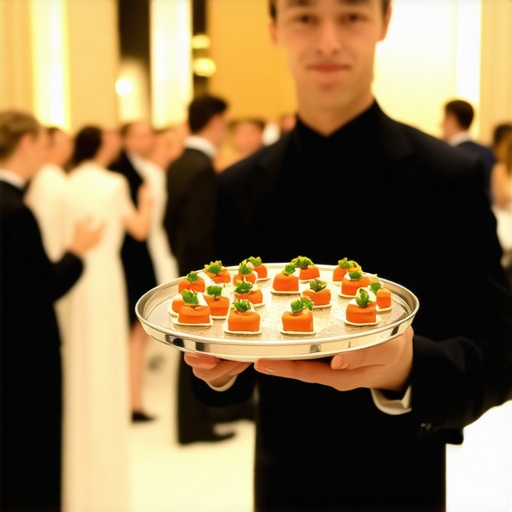
The logistics that planners usually ignore
Another hidden nuance is the ‘back-of-house’ flow. You can have the best servers in the world, but if the venue layout is flawed, they will fail. I’ve seen beautiful events stall because most corporate buffets fail the temperature test simply due to being placed too far from the kitchen doors. We often suggest that your business luncheon needs a dedicated coat check person not just for convenience, but to keep the dining area free of bulky bags and coats that trip up servers carrying heavy trays. When the aisles are clear, the service is faster, and the food stays hotter. It is a simple chain reaction that separates the amateurs from the experts. Have you ever fallen into this trap of prioritizing the ‘look’ over the ‘logistics’? Let me know in the comments.
Execution at this level isn’t just about talent; it is about the systems you have in place when things go sideways. To keep everything working across a season of forty weddings, I rely heavily on digital floor-planning tools like Social Tables. It allows me to visualize the ‘service lanes’ and ensure the ultimate guide to corporate event catering logistics isn’t just a document, but a lived reality on the ballroom floor. By mapping out exactly where the servers pivot, we avoid the ‘pinball’ chaos I mentioned earlier. This is especially critical when you layout a corporate ballroom for maximum networking, as every inch of space is a premium.
The physical hardware that guarantees a perfect plate
Beyond software, my ‘never-leave-home-without-it’ tool is a high-precision digital thermometer, specifically the Thermapen. In catering, ‘feeling’ the heat of a plate is amateur hour. To adhere to professional standards like those found in the 2022 FDA Food Code, which mandates that TCS (Time/Temperature Control for Safety) foods must be maintained at 135°F (57°C) or above during hot holding, we check every third plate before it leaves the kitchen. This rigor is how you master the trick to serving 300 steaks at the exact same temperature. It transforms a guessing game into a scientific process, ensuring that even the last guest served has the same premium experience as the first.
How do I maintain consistent service quality as my event business grows?
Scaling is the ultimate test of your systems. Most companies lose their soul when they move from ten-person dinners to thousand-person galas. The secret is the ‘Squad Lead’ method. Instead of one manager for fifty servers, I break them into squads of five, each with a veteran lead. This ensures why your server team needs a clear chain of command on site is respected. Each lead is responsible for the ‘micro-climate’ of their assigned tables, allowing for top server tips to elevate your event experience to be implemented at a granular level. We also use a ‘post-mortem’ checklist after every event to capture what worked and what failed, turning every mistake into a permanent update to our training manual.
Looking ahead, I predict that ‘predictive guest flow’ software will become the next major trend. We are already seeing AI tools that can simulate how guests will move toward a buffet based on the room’s layout, which will help us solve bottlenecks before the first guest even arrives. This will be a game-changer for wedding catering trends to impress guests in 2025. If you want to elevate your next event immediately, try my ‘Reverse Serve’ logic for your VIPs. It requires guts to wait to feed the most important people in the room, but the look of relief on their faces when they can finally eat in peace is worth every second of the wait.
Hard Truths I Learned From Five Hundred Cold Entrees
After years of managing high-pressure ballrooms, I have come to realize that silence is the most expensive sound in the room. If the guests are quiet, they are eating, and if they are eating, your plan is working. One of the biggest lessons I have learned is that the ‘VIP’ treatment often looks like a paradox; sometimes the kindest thing you can do for the guest of honor is to make them wait. This prevents them from becoming a social target before they can pick up their fork. I have also learned that staffing levels don’t solve logic problems; you can have a hundred servers, but without a comprehensive guide to corporate event catering logistics, you just have a crowded room. Finally, remember that your lead servers are your eyes and ears. Trust their gut when they tell you a table isn’t ready for their next course.
The Equipment and Resources I Bet My Reputation On
To execute these high-level strategies, I rely on a very specific toolkit that moves beyond standard kitchen gear. First, a high-precision digital thermometer like the Thermapen is non-negotiable to ensure every plate meets the safety standards found in the essential checklist for successful corporate event catering. For floor planning, software like Social Tables helps me visualize service lanes so my team never creates a bottleneck. I also recommend staying updated on the latest wedding catering trends to impress guests in 2025, as the shift toward experiential dining is changing how we approach the plate-up. These resources turn a chaotic evening into a controlled, professional performance.
#IMAGE_PLACEHOLDER_E#
Go Ahead and Break the Traditional Rules
It takes a certain amount of professional courage to tell a client that you aren’t going to serve them first. However, once you frame it as protecting their time and their meal, you transition from being a vendor to a strategic partner. As you look toward your next big gala or reception, I encourage you to boost your corporate event with expert server techniques that prioritize the flow of the room over the rigid traditions of the past. The goal of any great caterer is to create a memory that isn’t marred by cold steak or interrupted conversations. When you master the invisible choreography of the ‘reverse serve,’ you aren’t just feeding people; you are curated their peace of mind. Have you ever been the guest of honor and felt too overwhelmed to actually eat your meal? Let me know your experience in the comments.