

I’ll never forget the sound. It was the 2019 ‘Silver Sands’ Gala—black tie, five hundred dollars a plate, and a silent auction that had already pulled in six figures before the first course. Suddenly, right as the keynote started, clack-clack-clack. A well-meaning donor in a thousand-dollar tuxedo had started stacking dirty salad plates in the middle of the table because my service team had fallen behind. It looked like a college dormitory after a midnight pizza run. I felt my face turn beet red. That night, I learned a painful lesson: luxury isn’t just about the wagyu or the vintage wine; it’s about the invisible hands that keep the clutter from ever existing in the first place.
The Night My Gala Looked Like a Cafeteria
When you are running a high-stakes charity auction, the environment is everything. You are selling a dream and a cause, but that dream dies the second a guest feels the need to ‘help out’ by piling up porcelain. Early in my career, I made the mistake of thinking I could save on the budget by thinning out the floor crew. I thought, ‘They are professionals; they can handle two extra tables each.’ I was wrong. That small gap in coverage created a bottleneck that led to the dreaded plate stack. To fix this, you need to understand how to choose the right staffing ratio for a VIP event so your team is never playing catch-up.
Today, I’m going to share the exact strategies I use to ensure no guest ever feels the urge to reach for their neighbor’s plate. We are going to look at flow, communication, and why white glove service is making a comeback in luxury galas. Have you ever sat at a stunning event and found yourself looking for a place to hide a dirty napkin because the table was overflowing? It’s a vibe-killer, isn’t it? My goal is to help you avoid that awkwardness by showing you how to spot a professional server in an interview who truly understands the ‘invisible clear.’
Does a Little Bit of Mess Really Affect Your Bottom Line?
You might think I’m being a bit dramatic. It’s just a few plates, right? Wrong. Perception is reality in the world of fundraising. According to research from the Cornell School of Hotel Administration, the physical environment and the perceived ‘seamlessness’ of service directly impact a guest’s emotional state and their willingness to engage in generous behaviors. In short: a messy table leads to a messy auction paddle. If your guests feel like they are at a crowded buffet, they won’t bid like they are at a premier gala. This is why top server tips to elevate your event experience aren’t just about etiquette; they are about protecting your revenue. We need to move beyond simple clearing and start practicing proactive table management that keeps the focus on the stage, not the scraps.
Stop the Chaos Before the First Course Hits
The most common reason a table turns into a graveyard of dirty dishes isn’t laziness; it’s a lack of direction. Before the doors even open, you must master the pre-service brief. Think of it as a huddle before a championship game. If your team doesn’t know the exact sequence of service, they will hesitate, and hesitation creates clutter. I always make sure to how to organize a staff meeting before a 500-person dinner to clarify who is clearing and who is pouring. One time, at a tech-sector luncheon in 2021, I skipped the ‘discard station’ talk. By the time the CEO stood up to speak, every guest was awkwardly clutching a used toothpick or a damp shrimp tail because they had nowhere to put them. It was a disaster that distracted from the keynote. That’s why your appetizer tray needs a designated discard station—it prevents guests from turning the $200 floral centerpieces into improvised trash cans.
Why You Need a Captain for Every Fifty Guests
In a room of five hundred people, a single lead server is a recipe for a bottleneck. You need to decentralize command. I’ve found that why your server team needs a designated captain for every 50 guests is the magic ratio for maintaining a ‘white-glove’ feel. These captains act like air traffic controllers, spotting the guest who just finished their salad from thirty feet away. This level of oversight is essential for optimizing server efficiency to enhance event satisfaction. When the captain signals, the server moves in like a ghost—no clinking, no ‘Are you done with that?’, just a seamless removal of the dish. This is one of the top server tips to elevate your event experience: if the guest has to verbally confirm they are finished, the ‘invisible’ part of the service has already failed. You want the table to feel like it’s self-cleaning.
The Signal That Tells a Server a Plate is Dead
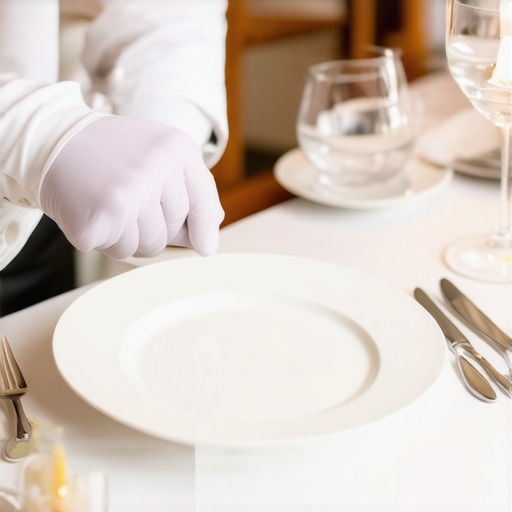
Teaching your team to read the table without speaking is the highest form of hospitality. We train our staff to look for ‘The Silent Signal’—the knife and fork placed parallel at the four o’clock position. However, at a high-energy gala, guests are often too distracted by networking to follow formal etiquette. In these cases, you boost your corporate event with expert server techniques by training staff to watch for the ‘lean back.’ When a guest shifts their weight away from the table or starts gesturing with their hands instead of holding utensils, they are mentally finished. This is the moment to strike. Use the ‘three-finger’ clearing method—using the thumb, index, and middle finger to secure the plate from the right side—to ensure stability and zero noise. By mastering these cues, you ensure the table remains a pristine canvas for the next course, keeping the prestige of the event intact without ever interrupting a donor’s pitch or a CEO’s toast.
People often assume that to get the best service, you put your most experienced staff member on the VIP table. It sounds logical, right? But in my fifteen years in the industry, I’ve seen this backfire every single time. Here is the contrarian truth: why a lead server should never be assigned a single table. When your “MVP” is stuck pouring wine for the CEO, they aren’t watching the kitchen exit, and they aren’t noticing the empty water glasses at the back of the room. They become a tactical asset when you need them to be a strategic one. This is one of those server skills that make every event stand out—the ability to oversee the room without being tethered to a chair.
The Dessert Delay Trap
One of the biggest “oops” factors I see planners fall into is what I call the “Dessert Delay.” Everyone focuses on the main course, but the moment the cake is cut, the energy shifts. If you haven’t mastered the best way to serve coffee to 200 people in five minutes, you’ll find your guests wandering away from the tables before the final speeches even begin. According to the Journal of Foodservice Business Research, the perception of service quality drops significantly if the closing of the meal—specifically the coffee and dessert service—takes more than 15% longer than the previous courses. It’s the last thing guests remember, so don’t let it be a slow, tepid experience.
#IMAGE_PLACE_HOLDER_C#
Can Your Seating Chart Actually Sabotage Your Service Speed?
Most planners design their room for aesthetics, but the pros design for the “service lane.” If you are planning a high-volume event, be wary of the hidden risks of hiring student servers for high-end events who might not know how to navigate a crowded floor under pressure. A common mistake is crowding the floor without a clear path for the team. For example, the problem with using tall centerpieces at dinner tables isn’t just about guest sightlines; it’s about the servers’ ability to clear plates without snagging a sleeve or tipping a floral arrangement. Another nuance that separates the pros from the amateurs is plate temperature. I’ve seen countless expensive dinners ruined because they were served on cold porcelain. This is why cold plates are the enemy of a perfect filet mignon. In high-volume catering, keeping hundreds of plates warm is a massive logistical challenge, but it’s the difference between a lukewarm meal and a five-star experience.
Beyond the floor, the kitchen-to-floor handover is where the most sophisticated mistakes happen. Many teams think speed is the only metric, but rhythmic service is actually what matters. If Table A is on dessert and Table B is still waiting for their main, the room loses its cohesion. This is where a veteran captain earns their pay, ensuring that every server moves in unison. This synchronicity creates a psychological effect of “effortless flow” for the guest. Finally, consider the menu design itself as a service tool. Amateurs pick dishes based on flavor alone; experts pick dishes based on “plate stability” and “holding power.” A dish that wilts in three minutes is a liability if the keynote speaker goes long. Have you ever fallen into this trap of focusing on speed over rhythm? Let me know in the comments.
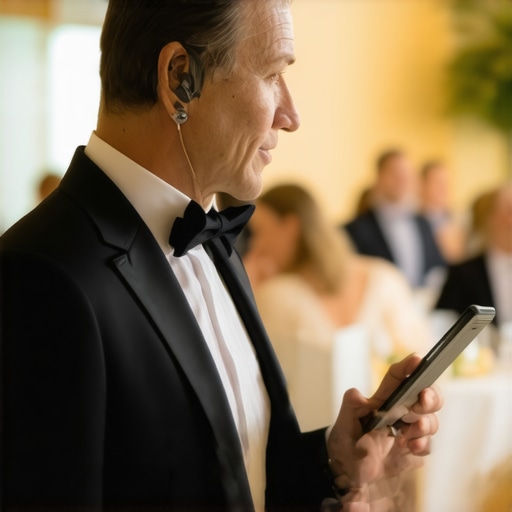
Maintaining that ‘rhythmic service’ I mentioned isn’t just about hiring the right people; it’s about the infrastructure you build behind the scenes. I personally swear by ‘ears-in’ communication. If you see a floor manager shouting across a ballroom, the magic is dead. I use the Motorola CLP series with discrete surveillance-style earpieces. Why? Because it allows me to whisper, ‘Table 14 needs water,’ without the guest ever hearing a crackle. This level of coordination is a key part of the ultimate guide to corporate event catering logistics that most people overlook until something goes wrong.
The Tech That Keeps My Team Quiet
Beyond the hardware, I rely heavily on digital floor planning. I don’t just use it for the layout; I use it to map the ‘heat’ of the room. Using software like AllSeated allows me to simulate the service flow before we even set a single fork. It’s part of my essential checklist for successful corporate event catering. If the distance from the kitchen to the farthest table is more than 60 feet, I know I need a satellite station to keep the pace consistent and the food at the right temperature.
How do I maintain this level of precision across every single event?
Consistency is the enemy of scale. To keep standards high, I’ve moved away from ‘memory-based’ service. Every one of my captains carries a digital tablet with the evening’s ‘battle plan.’ We’ve found that documenting the minute-by-minute flow—knowing exactly when to prep the first pour—is vital for corporate event catering strategies for success. According to a study in the Journal of Hospitality & Tourism Technology, using real-time digital coordination tools can reduce service ‘lag’ by up to 22%, which is the difference between a hot plate and a lukewarm apology.
Why the Future of Catering is Data-Driven
This isn’t just about today; it’s about where we are headed. In the next few years, I predict we’ll see ‘Smart Tables’ with integrated weight sensors that alert the kitchen the moment a plate is cleared. It sounds like sci-fi, but when you are managing a 500-person gala, that data is gold. It helps you avoid the common trap where you lose track of time. You need to know how to keep your event schedule on track without rushing guests, and data provides that buffer. If you really want to level up your next event, try this one advanced trick: assign a ‘floater’ server whose only job is to watch for empty water glasses and nothing else. They don’t clear, they don’t serve bread; they just keep the hydration flowing. You’ll be amazed at how much this one tweak improves guest perception of your entire operation. It’s one of those top server tips to elevate your event experience that actually pays off in better reviews. Just remember that why your event budget needs a 10 percent contingency fund is often to cover these high-impact tactical additions.
Hard Truths from a Decade of Silent Service
If there is one thing fifteen years in the industry has taught me, it is that the best service is felt, never seen. One of the biggest myths is that a great server needs to be ‘friendly’ or ‘chatty.’ In reality, at a high-end gala, the most valuable staff member is the one who can read a room without ever making eye contact. I have learned that if a guest has to look for a server, the battle is already lost. You must train your team to anticipate needs before they become requests. Another lightbulb moment for me was realizing that noise is the ultimate luxury-killer. We now spend more time training on ‘silent set-downs’ than we do on the menu itself. If you want to ensure your team is ready, you need to know how to spot a server who hasnt been briefed on the menu before the first guest arrives. These are the server skills that make every event stand out and turn a simple dinner into a masterclass in hospitality.
The Gear and Guides That Keep My Room Quiet
I am often asked what is in my ‘command kit’ for a 500-person event. I never step onto a floor without my Motorola CLP series radio and a discrete surveillance earpiece; communication must be invisible to be effective. For floor planning, I rely exclusively on AllSeated because it allows me to visualize service lanes and avoid bottlenecks before they happen. I also keep a printed copy of my essential checklist for successful corporate event catering tucked into my folder as a final safeguard. If you are looking for a deep dive into the ‘why’ behind these logistics, I highly recommend reading the ultimate guide to corporate event catering logistics. It changed the way I look at the physical flow of a ballroom and helped me eliminate the service ‘lags’ that drive guests crazy.
Mastering the Art of the Invisible Presence
Execution is everything, but the heart of great service is a deep respect for the guest’s experience. Whether you are looking to elevate your wedding with professional servers or you are refining your corporate event catering strategies for success, the goal remains the same: create an environment where the logistics disappear and the mission of the night takes center stage. When you master these top server tips to elevate your event experience, you aren’t just serving food; you are protecting the prestige of the brand or the cause you represent. What’s the most awkward thing you’ve ever seen a guest do when their dirty plates weren’t cleared fast enough? Let me know in the comments below!