

I’ll never forget the corporate launch I helped with three years ago in an old, repurposed shipyard. It was beautiful, but it was a logistical nightmare. I stood by the entrance, watching five hundred people in suits just… hover. They were stuck. They couldn’t see where the cocktails were, and the appetizer trays were getting caught in a bottleneck because everyone was too afraid to move into the dark corners of the room. It was embarrassing. That night, I realized that even the best corporate event servers for 2025 can’t fix a floor plan if your guests feel like they’re walking into a cave. We are going to solve that today by turning your lights into a visual GPS that moves people exactly where you want them.
Stop Watching Your Guests Get Lost in the Dark
Early in my career, I made a massive mistake: I thought a few printed signs and some floor decals were enough to direct a crowd. They aren’t. People don’t look at signs when they are chatting; they follow their eyes toward brightness. If you want to avoid a crowded entrance, you need to use lighting tricks to make a warehouse look warm and inviting from the back forward. By highlighting the bar or the buffet with a slightly higher intensity of light, you subconsciously pull the crowd toward those anchors. This is especially vital when you’re mastering corporate event planning secrets for high-stakes galas. Research from the Illuminating Engineering Society has long shown that people naturally gravitate toward the most brightly lit areas in a multi-use space. Have you ever noticed your guests huddling in one corner like penguins while the rest of the venue sits empty? Drop a comment and tell me where your biggest bottleneck usually happens.
Is Professional Lighting Really Worth the Price Tag?
I get it. When you are looking at your budget, specialized lighting feels like an ‘extra’ you can cut. But think of it this way: if your guests can’t find the bar, you’ve failed at setting up a bar to avoid congestion. If they can’t see the food, those essential server skills you paid for won’t matter because the flow is dead on arrival. Good lighting is an investment in guest comfort and safety, and it ensures that the beautiful atmosphere you worked so hard to create actually gets seen. We’re going to dive into the specific techniques I use to create ‘light paths’ that keep the energy high and the movement fluid.
Stop Relying on Signage and Start Using Brightness
Think of your venue like a theater stage where you are the director. Guests are naturally ‘moths to a flame.’ If you want them to move toward the back of a deep room, you don’t need a neon sign; you need to increase the lumens on the back wall. I learned this the hard way at a tech mixer in an old boiler room. We had signs everywhere, but everyone huddled at the entrance because it was the only place they felt ‘safe’ in the light. Once we pivoted and threw a wash of warm amber light onto the bar, the crowd shifted within minutes. This is a core part of effective catering strategies for corporate event impressiveness.
Light the Destination Not the Path
When you light the walkway, people stop in the walkway. Instead, light the prize. If you want people to move through a tight space, you need to know how to set up a bar to avoid congestion by making the bar itself the most visually interesting part of the room. Use pin-spotting on the liquor bottles or a glowing front panel. When the destination looks inviting, guests will naturally navigate through the darker transit zones to get there. 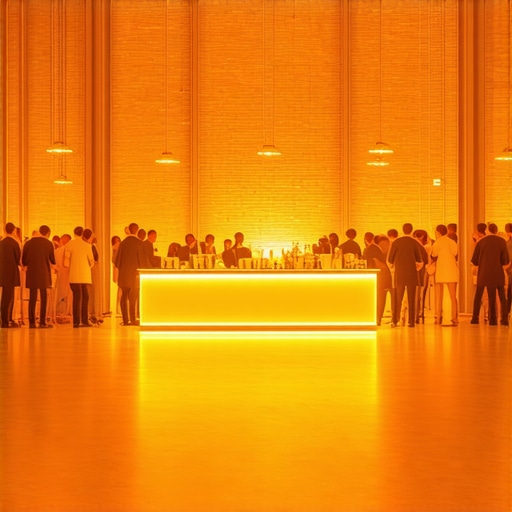
Kill the Yellow Glow and Use Visual Depth
Most hotel ballrooms have two settings: ‘Operating Room’ and ‘Late Night Dive Bar.’ To avoid this, you must learn how to light a hotel ballroom without that yellow glow. The trick is layers. You want ‘pools’ of light. Think of it like a forest—sunlight hits the clearings, but the shadows between the trees give the space depth. Use uplights against columns to define the perimeter, then use focused spotlights on the tables. This creates a rhythm that encourages guests to circulate rather than standing in one spot. I’ve seen top server tips to elevate your event experience fall flat because the staff was literally working in the dark, unable to make eye contact with guests because of poor lighting layers.
Turn Your Furniture Into Light Anchors
Your layout and lighting should work as a team. Pairing focused lighting with vertical elements works wonders for crowd control. This is why high-top tables are the secret to better networking flows; they act as physical pillars you can light from above or below. At a gala last year, we actually placed small battery-powered LEDs inside the floral arrangements on high-tops. It turned every table into a soft lantern. It didn’t just look pretty—it acted as a beacon for guests who were wandering, giving them a ‘safe harbor’ to land at and start a conversation. You are essentially building a map with photons. When your essential server skills are combined with a visible, well-lit service station, the entire energy of the room feels professional and controlled rather than chaotic. No one likes feeling lost in a crowd, and bright anchors give them the confidence to explore the entire footprint of your venue.Most people assume that if you have a high staff-to-guest ratio, the event will run perfectly. That’s a myth. I’ve seen 20-person dinners with three servers feel like a chaotic mess, while a 200-person gala with minimal staff ran like a Swiss watch. The secret isn’t just adding more bodies; it’s optimizing server efficiency to enhance event satisfaction. If your team doesn’t understand the choreography of the room, they become another physical obstacle for your guests to navigate, rather than a solution. Let’s dig deeper into the human element that most planners overlook.
Why Your Most Experienced Server Shouldn’t Be at Your Top Table
Here is where most planners get it wrong: they assign their most experienced person—the lead server—to the VIP table. It feels logical, right? Put your best person on the most important guests. But in my experience, why a lead server should never be assigned a single table is one of the most critical lessons in professional hospitality. When your lead is stuck pouring wine for the CEO, they aren’t noticing that the buffet line has stalled or that the trash cans in the lobby are overflowing. A true professional lead acts like a conductor, not a solo violinist. You need someone with a 30,000-foot view who can spot a bottleneck before it starts. 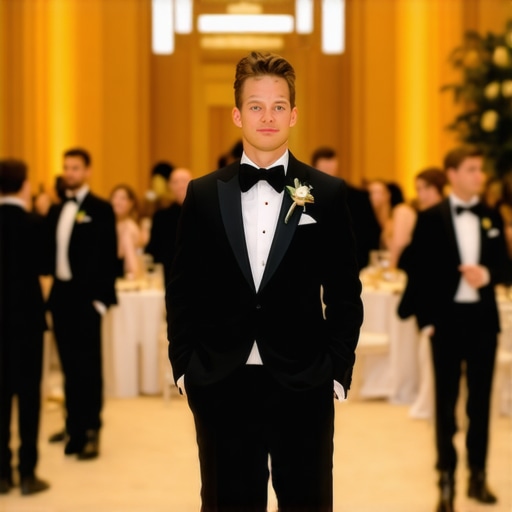
Don’t Treat the Kitchen and the Floor Like Different Countries
One major trap I see often is the ‘Kitchen Blindness’ error. Planners often treat the back-of-house and the front-of-house as two separate entities. But if your server lead needs a copy of the event script and doesn’t have it, the timing will inevitably collapse. A study on team coordination published in the Journal of Applied Psychology found that teams with a shared mental model—where everyone understands the sequence and ‘why’ behind the timing—outperform teams simply following orders by over 20%. If the kitchen is firing the main course while the CEO is halfway through a surprise 15-minute speech, the food will be cold, and the energy will die. This is why mastering corporate event planning secrets requires a bridge between the chef and the floor lead.
How Do You Spot a Service Breakdown Before It Happens?
You have to watch the ’empty space.’ If servers are huddled near the kitchen door or guests are looking around for a napkin, your flow is already broken. This is where essential server skills come into play. A pro doesn’t wait to be asked; they anticipate. I always tell my clients to audit your server to guest ratio for VIP dinners not just for speed, but for the invisible service that happens in the background. High-stakes events don’t just need food; they need a team that can read a room as well as they read a menu. Have you ever fallen into this trap where your best staff was ‘locked’ into one spot while the rest of the room suffered? Let me know in the comments.
I’ve spent thousands of hours on event floors, and I’ve learned that intuition only takes you so far before you hit a ceiling. If you want to scale from boutique dinners to massive galas without losing that personal touch, you need a toolkit that works as hard as your team does. I’m not talking about shiny gadgets for the sake of it; I’m talking about the gear that prevents the ‘silent failures’ most guests never see but always feel.
Get Your Team Off the Radio and Into Earpieces
One of the biggest distractors at a high-end event is the constant crackle-hiss of a loud walkie-talkie. It shatters the illusion of effortless service. I personally swear by discrete surveillance-style earpieces for my leads. Why? Because it allows for ‘invisible’ coordination. When the kitchen is three minutes out on the main course, the lead can whisper that to the floor team without a single guest noticing. This is how you execute expert server techniques that feel like magic. In fact, professional communication standards often cite the ‘Cocktail Party Effect’—the ability to focus on one voice in a noisy room—as a reason why high-fidelity earpieces are superior to open speakers. When you look for the best corporate event servers for 2025, check if they bring their own comms gear; it’s a massive tell for their level of professionalism.
Ditch the Paper Maps for Real-Time Logistics
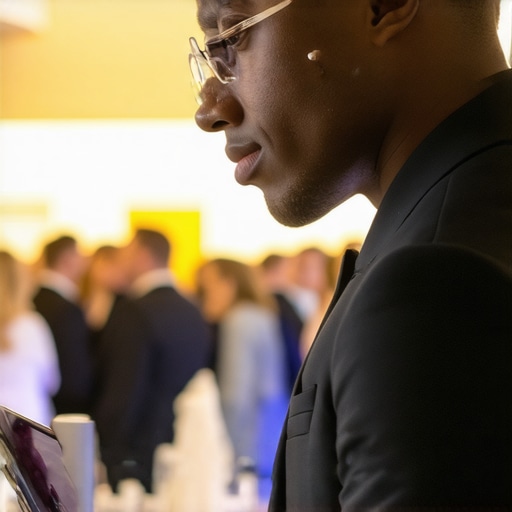
If you are still carrying around a physical clipboard with a static seating chart, you are living in the past. I use digital floor planning tools that sync in real-time across the lead server’s tablet and the kitchen’s monitor. If a guest at Table 12 has a last-minute shellfish allergy, I update it once, and everyone knows instantly. This level of detail is part of the essential checklist for successful corporate event catering. We also have to talk about safety standards. According to the NFPA 101 Life Safety Code, maintaining clear egress paths is non-negotiable, and a digital map allows you to simulate crowd flow before the first chair is even set. If you don’t account for this, your event venue selection might backfire when the fire marshal shows up to a room that’s visually stunning but dangerously cramped.
How do I maintain these high standards for every single event?
Maintenance is about the ‘Post-Game.’ Every single event we run ends with a 15-minute ‘Hot Wash’—a debrief where the team identifies one thing that went perfectly and one thing that almost broke. This is how you achieve server efficiency to enhance event satisfaction over the long haul. You aren’t just looking for mistakes; you are looking for patterns. If the coffee station always has a line, your gear or your placement is the problem, not your people. Looking ahead, I predict we’ll see more AI-driven ‘predictive’ staffing models, but for now, your best tool is a disciplined feedback loop. I want you to try this at your next event: give your server lead a copy of the event script and tell them they are authorized to make one ‘executive’ decision on the fly to save the flow. Empowering your team with the right tools and the right trust is the only way to win consistently.
How One Dark Corner Taught Me Everything About Crowd Psychology
Reflecting on years in the trenches, I’ve realized that the ‘perfect’ event is an illusion—it’s actually a series of pivots handled with grace. One thing experts won’t tell you is that your most expensive floral arrangement is worthless if it’s sitting in a shadow. I learned that movement is biological; if you don’t light the way, guests will naturally stagnate, causing the very congestion you’re trying to avoid. Another lightbulb moment was realizing that spotting a pro server happens in the first thirty seconds—it’s in how they scan the room, not just how they hold a tray. Finally, remember that silence on the radio is the ultimate sign of a team in sync.
The Gear That Saves My Sanity Every Time
I don’t walk into a venue without a few specific tools that bridge the gap between ‘okay’ and ‘outstanding.’ First, a high-quality surveillance earpiece is non-negotiable for discrete communication. Second, I always ensure my server lead has a detailed event script so they can anticipate transitions rather than reacting to them. Lastly, I rely heavily on digital floor planning software to simulate flow before the doors even open. These aren’t just gadgets; they are the foundation for elevating the guest experience from the moment they arrive.
Take the Leap into Seamless Event Mastery
Mastering the art of flow and light isn’t something that happens overnight, but every small adjustment you make creates a more comfortable environment for your guests. When you prioritize the ‘invisible’ details—like the brightness of a bar or the strategic placement of your staff—you create a space where networking happens effortlessly. The best corporate event servers for 2025 are the ones who understand this choreography of photons and people. Go out there and start experimenting with these layers; your guests will feel the difference even if they can’t quite put their finger on why the night felt so perfect. Have you ever noticed a specific spot in your venue where guests always seem to get stuck? Let me know your biggest bottleneck challenge in the comments!