

I stood at the back of the most beautiful wildflower meadow you’ve ever seen, watching my best friend pour her heart out in her vows, and all I could hear was a distant lawnmower and the rustle of my own silk dress. It was heartbreaking. I’m a guy who loves the great outdoors, but that day taught me a brutal lesson: nature is loud, and human voices are surprisingly quiet. I’d spent months helping her with innovative wedding themes, but we completely ignored the physics of sound. We assumed that because the guest list was small, the intimacy of the setting would carry the noise. We were wrong. It felt like watching a beautiful silent film when we really wanted the full cinematic experience.
Nature Won’t Lower Its Volume for Your Big Day
If you are planning an outdoor celebration, you are probably worried about rain or heat, but I’m here to tell you that the wind is your real enemy. Today, I’m going to walk you through exactly how to ensure every guest—from the front row to the very back—hears every single syllable of your ceremony. We are going to solve the silent movie effect that plagues so many garden and beach weddings. I made the mistake early in my career of thinking a natural vibe meant skipping the tech, but trust me, there is nothing natural about 100 people leaning forward in frustration because they can’t hear the officiant. Getting the audio right is just as crucial as planning the ultimate wedding reception meal because if they can’t hear the I dos, the rest of the party feels disconnected.
Do we really need bulky speakers in a beautiful garden?
I get the skepticism. You don’t want your aesthetic ruined by messy cables or huge black boxes. I used to think the same thing until I saw a professional setup that used wireless microphones for speeches that were practically invisible. The reality is that sound in an open field doesn’t behave like it does in a ballroom. Without walls to bounce off, sound waves just disappear. According to the Audio Engineering Society, sound pressure levels drop significantly as distance increases in an open-air environment, often losing 6 decibels for every doubling of distance. If you don’t fight back with the right gear, your ceremony is just a visual exercise. I once tried to save a client a few hundred dollars by using a consumer-grade Bluetooth speaker for an outdoor processional; the music sounded like it was coming from a tin can. It was a total disaster. Have you ever been to a wedding where you had to lip-read the couple because the wind was too high? We are going to make sure that never happens to you. To start, we need to look at how your venue selection impacts your AV budget from the very first site visit.
Stop Scattering Sound into the Atmosphere
When you are in a room, the walls are your best friends; they keep sound energy contained like water in a glass. Outside, that sound is like water thrown onto flat pavement—it just spreads out and disappears instantly. To fight this, you have to prioritize speaker height. If your speakers are sitting on the ground or a low table, the first two rows of guests act as acoustic sponges, soaking up all the sound energy before it ever reaches the middle of the crowd. You must get those speakers on stands, elevated at least six feet high, so the sound waves travel over the heads of the front row and reach the guests in the back. This is exactly where learning how to hide the djs messy cables with strategic floral arrangements becomes a lifesaver, because no one wants a heavy black tripod looming over their carefully curated garden aesthetic. 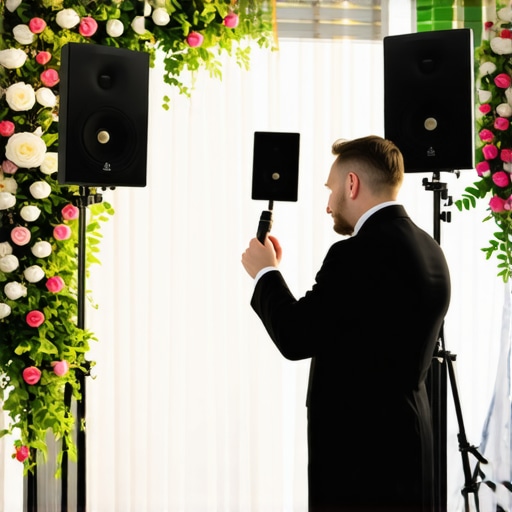
Elevate Your Gear Above the Crowd
I remember a cliffside ceremony in Big Sur where the wind was gusting so hard it was knocking over champagne flutes. We had the officiant and the groom mic’d up with high-quality wireless lavaliers. Because we had briefed the entire production team on how to reduce noise during the transition from dinner to dancing and ceremony segments, the audio tech knew exactly when to cut the gain on the ambient mics. The guests didn’t hear the roar of the Pacific Ocean because the sound was directional and crisp. If you see a professional audio tech putting a little furry cover over a microphone, don’t laugh—that ‘dead cat’ windscreen is the only thing standing between your vows and a deafening roar of wind distortion.
The Invisible Advantage of Wireless Lapel Mics
I once worked a wedding where the groom insisted on a handheld microphone because he wanted that ‘classic’ look. Every time he turned his head to look at his bride, his voice vanished into the breeze. Now, I always emphasize the advantage of using a wireless microphone for speeches and ceremonies. Specifically, you want high-frequency lavaliers clipped discreetly to a lapel or the inside of a dress. This keeps the source of the sound—the mouth—at a constant distance from the microphone, preventing those awkward volume drops that happen when emotions run high and people move around.
Coordinate Your Audio Tech with the Service Team
Coordination is the final piece of the puzzle that most couples skip. It isn’t just about the technology; it’s about the timing of the humans in the space. This is why your server lead needs a copy of the event script. If the catering team starts clearing glassware or moving heavy service trays during a silent prayer or the exchange of rings, that clatter will be magnified tenfold by the lack of ambient walls to dampen the noise. You need your audio tech, your wedding coordinator, and your catering captain in total sync. Furthermore, remember that your wedding film is only as good as its audio. I’ve seen $10,000 films ruined because the microphone only caught the whistling wind. Ensure your professional knows why your videographer needs a soundboard patch for the toasts and the ceremony. A direct line from the mixer to the camera ensures that even if a plane flies over the garden, the recording of your ‘I do’ remains pristine and intimate.
More Staff Doesn’t Always Mean Better Service
Most event planners will tell you that the secret to a luxury experience is a high staff-to-guest ratio. However, in my years on the ground, I’ve found that simply throwing more bodies at a banquet is a recipe for disaster. If you have too many people on the floor without a clear hierarchy, you end up with ‘ghost servers’—people who look busy but aren’t actually accomplishing anything. It’s far more effective to focus on optimizing server efficiency to enhance event satisfaction than to just hire a crowd. A study by the Cornell School of Hotel Administration confirms this, noting that service quality perception often plateaus or even declines once the staff-to-guest ratio exceeds a specific threshold, primarily due to communication breakdowns and physical crowding in the service lanes. You aren’t just buying labor; you are buying a coordinated performance. This is exactly why your server team needs a designated captain for every 50 guests to maintain that delicate flow.
The Chaos Trap of Unmanaged Server Teams
One of the most expensive mistakes I see is the ‘flat’ management structure where every server reports directly to the caterer. This creates a bottleneck where the person in charge is too busy answering small questions to see the big picture. I once saw a corporate gala fall apart because there was no middle management; the servers were wandering aimlessly while the main course sat under heat lamps. To avoid this, you need to know how to spot a professional server in an interview who understands chain of command. A high-end event requires people who can execute effective catering strategies for corporate event impressiveness without needing their hand held every five minutes. If you aren’t careful, you’ll end up with a team that looks the part but lacks the skill, which is why you must learn how to spot a fake luxury server team before they ruin your gala. 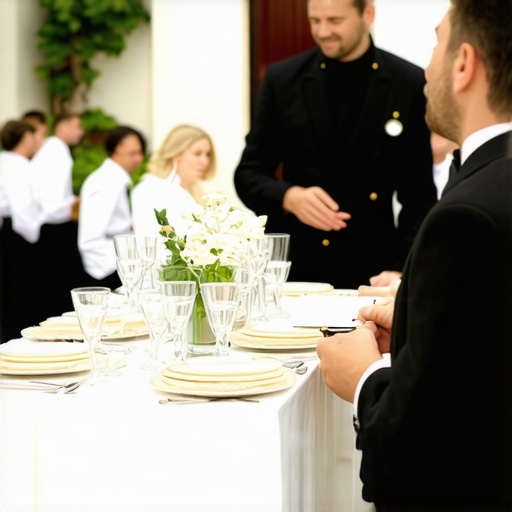
Does a 1:10 Staffing Ratio Actually Guarantee a VIP Experience?
The short answer is no. While a 1:10 or even 1:8 ratio is often touted as the ‘gold standard,’ it only works if the team is trained in specific movements. For example, the advantage of hiring servers who specialize in French service is that they understand how to navigate a tight room without disrupting the guest’s ‘audio’ or visual experience. If your team isn’t trained, they will inevitably cause a clatter that interrupts the very speeches you worked so hard to amplify. I always tell my clients that server skills that make every event stand out are often the ones the guests don’t see—like the ability to clear a table in total silence. Have you ever fallen into this trap where too many servers felt like they were just in the way? Let me know in the comments.
The Software I Use to Block Out Local Interference
I’ve learned the hard way that you can’t just turn on a wireless mic and hope for the best, especially in urban environments. To prevent those horrifying screeching sounds or sudden dropouts during the vows, I personally use Shure Wireless Workbench. This isn’t just some fancy app; it’s a coordination powerhouse that scans the local spectrum for digital television interference. According to Shure’s technical documentation, even a 5% shift in local humidity or a new cellular tower nearby can alter the effective range of your RF equipment. If you aren’t scanning your environment thirty minutes before the ceremony, you are gambling with your client’s most precious memories. I’ve seen a beautiful outdoor toast ruined because a local news station’s signal bled into the frequency. Using this tool allows me to lock in a ‘clean’ channel that stays stable regardless of how many guests are clogging the local Wi-Fi with their live streams.
How do I keep this level of precision for every event?
Maintaining this level of quality over a long season requires more than just good intentions; it requires a rigid maintenance schedule for your gear and your people. Every Monday after a wedding weekend, we don’t just collapse—we audit. We check every cable for frays, swap out every rechargeable battery, and most importantly, we debrief the staff. It’s about creating a culture where top server tips to elevate your event experience aren’t just suggestions but standard operating procedures. You have to treat your team like a high-performance engine that needs tuning. If you let things slide once, that becomes the new baseline, and before you know it, your ‘luxury’ service is looking pretty mediocre.
Briefings are the Secret Sauce for Large Scale Success
The biggest hurdle to a seamless evening is a lack of shared information. To combat this, I’ve moved away from paper-only schedules. While why your server lead needs a copy of the event script remains a fundamental truth, we now use digital briefing boards. This is how we learn how to brief your server team on complex dietary restrictions in minutes without causing a bottleneck in the kitchen. I can update a guest’s allergy info on my tablet, and it instantly syncs to the captain’s phone. This prevents that awkward ‘let me go check with the chef’ dance that slows down service.  Knowing how to organize a staff meeting before a 500 person dinner is the difference between a team that is reacting to chaos and a team that is anticipating needs. I always include an essential checklist for successful corporate event catering in every server’s digital packet so they can check off tasks like pre-pouring water or setting the bread service without needing a verbal prompt.
AI and the Future of the Silent Wedding
I predict that in the next five years, we will see real-time AI noise cancellation built directly into our mixing boards. We are already seeing the early stages of this with software that can isolate a human voice from the sound of a crashing ocean or a gust of wind. The ‘silent’ wedding trend will evolve, where guests can choose to hear the ceremony through high-fidelity, discreet earpieces, completely bypassing the acoustic limitations of the venue. This will allow for ceremonies in places we never thought possible—like right next to a waterfall or a busy city street. To start elevating your events today, I challenge you to do one thing: the next time you host, conduct a ‘silent walk-through’ of your service path. If you can hear the servers more than the music, your flow needs a fix.
The Nuances They Never Teach You in Event School
Over the years, I’ve realized that the difference between a good event and a legendary one isn’t just the budget—it’s the hyper-awareness of the environment. Here is what I’ve picked up through trial and error in the field:
- Sound is a physical guest. Treat your audio waves like people; if you crowd them or block them with low placements, they’ll stop moving. Always elevate your speakers to clear the heads of the crowd.
- The silence of a server is a skill. The best teams move like shadows. This is why I always look for server skills that make every event stand out, specifically their ability to communicate with hand signals rather than whispers during the vows.
- Redundancy is your best friend. If you have one mic, you have none. If you have two, you have one. Always have a wired backup tucked under the altar for those moments when the RF environment suddenly becomes hostile due to local interference.
- The Invisible Captain. For large groups, why your server team needs a designated captain for every 50 guests becomes apparent the moment a guest asks for something off-script. The captain handles it so the service flow remains unbroken.
#IMAGE_PLACE_HOLDER_E#
Gear and Standards That Keep My Events Frictionless
I don’t just rely on instinct; I rely on tools that have proven their worth in high-stakes environments. For audio coordination, Shure Wireless Workbench remains the gold standard for scanning local frequencies and avoiding catastrophic dropouts. When it comes to finding the right talent, I focus on how to choose the perfect servers for your wedding to ensure the team matches the specific aesthetic and technical demands of the day. Lastly, for logistics, I keep a digital copy of the essential checklist for successful corporate event catering synced across all lead staff devices to ensure no detail—from water temperatures to cable safety—is overlooked.
Your Journey Toward an Unforgettable Atmosphere
Planning a wedding or a gala is an act of storytelling. Every note heard and every plate served is a sentence in that story. By mastering the invisible elements—the sound frequencies and the server movements—you create a space where guests can truly lose themselves in the moment. Don’t be afraid to experiment with innovative wedding themes that challenge the norm, as long as you have the technical foundation to support them. You are building more than an event; you are building a memory that will last long after the last speaker is packed away. Unforgettable wedding catering ideas for a magical celebration start with a solid plan and end with a flawless execution. Have you ever attended an outdoor wedding where you couldn’t hear the couple’s vows? Let me know your biggest event pet peeves in the comments below!