

I’ll never forget the sound of three champagne flutes shattering against a marble floor just ten minutes into what was supposed to be the most prestigious gala of the season. I had hired a team that promised “unparalleled elegance,” but within an hour, it was clear they hadn’t even been taught the basics of tray service. One server actually asked a VIP guest to hold their own dirty appetizer napkin while they searched for a discarded tray. My face turned bright red, and I realized right then that a tuxedo is just a costume if the person wearing it hasn’t been properly trained. We’ve all been there—seduced by a glossy brochure only to find out the “staff” was hired off a generic gig app the night before. Today, I want to help you avoid that nightmare.
Why a Fancy Uniform Does Not Guarantee Five-Star Service
The reality is that “luxury” has become a buzzword used to justify high markups without the actual infrastructure to back it up. Early in my career, I made the amateur mistake of assuming that if a catering company charged a premium, they were automatically providing the best corporate event servers in the business. I didn’t dig deeper. I didn’t ask about their internal training protocols or check if they had a dedicated captain for every 50 guests. A true high-end team moves like a silent, well-oiled machine. They know that floor-length linens can be a safety hazard and know exactly how to navigate them with grace. They understand the nuance of French service techniques and won’t stand around looking confused during a complicated course transition. According to a report by the National Restaurant Association, the hospitality industry faces an annual turnover rate of over 70%, which means many so-called “luxury” agencies are constantly cycling through green staff who have never stepped foot in a formal gala environment.
Is a high price tag actually a guarantee of quality?
Price is often used as a smoke screen. I’ve seen budget-friendly teams outperform “prestige” agencies simply because they had better leadership. To ensure your event stays on track, you need to know how to spot a professional server during the vetting process, not when the first course is being served. Today, I’m going to show you the red flags I missed back then so you can protect your reputation and your guests’ experience. When you’re keeping your event schedule on track, the last thing you want to do is micromanage the people who are supposed to be the experts. Have you ever felt that sinking feeling in your stomach when you realized your event staff was in over their heads? It’s a common hurdle, but one we can definitely clear together.
Stop Leaving Service Quality to Chance
Think of your server team as a pit crew at the Daytona 500. If the guy changing the left rear tire doesn’t know the car is coming in for a 12-second stop, the whole race is lost. In the catering world, that “stop” is the first 20 minutes of your event. I’ve learned that top server tips to elevate your event experience aren’t just about how to hold a bottle of wine; they are about communication. During a high-stakes board dinner last fall, I pulled the lead server aside and asked him to describe the reduction on the sea bass. He blanked. I realized the agency hadn’t shared the menu cards I’d sent weeks in advance. We had to pause everything for an emergency drill in the kitchen. To avoid this, you must learn how to organize a staff meeting before a 500-person dinner. This 15-minute huddle is where you identify how to spot a server who hasn’t been briefed on the menu before they ever reach a guest’s table.
Why Your Lead Server Needs the Full Script
A server who only knows when to serve the salad is a liability. They need to know when the speeches start, when the lights dim, and when the keynote speaker is likely to walk off stage. This is why your server lead needs a copy of the event script. If they aren’t synced with the AV team, you’ll have the sound of clinking silverware during the most emotional part of a wedding toast or a CEO’s vision statement. 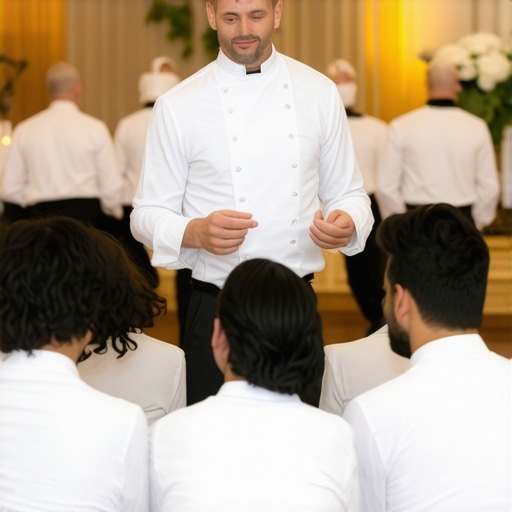
The Math Behind Flawless VIP Service
Most people think hiring more people is the solution to slow service. It’s not. It’s about the hierarchy. You should know how to choose the right staffing ratio for a VIP event, but more importantly, you need a chain of command. I always insist that your server team needs a designated captain for every 50 guests. This person doesn’t carry trays; they monitor the room like a hawk, watching for empty water glasses and guests who look like they’re searching for a restroom. They are the ones who ensure pre-pouring water is the secret to a fast service start. By the time the first guest sits down, the room should already feel “alive” and ready, not like a construction site in progress. If you wait until the guests are seated to begin the water service, you’re already ten minutes behind schedule, and in the world of high-end events, ten minutes is an eternity. This level of optimizing server efficiency to enhance event satisfaction is what separates a chaotic banquet from a curated experience.
Why Too Many Menu Options Ruin Your Event Flow
Most planners think offering a massive variety at a buffet is the ultimate sign of hospitality. In reality, it’s a recipe for a logistical bottleneck. I’ve watched 500-person galas grind to a halt because guests were paralyzed by sixteen different side dish choices. This is a classic case of the ‘paradox of choice’—too many options lead to slower decision-making and longer lines. In my experience, why most buffets waste 30 percent of the food produced often comes down to this lack of focus. Instead of a sprawling spread, I now advocate for a curated approach. You can still provide variety by understanding how to design a menu that works for both keto and vegan guests without doubling the footprint of your service station. According to a study by the Cornell University School of Hotel Administration, excessive menu complexity in high-volume settings can increase guest transaction time by over 20%, which is the difference between a smooth evening and a frustrated crowd. I often suggest the benefit of using a plated dessert over a cake table to keep people in their seats and maintain the momentum of the program.
Don’t Let Table Hopping Delay Your Main Course
One of the most frequent ‘oops’ moments I see at weddings and corporate galas is the loss of control during the transition from cocktails to dinner. Guests love to mingle, but if you don’t have a strategy for how to prevent table hopping from delaying the main course, your expensive filets will be sitting in a warming drawer turning into leather. I’ve seen beautiful events ruined because the host didn’t realize the secret to keeping fish from drying out in a warming drawer only buys you about fifteen minutes of grace. To avoid this, you need to master the best way to transition guests from cocktail hour to dinner, which usually involves a strategic ‘light cue’ or a specific musical shift.
Can you actually serve a 400-person plated dinner in a tent without it being a disaster?
Serving a high-end meal in a remote field or a temporary structure is the ultimate test of a catering team. The biggest mistake is assuming your kitchen staff can work with the same efficiency they would in a ballroom. You have to account for the logistics of a 400-person plated dinner in a tent, which includes everything from power draws for ovens to ensuring your wedding venue needs a temperature-controlled prep space. If the kitchen is 100 yards away from the furthest table, that plate will be cold by the time it lands. This is where optimizing server efficiency to enhance event satisfaction becomes a game of inches and seconds. Have you ever fallen into the trap of choosing style over logistics and regretted it mid-event? Let me know in the comments.It’s one thing to survive a single gala, but it’s another to deliver excellence consistently across a hundred-event season. I’ve found that the secret isn’t just in the talent; it’s in the infrastructure. I rely heavily on digital floor planning software because it allows me to visualize every pinch point before a single plate leaves the kitchen. I’ve learned the hard way that why your ballroom floor plan needs a three foot safety buffer is more than a suggestion; it’s the difference between a server safely passing a tray and a guest having a glass of red wine in their lap. I also swear by the ‘Captain’s Audit’ method. Every forty-five minutes, my lead captain must walk the perimeter. This proactive approach ensures that why every event needs a designated clean up crew isn’t just a thought we have at midnight when the lights come up.
How do I maintain elite service standards as my business grows?
Sustainability in high-end catering comes down to two things: checklists and morale. Using an essential checklist for successful corporate event catering for every load-in removes the ‘human error’ element that plagues so many agencies. But you can’t just treat people like robots. A 2023 study by the Cornell Dyson School of Applied Economics and Management highlights that staff burnout in seasonal hospitality drops by 22% when consistent operational ‘rituals’—like the pre-shift huddle—are strictly enforced regardless of event size. I’ve personally seen that why your event staff should have a dedicated break room is often the most overlooked factor in maintaining a happy, professional team. If your servers are forced to eat their dinner standing up next to a dumpster, they won’t treat your guests like royalty.
The Tools That Turned My Chaos Into Order
Beyond software, the physical tools matter just as much. I never enter an event without a set of high-lumen, wireless magnetic LEDs for the buffet. Poor lighting can make even the most expensive salmon look unappetizing. I also empower my staff with top server tips to elevate your event experience, such as the ‘silent sweep’—a technique where they scan for discarded cocktail napkins without interrupting guest conversations. Looking ahead, I predict that by 2027, we’ll see real-time ‘heat mapping’ in ballrooms, where server leads can see on their tablets exactly where guest water glasses are empty based on weight-sensitive table sensors. For now, the best tool is still a well-trained eye. My challenge for you: On your next event, implement a ‘silent sweep’ protocol where every thirty minutes, a server walks the room specifically looking for trash rather than waiting for a guest to ask. You’ll be amazed at how much more ‘luxury’ the room feels when it stays pristine.
Hard Truths About Why Elite Service Actually Fails
After years in the trenches, I’ve realized that the most expensive uniform in the world can’t hide a lack of preparation. Here are the lightbulb moments that changed how I manage my teams: First, your servers are your early warning system; if they aren’t trained in server skills that make every event stand out, they won’t notice the guest who is quietly unhappy until it’s too late. Second, the ‘silent service’ is a disappearing art—true luxury means never having to ask for a refill. Finally, I’ve learned that a team’s energy is contagious; if the staff feels respected, the guests feel cherished.
The Survival Kit I Never Leave at Home
To keep my sanity and my standards high, I rely on a few specific resources. I always keep effective catering strategies for corporate event impressiveness at the forefront of my planning phase. I also swear by high-lumen magnetic LEDs to fix poor buffet lighting on the fly. For industry insights, I regularly dive into the Cornell University hospitality reports, which offer data-backed ways to reduce staff burnout during the peak season. These tools turn ‘hoping for the best’ into a repeatable system for success.
Craft Your Own Legacy of Excellence
Transforming a chaotic banquet into a seamless masterpiece doesn’t happen by accident, but it is entirely within your reach. When you focus on the human elements—the training, the communication, and the care for your team—the logistics naturally fall into place. Every event is a new opportunity to provide unforgettable wedding catering ideas for a magical celebration or a flawless corporate dinner. Go out there and create something your guests will talk about for years. What’s the biggest catering ‘disaster’ you’ve ever turned around with a great team? Let me know below!