

I stood there, staring at forty empty chairs while the band played to a room that felt half-empty. It was my sister’s wedding, and I had personally vetted the RSVP list. Everyone said they were coming. Yet, there I was, watching the servers whisk away perfectly good plates of food that no one was there to eat. It felt like a punch to the gut. If you have ever planned a corporate gala or a wedding reception, you know that hollow feeling in your stomach when the final count meets reality. The truth is, that 20 percent drop isn’t an accident. It is a statistical certainty.
The Ghost Guest Phenomenon is Real
Early in my career, I made the amateur mistake of taking RSVPs at face value. I thought if someone checked yes on a fancy card, they would show up. I was wrong. Life happens. According to industry data from event management platforms like Cvent, the average no-show rate for professional events typically hovers between 10 and 25 percent. It is not just about rude guests; it is about mastering corporate event planning secrets and recognizing that human nature is fundamentally unpredictable. Today, I am going to walk you through exactly why this happens and how you can protect your sanity and your wallet.
Can You Actually Predict Human Behavior?
You might be thinking that your family is different or that your corporate guests are more disciplined. Trust me, I have heard it all. Even when you are planning the ultimate wedding reception meal, people get flat tires, kids get sick, or social anxiety kicks in at the eleventh hour. Have you ever stared at a seating chart an hour before the doors open and realized you are paying for ghosts? I want to hear your stories—have you ever been burned by a massive no-show rate?
Why Your Budget Takes the Hardest Hit
The problem isn’t just the empty seats; it is the wasted resources. When I failed to account for the inevitable drop, I didn’t just lose money on steak and salmon; I overstaffed the entire room. You need to understand the math behind hiring extra servers versus scaling back based on realistic expectations. Every empty chair represents a portion of why your wedding budget needs a 10 percent emergency fund that just evaporated. We need to stop planning for the perfect scenario and start planning for the human one.
Cut Your Guarantees with the 15 Percent Rule
Stop treating your RSVP list as a holy text. It is a living document that almost always shrinks. When the caterer asks for your final guarantee 72 hours before the event, do not give them the full count of people who said ‘Yes.’ Instead, apply a calculated hedge. For corporate events, I typically provide a guarantee that is 10 to 15 percent lower than the RSVP total. Most venues can actually produce up to 5 percent over the guarantee on the fly if needed, so you are rarely at risk of running out of food. By doing this, you avoid paying for meals that will never leave the kitchen. I once managed a 500-person gala in downtown Chicago during a surprise blizzard; we had 120 ‘ghosts.’ Because I had already shaved 15 percent off the guarantee, I saved the client nearly $9,000 in food waste and overages. You need to implement the secret to getting corporate guests to actually RSVP on time to get a cleaner starting number, but always remember that the ‘guarantee’ is your strongest financial lever.
Deploy a Tiered Staffing Strategy
Your staffing needs to be as flexible as your menu. Instead of hiring a flat number of servers, organize your team into ‘Core’ and ‘On-Call’ units. This is where why your server team needs a designated captain for every 50 guests becomes a logistical lifesaver. If the guest count drops significantly, your captains can quickly pivot their teams to handle more complex tasks, like wine service or clearing, rather than standing around empty tables. Think of your server team like a military squad; they need a clear chain of command to adapt when the ‘enemy’ (the no-show rate) changes the plan.
How to Hide the Empty Space Without Looking Desperate
Nothing kills the energy of a room faster than a ‘gap-toothed’ seating arrangement where every other chair is empty. If you see a high no-show rate during the first thirty minutes of cocktail hour, you must act fast. I keep a ‘ghost crew’ of two servers specifically to remove empty chairs and place settings from tables before dinner is announced. By pulling the unused chairs and slightly widening the remaining settings, you turn a half-empty table into a spacious, luxury experience. This is the trick to making a 200 person wedding feel like an intimate dinner rather than a failed party. 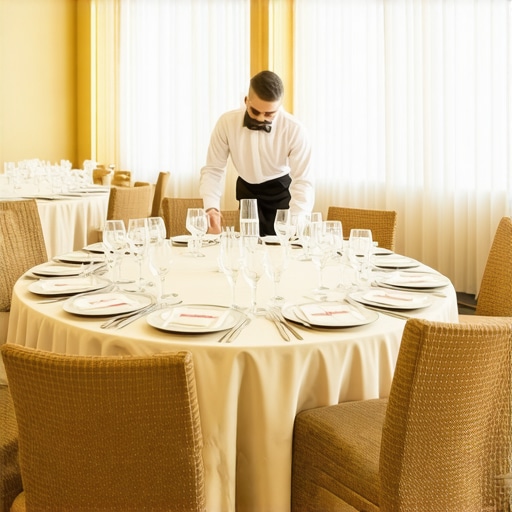
Manage the Late Arrival Chaos
Even when people don’t show, some will show up forty minutes late and expect a full service. You need a specific protocol for this. I always instruct the team on the best strategy for seating late arrivals at a wedding ceremony and reception so they don’t interrupt the flow of the main course. Designate one corner table near the kitchen as the ‘swing table’ for latecomers. It allows the kitchen to serve them quickly without the servers having to run across a crowded, dark room and trip over guests who are already halfway through their salads.
Brief Your Team on the Fly
When the count changes, your dietary restriction list usually changes with it. You don’t have time for a long meeting once the doors are open. You must know how to brief your server team on complex dietary restrictions in minutes. At that Chicago gala, we realized half of our vegan requests hadn’t shown up. By communicating this to the kitchen immediately, we were able to trade those specialized meals for extra portions of the main protein for guests who wanted seconds. It is about resource reallocation, not just loss mitigation.Most planners think the key to a smooth event is the ‘human-to-guest’ ratio. They believe if they have one server for every ten guests, they have bought insurance against disaster. In reality, throwing more bodies at a poorly managed floor is the fastest way to create a logistical bottleneck. I have seen ballrooms where servers literally bump into each other like a slow-motion car crash because no one defined their zones. You do not need a crowd; you need to focus on optimizing server efficiency to enhance event satisfaction through surgical precision.
Why does the standard 1:10 server ratio often fail in practice?
The issue is that labor productivity is not linear. A study published in the Cornell Hospitality Quarterly highlights that in high-volume banquet settings, adding more labor without a strict hierarchy actually leads to an increase in service errors and a decrease in guest satisfaction. When everyone is responsible for everything, no one is responsible for the ‘dead zones’ at the back of the room. This is why your server team needs a clear chain of command on-site. Without a captain who knows exactly who is holding a wine bottle and who is watching the vegan tray, the 1:10 ratio is just an expensive way to look busy.
Watch out for the silent clearing trap
One of the biggest mistakes I see at high-end galas is the ‘eager clearing’ phenomenon. Servers are often trained to clear plates the second a fork touches the ceramic. It looks efficient, but it is actually incredibly disruptive to a keynote speech or a toast. It creates a ‘clink and clatter’ white noise that ruins the atmosphere. You have to learn how to prevent plate stacking at high-end charity auctions to keep the room focus on the stage, not the kitchen.
The danger of hiring warm bodies
Many catering companies will supplement their core team with ‘day-of’ hires. It is a common industry practice, but it is a trap for you as the host. You need to know the hidden risks of hiring student servers for high-end events compared to seasoned professionals. A student might be polite, but they will not know how to spot a server who hasn’t been briefed on the menu before the first course hits the table. High-level service is an instinctual dance, not a checklist. It requires specific server skills that make every event stand out, such as anticipating a guest’s need for a refill before they even look for the waiter. Have you ever fallen into this trap of prioritizing quantity over quality in your staffing? Let me know in the comments.
I have traded my old-school paper clipboards for a high-definition tablet long ago because precision is the only way to survive a 500-person gala. To keep the machine running, I rely heavily on 3D floor-planning software like Allseated. It allows me to simulate guest flow before a single fork is placed. If you are serious about the ultimate guide to corporate event catering logistics, you need to see your floor plan in three dimensions to identify the ‘collision zones’ where servers and guests will naturally bottleneck. I also insist on using sub-audible radio headsets for my captains. In a luxury environment, shouting or frantic hand signals are unacceptable; the goal is for the service to feel like it is happening by magic, driven by top server tips to elevate your event experience through silent, synchronized coordination.
How do I maintain peak service standards over a five-hour event?
The secret is ‘The Second Wind’ briefing. Two hours into any event, the initial adrenaline wears off and mistakes start to creep in. I pull my lead captains aside for a ninety-second huddle to recalibrate. We check the the math behind hiring extra servers against the actual bodies in the room and pivot resources toward the bar or the coffee stations as the energy shifts. According to the National Association of Catering and Events (NACE), the ‘service fatigue’ window is the primary cause of dropped glassware and forgotten dietary requests. By staying ahead of this curve and optimizing server efficiency to enhance event satisfaction, we ensure the last guest receives the same level of care as the first.
Looking ahead, I predict that ‘Smart Plates’ equipped with low-cost RFID tags will soon be the standard for high-end galas. Imagine a kitchen monitor that lights up red when a guest with a severe nut allergy hasn’t been served their specific meal yet. This level of technical oversight is where the industry is heading to ensure effective catering strategies for corporate event impressiveness. For now, you should focus on the human element by implementing a ‘lead-follow’ system where one senior server directs the movements of three juniors. This creates a scalable model that works whether you are hosting fifty people or five hundred. I challenge you to try the ’15 percent shave’ on your next guest guarantee; the money you save on those ‘ghost meals’ can be reinvested into a higher quality of service that your guests will actually notice. To get started on planning your next high-precision event, feel free to contact us today.
I stood there, staring at forty empty chairs while the band played to a room that felt half-empty. It was my sister’s wedding, and I had personally vetted the RSVP list. Everyone said they were coming. Yet, there I was, watching the servers whisk away perfectly good plates of food that no one was there to eat. It felt like a punch to the gut. If you have ever planned a corporate gala or a wedding reception, you know that hollow feeling in your stomach when the final count meets reality. The truth is, that 20 percent drop isn’t an accident. It is a statistical certainty.
The Ghost Guest Phenomenon is Real
Early in my career, I made the amateur mistake of taking RSVPs at face value. I thought if someone checked yes on a fancy card, they would show up. I was wrong. Life happens. According to industry data from event management platforms like Cvent, the average no-show rate for professional events typically hovers between 10 and 25 percent. It is not just about rude guests; it is about mastering corporate event planning secrets and recognizing that human nature is fundamentally unpredictable. Today, I am going to walk you through exactly why this happens and how you can protect your sanity and your wallet.
Can You Actually Predict Human Behavior?
You might be thinking that your family is different or that your corporate guests are more disciplined. Trust me, I have heard it all. Even when you are planning the ultimate wedding reception meal, people get flat tires, kids get sick, or social anxiety kicks in at the eleventh hour. Have you ever stared at a seating chart an hour before the doors open and realized you are paying for ghosts? I want to hear your stories—have you ever been burned by a massive no-show rate?
Why Your Budget Takes the Hardest Hit
The problem isn’t just the empty seats; it is the wasted resources. When I failed to account for the inevitable drop, I didn’t just lose money on steak and salmon; I overstaffed the entire room. You need to understand the math behind hiring extra servers versus scaling back based on realistic expectations. Every empty chair represents a portion of why your wedding budget needs a 10 percent emergency fund that just evaporated. We need to stop planning for the perfect scenario and start planning for the human one.
Cut Your Guarantees with the 15 Percent Rule
Stop treating your RSVP list as a holy text. It is a living document that almost always shrinks. When the caterer asks for your final guarantee 72 hours before the event, do not give them the full count of people who said ‘Yes.’ Instead, apply a calculated hedge. For corporate events, I typically provide a guarantee that is 10 to 15 percent lower than the RSVP total. Most venues can actually produce up to 5 percent over the guarantee on the fly if needed, so you are rarely at risk of running out of food. By doing this, you avoid paying for meals that will never leave the kitchen. I once managed a 500-person gala in downtown Chicago during a surprise blizzard; we had 120 ‘ghosts.’ Because I had already shaved 15 percent off the guarantee, I saved the client nearly $9,000 in food waste and overages. You need to implement the secret to getting corporate guests to actually RSVP on time to get a cleaner starting number, but always remember that the ‘guarantee’ is your strongest financial lever.
Deploy a Tiered Staffing Strategy
Your staffing needs to be as flexible as your menu. Instead of hiring a flat number of servers, organize your team into ‘Core’ and ‘On-Call’ units. This is where why your server team needs a designated captain for every 50 guests becomes a logistical lifesaver. If the guest count drops significantly, your captains can quickly pivot their teams to handle more complex tasks, like wine service or clearing, rather than standing around empty tables. Think of your server team like a military squad; they need a clear chain of command to adapt when the ‘enemy’ (the no-show rate) changes the plan.
How to Hide the Empty Space Without Looking Desperate
Nothing kills the energy of a room faster than a ‘gap-toothed’ seating arrangement where every other chair is empty. If you see a high no-show rate during the first thirty minutes of cocktail hour, you must act fast. I keep a ‘ghost crew’ of two servers specifically to remove empty chairs and place settings from tables before dinner is announced. By pulling the unused chairs and slightly widening the remaining settings, you turn a half-empty table into a spacious, luxury experience. This is the trick to making a 200 person wedding feel like an intimate dinner rather than a failed party. #IMAGE_PLACE_HOLDER_B#
Manage the Late Arrival Chaos
Even when people don’t show, some will show up forty minutes late and expect a full service. You need a specific protocol for this. I always instruct the team on the best strategy for seating late arrivals at a wedding ceremony and reception so they don’t interrupt the flow of the main course. Designate one corner table near the kitchen as the ‘swing table’ for latecomers. It allows the kitchen to serve them quickly without the servers having to run across a crowded, dark room and trip over guests who are already halfway through their salads.
Brief Your Team on the Fly
When the count changes, your dietary restriction list usually changes with it. You don’t have time for a long meeting once the doors are open. You must know how to brief your server team on complex dietary restrictions in minutes. At that Chicago gala, we realized half of our vegan requests hadn’t shown up. By communicating this to the kitchen immediately, we were able to trade those specialized meals for extra portions of the main protein for guests who wanted seconds. It is about resource reallocation, not just loss mitigation.Most planners think the key to a smooth event is the ‘human-to-guest’ ratio. They believe if they have one server for every ten guests, they have bought insurance against disaster. In reality, throwing more bodies at a poorly managed floor is the fastest way to create a logistical bottleneck. I have seen ballrooms where servers literally bump into each other like a slow-motion car crash because no one defined their zones. You do not need a crowd; you need to focus on optimizing server efficiency to enhance event satisfaction through surgical precision.
Why does the standard 1:10 server ratio often fail in practice?
The issue is that labor productivity is not linear. A study published in the Cornell Hospitality Quarterly highlights that in high-volume banquet settings, adding more labor without a strict hierarchy actually leads to an increase in service errors and a decrease in guest satisfaction. When everyone is responsible for everything, no one is responsible for the ‘dead zones’ at the back of the room. This is why your server team needs a clear chain of command on-site. Without a captain who knows exactly who is holding a wine bottle and who is watching the vegan tray, the 1:10 ratio is just an expensive way to look busy.
Watch out for the silent clearing trap
One of the biggest mistakes I see at high-end galas is the ‘eager clearing’ phenomenon. Servers are often trained to clear plates the second a fork touches the ceramic. It looks efficient, but it is actually incredibly disruptive to a keynote speech or a toast. It creates a ‘clink and clatter’ white noise that ruins the atmosphere. You have to learn how to prevent plate stacking at high-end charity auctions to keep the room focus on the stage, not the kitchen. #IMAGE_PLACE_HOLDER_C#
The danger of hiring warm bodies
Many catering companies will supplement their core team with ‘day-of’ hires. It is a common industry practice, but it is a trap for you as the host. You need to know the hidden risks of hiring student servers for high-end events compared to seasoned professionals. A student might be polite, but they will not know how to spot a server who hasn’t been briefed on the menu before the first course hits the table. High-level service is an instinctual dance, not a checklist. It requires specific server skills that make every event stand out, such as anticipating a guest’s need for a refill before they even look for the waiter. Have you ever fallen into this trap of prioritizing quantity over quality in your staffing? Let me know in the comments.
I have traded my old-school paper clipboards for a high-definition tablet long ago because precision is the only way to survive a 500-person gala. To keep the machine running, I rely heavily on 3D floor-planning software like Allseated. It allows me to simulate guest flow before a single fork is placed. If you are serious about the ultimate guide to corporate event catering logistics, you need to see your floor plan in three dimensions to identify the ‘collision zones’ where servers and guests will naturally bottleneck. I also insist on using sub-audible radio headsets for my captains. In a luxury environment, shouting or frantic hand signals are unacceptable; the goal is for the service to feel like it is happening by magic, driven by top server tips to elevate your event experience through silent, synchronized coordination.
How do I maintain peak service standards over a five-hour event?
The secret is ‘The Second Wind’ briefing. Two hours into any event, the initial adrenaline wears off and mistakes start to creep in. I pull my lead captains aside for a ninety-second huddle to recalibrate. We check the the math behind hiring extra servers against the actual bodies in the room and pivot resources toward the bar or the coffee stations as the energy shifts. According to the National Association of Catering and Events (NACE), the ‘service fatigue’ window is the primary cause of dropped glassware and forgotten dietary requests. By staying ahead of this curve and optimizing server efficiency to enhance event satisfaction, we ensure the last guest receives the same level of care as the first.
#IMAGE_PLACE_HOLDER_D#
Looking ahead, I predict that ‘Smart Plates’ equipped with low-cost RFID tags will soon be the standard for high-end galas. Imagine a kitchen monitor that lights up red when a guest with a severe nut allergy hasn’t been served their specific meal yet. This level of technical oversight is where the industry is heading to ensure effective catering strategies for corporate event impressiveness. For now, you should focus on the human element by implementing a ‘lead-follow’ system where one senior server directs the movements of three juniors. This creates a scalable model that works whether you are hosting fifty people or five hundred. I challenge you to try the ’15 percent shave’ on your next guest guarantee; the money you save on those ‘ghost meals’ can be reinvested into a higher quality of service that your guests will actually notice. To get started on planning your next high-precision event, feel free to contact us today.
What I Learned When 40 Empty Chairs Taught Me More Than Any Textbook
I realized that a ‘yes’ on a card is often a wish rather than a promise. The most successful planners are those who embrace the data over the emotion. I eventually stopped feeling insulted by the no-show rate and started treating it as a standard variable to be managed. This shift allowed me to focus my energy on the guests who did show up, ensuring they had an incredible experience without the visual clutter of unused place settings. Another hard-won truth is that over-communication with your vendor team is your only shield. Whether you are utilizing wedding catering tips from industry experts or managing a high-stakes board dinner, your team needs to know the contingency plan for the ‘ghosts’ before the first tray leaves the kitchen.
The Essential Toolkit That Keeps My Logistics From Crashing
I never walk into a ballroom without Allseated loaded on my tablet; seeing the spatial reality of the room prevents the bottlenecks that ruin high-end service. For deeper insights into the psychology of hospitality management, I constantly revisit Cornell’s hospitality research archives and NACE safety guidelines. To keep my teams sharp, I use a rigorous pre-shift briefing template that covers everything from complex dietary nuances to top server tips to elevate your event experience. These resources are my foundation because they rely on tested metrics rather than guesswork.
Stop Planning for Perfection and Start Planning for Reality
At the end of the day, your event isn’t defined by the people who didn’t show up—it’s defined by the warmth and precision felt by those in the room. By implementing effective catering strategies for corporate event impressiveness and learning how to choose the perfect servers for your wedding, you are building a resilient experience. Take the 15 percent shave on your guarantee, trust your core captains, and watch how much more fluid your celebration becomes when the math finally matches the reality. Have you ever had a massive no-show rate that threw your budget for a loop, and how did you pivot on the fly? Let me know in the comments below!