

The sun was relentless. I stood there, clutching a lukewarm glass of Chardonnay, watching my biggest client’s expensive silk tie slowly soak through with sweat. We were on the 42nd floor of a gorgeous glass tower, the skyline was breathtaking, and yet, everyone was miserable. I’d made the classic rookie mistake: I fell in love with the view and forgot to ask about the ventilation. That afternoon was a masterclass in embarrassment. The wind picked up, sent three napkins into the street below, and blew over a flimsy floral arrangement. I realized then that a rooftop isn’t just a venue; it’s an ecosystem. If you don’t master the environment, the environment will master you. Today, I’m helping you avoid that “sweaty tie” moment. We’re going to break down the five non-negotiable questions you need to grill a venue manager about before you sign that deposit check. Whether you’re mastering corporate event planning secrets to seamless success or just trying to pull off a one-off mixer, these details are your lifeline.
Stop Chasing the Skyline and Start Looking at the Floor Plan
Most people walk onto a terrace, see the city lights, and stop thinking. Don’t be that person. I once forgot to check the freight elevator speed, and my catering team spent two hours just getting the hors d’oeuvres to the roof. Talk about a disaster. When you’re looking at a space, you need to think about the flow. For instance, the logic of placing the bar away from the entrance is even more critical on a rooftop where space is often narrow. If the bar is at the door, you get a bottleneck that blocks the very view you paid for.
Does the “Wow Factor” justify the logistical headache?
It’s a fair question. You’re likely paying a premium just for the altitude. Is it worth it? Usually, yes—if you’ve planned for the variables. But you have to be realistic about the tech. You need to vet a venue for corporate wifi stability and speed before you promise a live-streamed keynote from the edge of the building. Wind interference is real, and the sun can wash out even the most expensive LED screens. According to research published in the International Journal of Environmental Research and Public Health, thermal discomfort can reduce social interaction by up to 50% in outdoor urban settings. If your guests are too hot or too cold, they won’t network; they’ll leave. Have you ever booked a space that looked perfect on paper but turned into a logistical nightmare once the sun came up? I’d love to hear your stories in the comments. Before we dive into the specific questions, make sure you have your essential checklist for successful corporate event catering ready, because food service at 500 feet is a whole different ballgame.
Own the Logistics Before the Logistics Own You
Think of a rooftop event like a space mission: once the countdown starts, you can’t just run back to the warehouse for a forgotten tray of glassware. Every single item must be accounted for and moved through a vertical pipeline that is usually half as wide and twice as slow as you need it to be. I learned this the hard way during a gala in Chicago; the wind was so intense that our custom-printed menus became paper airplanes, soaring over the edge before the first toast was even made. We ended up having to duct-tape the floral bases to the marble tables just to keep the centerpieces from becoming projectiles. If you are not over-preparing, you are under-performing. Start by mapping out the ultimate guide to corporate event catering logistics specifically for vertical transport. You need to know the dimensions of the service elevator down to the inch, because a three-tiered cake doesn’t care about your ‘rough estimates.’
Stop Thinking Like a Ground-Level Planner
On the ground, you have the luxury of space; on a roof, you have the constraint of height. This changes how you staff your team. You aren’t just looking for servers; you are looking for a precision-drill team. I recommend optimizing server efficiency to enhance event satisfaction by creating ‘zones’ that minimize the need for staff to cross the floor or return to the service area. If your kitchen is on the 40th floor and the party is on the 42nd, every trip to the walk-in is a five-minute loss. Use satellite prep stations and insulated hot boxes to keep the food at temperature without relying on the elevator. 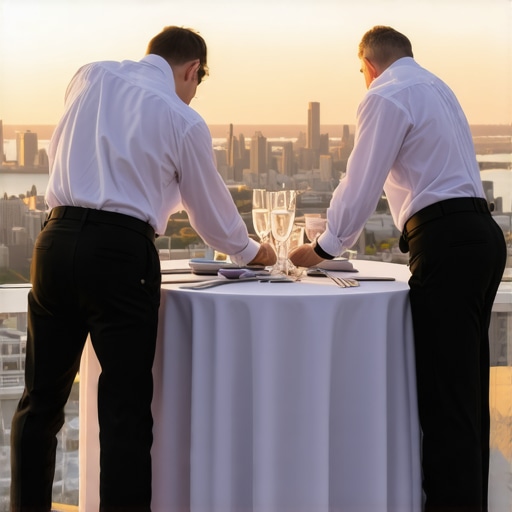
Keep Your Linens from Taking Flight
Wind is the silent killer of rooftop elegance. I’ve seen $500 silk overlays whipped off a table like a cheap magic trick. The solution isn’t just heavier plates; it’s a total shift in décor strategy. Use ‘spandex’ style linens that hug the table legs or heavy-duty magnets hidden in the hem of the fabric. Also, remember that rooftops are basically giant magnets for local fauna. You must implement a why your outdoor wedding needs a bug mitigation strategy even if you think you’re too high for mosquitoes. Rising heat thermals can carry pests higher than you’d expect, and there’s nothing ‘luxury’ about a fly in the Chardonnay.
Staff for the Stairwell and the Sky
When you’re high up, your team is your lifeline. Don’t just hire a generic crew; look for those with experience in high-volume, restricted-access environments. You’ll want to review top server tips to elevate your event experience to ensure your staff knows how to maintain poise when the wind is gusting at 25 mph. Successful execution relies on corporate event catering strategies for success that prioritize communication. Give every lead server a radio. If the elevator breaks—and in my experience, it often does—you need a ‘Plan B’ for the stairs that doesn’t result in a cold meal or an exhausted crew. It’s about building a fortress of preparation around a very fragile, very beautiful environment.Everyone tells you to just ‘increase the headcount’ when service gets slow. In my experience, throwing more bodies at a disorganized floor is like adding more cars to a traffic jam. The real secret to a high-end experience isn’t volume; it’s a rigid, military-style hierarchy. You need to understand why your server team needs a clear chain of command on-site. Without a dedicated ‘captain’ who treats the floor like a tactical map, those extra servers just become expensive obstacles. I’ve seen events where twenty servers were outpaced by a team of eight because those eight had a lead for every specific pocket of the room. This is the hidden benefit of hiring a lead server for every ten guests—it’s about accountability, not just a count of bodies. 
Don’t Trust Your Venue Manager with the Final Details
It is one of the most common mistakes I see in corporate planning. You assume the venue manager has your back because they’re professional and they know the building. But you have to realize that their primary loyalty is to the venue’s infrastructure, not your event’s specific schedule.
Can a venue manager actually double as your day-of coordinator?
The short answer is: no. This is why your venue manager should not be your day-of coordinator. They are there to ensure the lights stay on and the elevators work; they aren’t there to make sure the CEO’s favorite scotch is ready the second he steps off the stage. If you don’t have an independent advocate, you’re flying blind. This becomes even more critical when you are optimizing server efficiency to enhance event satisfaction, as you need someone focused entirely on the guest experience, not the building’s HVAC system.
Spot a Fake Luxury Server Before the First Course
One of the biggest traps is hiring cheap labor to fill gaps in a high-stakes environment. You might save a few dollars on the invoice, but the hidden risks of hiring student servers for high-end events are astronomical. They lack the ‘sixth sense’ developed by veterans—the ability to see a half-empty glass from across the room or the poise to handle a mid-toast technical glitch. Research from the Cornell School of Hotel Administration suggests that labor productivity in luxury service environments is significantly higher when teams have specialized training rather than general hospitality experience. High-end service is invisible; if you can hear the servers whispering or the clink of silverware being sorted, the illusion is shattered. If you’re hosting a gala, you must know how to spot a fake luxury server team before they ruin your gala. Look for the way they carry a tray or handle a silent clear; if they look like they’re thinking about the steps, they haven’t been trained for your level of event. You should also boost your corporate event with expert server techniques like mandatory pre-shift briefings to ensure everyone is on the same page. Have you ever fallen into this trap where the ‘experts’ you hired turned out to be amateurs? Let me know in the comments.Speaking of those amateurs, the difference usually boils down to the toolkit they bring to the fight. You can have the most talented servers in the city, but if your equipment can’t handle the vertical climb, your reputation will stay on the ground floor. For me, the non-negotiable tool is a fleet of ultra-light, industrial-grade thermal carriers. I’ve seen too many planners rely on old-school heavy metal boxes that kill the elevator weight limit. Modern expanded polypropylene (EPP) carriers are a game-changer because they keep food at safe temperatures for over four hours without needing a single watt of power. This is exactly why most corporate buffets fail the temperature test—people prioritize the look of the chafing dish over the integrity of the heat source. If you’re not tracking your ‘cold chain’ with the same intensity as a lab tech, you aren’t doing luxury catering. According to the USDA’s Food Safety and Inspection Service (FSIS) guidelines on ‘Danger Zones,’ food must be kept above 140°F or below 40°F; on a windy roof, that 140°F can vanish in minutes without the right gear.
How do I maintain peak service quality when the event lasts all night?
The biggest threat to a gala isn’t the first hour; it’s the fatigue that sets in at hour four. To scale your success, you need a system for constant replenishment that doesn’t rely on the main kitchen. I always set up ‘shadow stations’—miniature staging areas hidden behind decor where backups of glassware and garnishes are pre-staged before the first guest even arrives. You should also how to audit your rental order for missing water glasses well in advance, because running out of clean glass on a roof is an unsolvable problem. To keep the energy high as the night winds down, consider why your corporate gala needs a secondary bar for the last hour. It keeps the party focused and prevents a mass exodus toward the elevators. 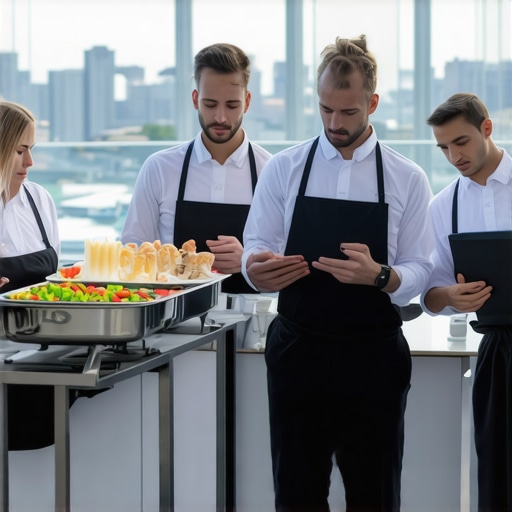 Looking ahead, the future of these high-stakes events is clearly leaning toward real-time inventory tracking. I’m already seeing a shift toward RFID-enabled service, where we can track exactly how many appetizers have left the tray in real-time, allowing us to pivot the menu before the guests even realize they’re hungry. This isn’t just about feeding people; it’s about using data to manage the flow of a room. If you want to elevate your next event, I challenge you to do a ‘logistics dry run’—actually time your elevator trips and temperature drops before the guests arrive. Use my top server tips to elevate your event experience to brief your team on the results. Don’t leave your success to chance when you can leave it to science.
Lessons Carved from Fifty Floors of Trial and Error
If I could go back to that sweaty afternoon on the 42nd floor, I’d tell myself that the view is just the bait; the logistics are the hook. One major lightbulb moment for me was realizing that wind patterns change hourly. Just because the morning was calm doesn’t mean your centerpieces won’t be flying by 6 PM. I also learned that silence is the ultimate luxury. When you are on a roof, every sound echoes. If your team hasn’t mastered server skills that make every event stand out, the sound of clearing plates will drown out the CEO’s speech. Finally, remember that your guests are there for the experience, but they stay for the comfort. If the temperature drops, your high-end gala becomes an endurance test.
The High-Stakes Gear That Actually Saves Your Sanity
You can’t run a vertical event with ground-level tools. I personally swear by three things: First, a dedicated handheld anemometer. If the wind hits 20mph, the umbrellas come down—no arguments. Second, I rely on the principles found in the ultimate guide to corporate event catering logistics to map out elevator cycles. Don’t guess; time it. Third, always have a ‘weather-proof’ menu backup. If the humidity spikes, your delicate tuiles will turn into mush; have a plan to pivot to sturdier options that don’t compromise on elegance. These are the effective catering strategies for corporate event impressiveness that separate the amateurs from the icons.
Go Build Your Own Skyline Masterpiece
Rooftop events are the ultimate high-wire act of the hospitality world. They are difficult, expensive, and logistically punishing—but when the sun sets and the city lights flicker to life, they are absolutely unbeatable. Don’t let the fear of a logistical glitch stop you from reaching for the sky. With the right team, a rigid plan, and a healthy respect for the elements, you can create something truly legendary. If you’re feeling overwhelmed by the vertical climb, don’t hesitate to contact us to help bridge the gap between your vision and the reality of the roof. Now, I want to hear from the frontline: What is the biggest ‘rooftop curveball’ you’ve ever had to handle during a live event? Let me know in the comments below!