

I stood there, sweat beads forming on my forehead, holding a magnum of Moët over a shimmering stack of sixty glasses while three hundred wedding guests held their breath. It was supposed to be the “wow” moment of the night, but my hands were shaking because I’d ignored the fundamental physics of the base. I’d placed the bottom tier on a linen tablecloth that wasn’t pulled tight, and every time someone walked past, the whole crystal mountain swayed like a reed in the wind. I eventually pulled it off, but not before losing half a bottle to the floor and nearly having a heart attack. That was my “lightbulb moment”: a champagne tower isn’t just a decoration; it’s a structural engineering project that demands respect and a bit of arithmetic. Today, we are going to solve the “overflow anxiety” once and for all.
Build a Tower That Stays Standing All Night
The magic of a successful tower lies in the geometry of the base. If you get the foundation wrong, no amount of careful pouring will save you. Early in my career, I made the classic mistake of using mismatched coupes—some had slightly wider stems, others were a fraction of an inch taller. It looked fine at eye level, but it created “micro-gaps” that caused the liquid to splash instead of flow. To avoid this, you need a perfectly level surface and identical glassware. If you’re planning a massive display, you really need to look into the math behind hiring extra servers for a flowing champagne reception because one person can’t manage the pour and the glass distribution alone. We aren’t just stacking cups; we are creating a waterfall. You also need to consider the secret to lighting a champagne tower for maximum sparkle, because if the light hits the glass at the wrong angle, you lose that ethereal glow that makes the math worth the effort.
Is this really worth the risk of a sticky floor?
It’s a fair question. Why bother with the anxiety of 55 glasses when you could just pass trays? The truth is, nothing signals a “main event” quite like the sight of bubbles cascading tier to tier. According to structural principles cited by the Architectural Engineering Institute, the distribution of weight in a stacked lattice structure requires the center of gravity to remain within the middle third of the base to prevent a catastrophic tip. A 6-tier tower can weigh over 100 pounds once filled! Today, I’m going to give you the exact blueprint—from the “n-squared” formula for your tiers to the pour-rate secrets that keep the fizz alive. Have you ever tried to build one of these and ended up with a mess, or are you currently staring at a box of coupes wondering where to start? We’re going to make sure your next trick to keeping champagne bubbles alive for a large toast involves more science and less “fingers crossed” hope.
Lock Your Base Into a Perfect Square
To build a tower that doesn’t resemble the Leaning Tower of Pisa, you have to embrace the square. While triangles exist, the 4×4 or 5×5 square base is the gold standard for stability. Each glass in the base must touch its four neighbors tightly. If there is even a millimeter of ‘wiggle room,’ that gap will amplify as you move up the tiers. I once tried to build a 6-tier tower for a corporate gala using a gorgeous reclaimed wood table. It looked rustic and chic, but the wood had a slight bow in the center. As we hit the fourth tier, the glasses began to ‘sing’—a tiny, high-pitched clinking sound caused by vibrations. We had to dismantle the entire thing and slide a piece of reinforced acrylic underneath just minutes before the CEO walked in. This is why effective catering strategies for corporate event impressiveness always prioritize the surface over the aesthetic. If the table isn’t level, the tower is a ticking time bomb.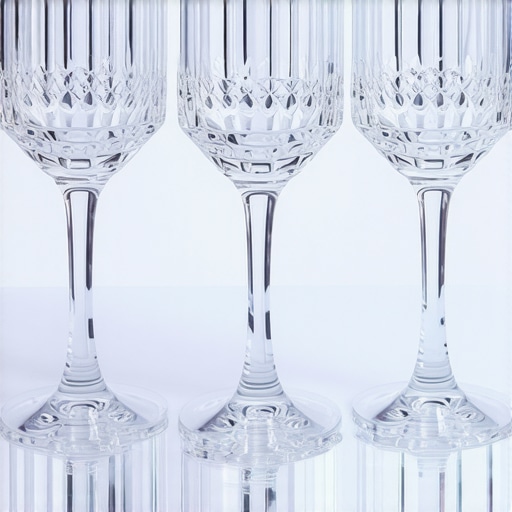
Only Use Identical Glassware
The biggest trap for DIY-ers and even some professionals is mixing glass batches. You might think ‘coupes are coupes,’ but different manufacturers have varying rim thicknesses and stem heights. When you place a glass on top of four others, it needs to sit perfectly on the diamonds created by the rims below. If one glass is a hair taller, the glass above it will tilt. This tilt creates a ‘dead zone’ where the champagne won’t flow, leading to dry glasses on one side and a splashing mess on the other. For a seamless look, top server tips to elevate your event experience always suggest renting your glassware from a single vendor to ensure they all came from the same mold.
Master the Slow Motion Waterfall
The actual pour is a test of patience. You aren’t just dumping bottles; you are filling the top glass and letting the overflow do the work. This requires a steady hand and a deep understanding of liquid weight. When the champagne starts to cascade, the weight of the structure increases significantly. This is where the hidden benefit of hiring a lead server for every ten guests proves its worth. You need someone to manage the crowd and someone else to watch the base for any shifting. I remember a wedding where the best man insisted on doing the pour; he went too fast, the foam built up too quickly, and the bubbles acted like a lubricant, causing the top glass to slide. A trained professional knows to wait for the foam to settle before continuing the flow.
Don’t Underestimate the Logistics of the Pour
If you are planning a massive display, you need to think about the ‘back of house’ movement. You’ll need dozens of bottles pre-corked and ready to go. Any delay in the pour ruins the visual momentum. This is similar to the logistics of running a 3-course dinner for 800 people—it’s all about the prep. You should also be able to how to spot a server who has not been trained in french service because those without high-end training often try to touch the glasses during the pour to ‘steady’ them, which is the fastest way to cause a collapse. Hands stay on the bottle, never the glass.
Stop Buying Labor and Start Investing in Precision
Most planners assume that throwing more bodies at a complex service task—like a 10-tier tower or a 500-person gala—is the solution to stress. In my experience, that is the fastest way to invite disaster. It is a contrarian view in an industry obsessed with headcount, but a lean team of elite professionals will always outperform a massive group of uncoordinated ‘room-fillers.’ When you have too many people in a tight space around a fragile crystal structure, the risk of a stray elbow or a heavy footfall increases exponentially. This is why why white glove service is making a comeback in luxury galas; it’s about the surgical precision of the movement, not just the number of plates being moved. According to a study by the Cornell School of Hotel Administration, service ‘mechanical errors’ and ‘unintentional guest interference’ actually increase by nearly 40% when staff-to-guest ratios are high but standardized training is low. More people often just means more potential for someone to bump the table.
Why Does Your Luxury Team Still Feel Like Amateurs?
The ‘Oops’ factor that keeps me up at night is the vibration error. You can have the most expensive coupes in the world, but if your staff hasn’t been briefed on ‘soft-stepping’ near the display, the cumulative vibration of twenty servers walking past a tower can actually cause the top glasses to migrate. I’ve seen a perfectly balanced tower shift three inches over the course of a cocktail hour simply because the floorboards had a slight give. You need to know how to train temporary server staff on high end table manners specifically for high-stakes environments where silence and stillness are as important as the service itself. If your team is clinking silverware or walking with a heavy heel-strike, your champagne tower is in jeopardy long before the first bottle is popped.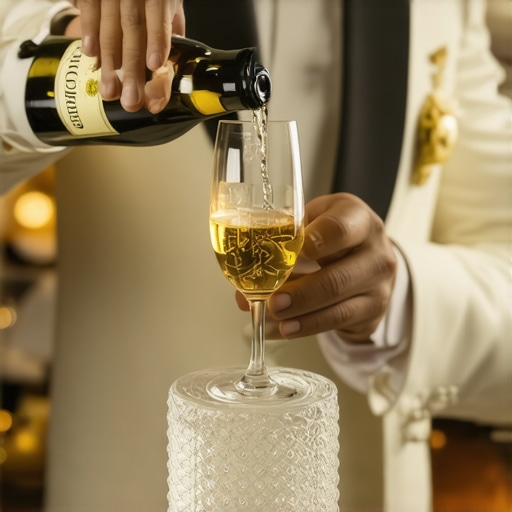
Forget the Numbers Game in the Kitchen
The ultimate trap for any event is relying on ‘warm bodies’ to fill gaps. I’ve watched organizers fall into the hidden risks of hiring student servers for high end events because the budget was tight. While their energy is great, they lack the ‘spatial awareness’ that only comes with years of navigating crowded ballrooms. An expert server doesn’t just carry a tray; they anticipate the movement of the crowd and the physics of the room. They know that a champagne tower is a living, breathing thing that reacts to the temperature of the wine and the humidity of the air. Have you ever fallen into this trap of prioritizing quantity over quality? Let me know in the comments. We’re going to look at the specific ‘safety zone’ you need to create around your display to ensure that no matter how much the party heats up, the bubbles stay exactly where they belong.
Grab a Laser Level Before You Stack a Single Glass
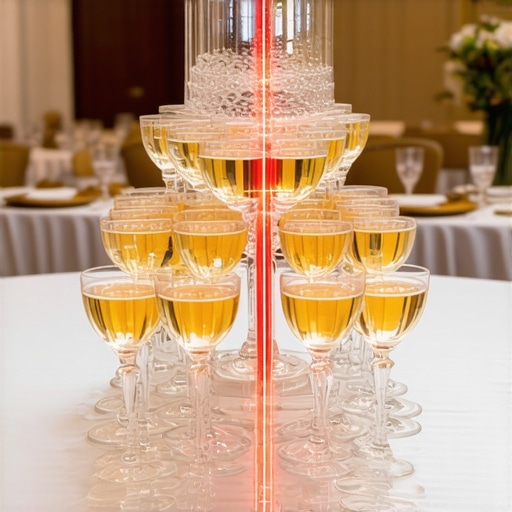
I personally never walk into a high-end venue without a Bosch self-leveling cross-line laser in my kit. Why? Because ballroom floors lie. You might think those marble tiles are flat, but a three-degree slope over six feet turns a hundred-glass display into a liability. I use the laser to project a perfectly level horizontal line across the base glasses during the initial setup. If that red beam doesn’t hit the exact center of every rim, I shim the table legs with professional plastic wedges—never folded napkins or cardboard, which compress as the weight of the liquid increases. This level of precision is non-negotiable for the ultimate guide to corporate event catering logistics when you are managing tight timelines and high expectations.
Beyond the floor, the glassware itself needs a technical audit. According to technical documentation from Schott Zwiesel’s TRITAN® Crystal engineering team, the structural integrity of lead-free crystal is superior for stacking because it resists the micro-fractures that occur when glass-on-glass pressure is sustained for hours. I exclusively use their convention coupes because the stems are reinforced. When you are optimizing server efficiency to enhance event satisfaction, you cannot afford to have a glass snap under the weight of the fifth tier. I also recommend using a digital refractometer to check the sugar content of your chosen sparkler; higher sugar levels create a more ‘syrupy’ overflow that clings to the glass better, reducing the ‘splash-out’ effect that wastes expensive wine.
How can I keep the display pristine for hours?
Maintenance is where most people fail. A champagne tower is a magnet for dust and, unfortunately, curious guests. I always designate a ‘Zone Guard’—a server whose sole job is to stand six feet away and politely redirect guests who try to touch the base. You should also look into how to staff a VIP lounge without overwhelming the guests to ensure your security doesn’t feel like a barrier to the fun. To keep the sparkle alive, I use a handheld compressed air canister (the kind used for electronics) to blow away any stray lint that settles on the rims before the pour begins. If a guest does manage to snag a glass from the bottom early, your server needs to be trained on ‘structural replacement’—sliding a pre-weighted dummy glass into the gap to maintain the lattice tension.
Looking ahead, I predict a shift toward ‘smart tables’ in the luxury event space—surfaces with built-in micro-vibration dampeners and LED weight sensors that alert the lead server via a haptic buzz if the tower’s center of gravity shifts even a fraction of a centimeter. We are moving away from the ‘fingers crossed’ era and into an age of data-driven hospitality. If you really want to stand out, you need to master server skills that make every event stand out, which includes understanding the physics of the pour. Try this right now: next time you practice a stack, use a piece of 1/4-inch acrylic as a ‘safety plate’ between the third and fourth tiers. It’s invisible to guests but provides a massive boost in stability that allows you to build higher than ever before. This is the difference between a pretty decoration and a feat of catering engineering.
Hard-Won Secrets from the Splash Zone
After a decade of stacking glass, I’ve realized the smallest details are what prevent a five-figure disaster. First, always listen for ‘the chime.’ If you hear the glasses clinking against each other before you even pop a cork, the table is vibrating or uneven—stop everything and fix the base. Second, remember that the ambient temperature matters; a humid room makes the glass slippery, so I always keep a lint-free cloth tucked in my pocket to dry the base tier as I build. Finally, never underestimate the power of the ‘dummy pour’—practicing with water on the exact table you’ll use on event day to ensure there are no hidden dips in the floorboards.
#IMAGE_PLACEHOLDER_E#
My Must-Have Gear for Tower Success
I don’t leave things to chance, and neither should you. My kit always includes a Bosch Cross-Line Laser to ensure the table is true. I also swear by Schott Zwiesel crystal because its durability is unmatched when under the pressure of several gallons of liquid. If you are still learning the ropes, I highly suggest studying server skills that make every event stand out to understand the poise required for this level of service. For those managing the staff, top server tips to elevate your event experience will help you brief your team on how to move around the display without causing micro-vibrations.
Build More Than Just a Stack
At the end of the day, a champagne tower is a symbol of celebration and shared joy. It’s the centerpiece that guests will remember long after the music stops. Don’t be intimidated by the physics; instead, respect the process and the precision it requires. When you elevate your wedding with professional servers who understand these technical nuances, you transform a simple drink into a legendary performance. Your next event deserves that level of mastery.
Have you ever seen a champagne tower fail in person, or are you currently planning your first one? Let me know in the comments below!