

I still have nightmares about the 2018 Henderson gala. Everything was pristine—white marble, white lilies, and three hundred guests dressed in their summer finest. Then, a server took a slight tumble with a tray of ‘Blackberry Bourbon Smashes.’ It looked like a scene from a horror movie. In that moment, I realized that a signature drink is more than just a flavor profile; it is a liability. If you are planning a high-stakes event, you need to think about the ‘stain factor’ just as much as the garnish. Today, I’m going to walk you through exactly how to design a menu that wows your guests without sending them straight to the dry cleaners. We are talking about sophisticated, flavorful options that stay in the glass and off the silk. [IMAGE_PLACEHOLDER]
Stop Choosing Cocktails That Double as Fabric Dye
I’ll be the first to admit I’ve made some messy calls. Years ago, I insisted on a beet-infused vodka martini for a luxury launch. It was ‘on brand,’ but it was a disaster waiting to happen. I learned the hard way that wedding catering tips from industry experts almost always lean toward caution for a reason. You don’t want your legacy as a host to be the person who ruined a dozen heirloom wedding dresses. This is especially true when you consider the danger of serving finger foods that require two hands—when guests are juggling a plate and a drink, spills are inevitable. To keep things safe, we need to look at effective catering strategies for corporate event impressiveness that prioritize guest comfort over a trendy, dark-colored liquid.
Wait, Won’t a Clear Drink Look Boring?
This is the biggest pushback I get. People think that if a drink isn’t bright red or deep purple, it lacks ‘personality.’ That’s a total myth. You can create incredible visual depth using clear spirits, translucent liqueurs, and edible garnishes that don’t bleed color. Think about the chemistry: red wine and dark fruit juices contain chromogens—intense color compounds—that, according to research cited by the Good Housekeeping Institute, bond to fabric fibers almost instantly. By focusing on ‘clear-label’ mixology, you aren’t sacrificing style; you’re providing a safety net for your guests’ wardrobes. Even when looking for luxury wedding catering ideas for a fairytale atmosphere, you’ll find that elegance often lies in transparency and light. Have you ever had a beautiful white dress ruined by a stray splash of sangria at a party? Let me know if you’ve ever lived through that nightmare!
Build Your Menu Around Transparency
I once had to pivot at the eleventh hour during a Soho boutique launch. The client wanted a deep beet-red ‘Signature Spritz,’ but one look at the white silk upholstery and the designer gowns convinced me otherwise. We switched to a ‘White Cosmopolitan’ using white cranberry juice, dry curaçao, and a touch of elderflower. Three glasses were bumped that night, yet there was zero drama. Designing for safety means starting with the base liquids.
Swap Dark Spirits for Botanical Clarity
Instead of bourbon, dark rum, or heavy red wine, look toward gin, tequila blanco, and vodka. You can achieve incredible flavor complexity through infusions that don’t involve pigment. For example, cucumber-infused gin or jalapeño-steeped tequila provides a cooling or spicy palate without the risk of a green or orange stain. When you are planning the drink flow, remember that the tactics for keeping an open bar line under two minutes often rely on simple, clear-pour recipes that servers can execute quickly and cleanly.
Use Garnish Chemistry Instead of Dye
Flavor doesn’t have to be liquid. Edible flowers, dehydrated citrus wheels, and sprigs of fresh rosemary add visual ‘pop’ without altering the color of the drink itself. This is the secret to a high-end look that remains fabric-friendly. 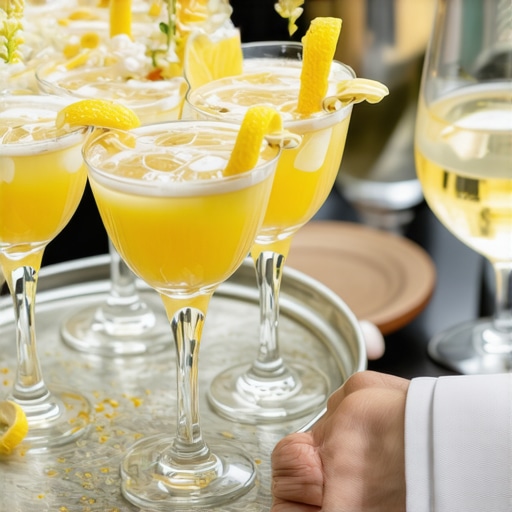
Fix the Logistics of Your Beverage Service
A safe menu is only half the battle; the other half is the physical movement of the glass. High-stakes environments require a more calculated approach to how drinks move from the bar to the guest’s hand, especially in a crowded ballroom.
How Glass Shape Dictates the Stain Risk
The classic V-shaped martini glass is a disaster for social events. It is essentially a splash-launching pad. Instead, opt for the Nick and Nora glass or a deep coupe. These shapes curve inward at the top, naturally containing the liquid during a slight stumble. If you are doing a large-scale celebration, the math behind hiring extra servers for a flowing champagne reception is crucial because overwhelmed staff are more likely to tilt a tray. Also, keep in mind the trick to keeping champagne bubbles alive for a large toast involves pouring smaller amounts more frequently, which also reduces the total potential spill volume per glass.
Train Your Staff to Spot a Potential Splash
A proactive team is the best insurance policy. You need to know how to train temporary server staff on high-end table manners so they understand that a tray should never be overloaded, even if it saves a trip back to the bar. This level of coordination is exactly why your server team needs a clear chain of command on site; if a spill does happen, the response must be immediate, quiet, and invisible to the rest of the guests.I’ve seen hosts throw five-figure budgets at additional staffing, assuming that a higher server-to-guest ratio is an automatic insurance policy against chaos. In reality, I’ve found that over-staffing without a strict hierarchy is the fastest way to cause a ‘traffic jam’ in the middle of a high-stakes toast. Everyone says that more hands make light work, but in high-end catering, too many uncoordinated hands usually result in broken stemware.
Why More Servers Often Mean More Spills
The common belief is that if you have 100 guests, you just need 10 servers to keep things moving. But in my experience, a bloated team without a clear structure leads to ‘server hovering’ and accidental collisions. Research from the Cornell School of Hotel Administration emphasizes that labor productivity in the service industry is more about the flow of communication than the sheer volume of staff. Without optimizing server efficiency to enhance event satisfaction, you are just increasing the number of people who can potentially trip over a guest’s chair. 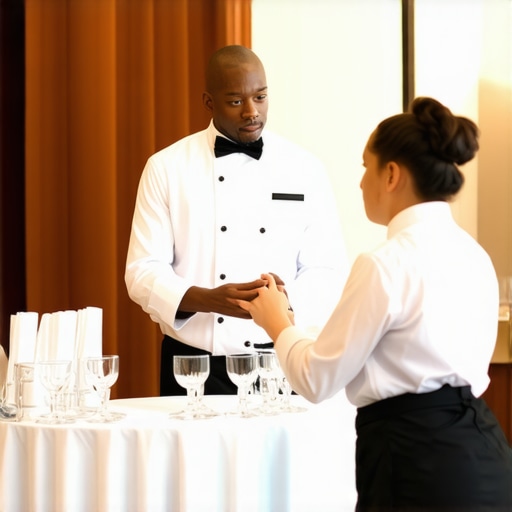
Is the Standard 1-to-10 Ratio Actually a Trap?
The ‘1-to-10’ rule is a baseline, not a gold standard. For a high-stakes gala where guests are wearing silk and the drinks are flowing, you need to look at the hidden benefit of hiring a lead server for every ten guests. This creates a secondary layer of accountability. While the math behind hiring extra servers for a flowing champagne reception might look good on paper, if those servers don’t know their specific zones, they’ll converge on the same VIP table, leaving others ignored and prone to seeking their own refills—a prime moment for a spill.
Stop Hiring Bodies and Start Hiring Skills
Here is the ‘oops’ factor that ruins many corporate galas: hiring ‘temp’ bodies to fill the uniform. There is a massive difference between a career server and someone who just picked up a tray for the weekend. I always warn clients about the hidden risks of hiring student servers for high-end events. They often lack the ‘peripheral vision’ required to navigate a crowded ballroom. A professional knows how to read the room, anticipating a guest’s sudden move before it happens. This level of coordination is exactly why your server team needs a clear chain of command on site to direct traffic and mitigate risks before a single drop of Chardonnay hits the floor. Have you ever fallen into this ‘more is better’ trap and regretted it? Let me know in the comments!Experience has taught me that the difference between a good caterer and a legendary one isn’t the menu—it is the logistics. When you are moving from a boutique thirty-person dinner to a massive ballroom, you can’t just ‘work harder.’ You have to work smarter. I rely heavily on digital floor-planning tools like Social Tables to create a ‘digital twin’ of the space before we even load the first crate. This allows me to visualize exactly where effective catering strategies for corporate event impressiveness might be hindered by a narrow hallway or a poorly placed bar. If you aren’t mapping your server paths digitally, you are essentially guessing where the bottlenecks will happen. According to the Journal of Foodservice Business Research, standardized training and procedural clarity are the highest predictors of perceived service quality in high-volume environments. That is why I never walk into a venue without a printed ‘Zone Map’ for every single member of the team.
How do I maintain service quality across fifty events a year?
The secret to long-term results is the ‘Post-Event Autopsy.’ Within twenty-four hours of every gala or wedding, I meet with my lead servers to discuss every single ‘near-miss’—from a wobbly table to a close call with a red wine pour. This constant feedback loop is vital for mastering corporate event planning secrets to seamless success over the long haul. We also keep a rigorous equipment maintenance schedule; there is nothing more embarrassing than a silent auction where the coffee airpots are failing because of scale buildup. To keep the team sharp, we regularly revisit server skills that make every event stand out, ensuring that even our veteran staff doesn’t get complacent with the basics of ‘silent service’ and guest intuition. 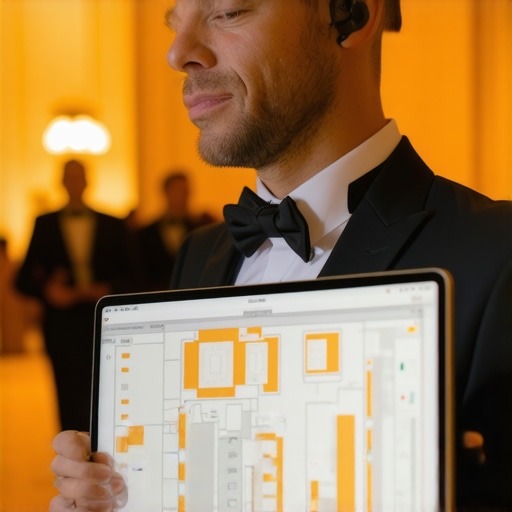
The Tech That Actually Makes a Difference
I’m not a fan of tech for tech’s sake, but I swear by discrete, bone-conduction earpieces for my lead staff. Unlike traditional walkie-talkies that hiss and crackle in a quiet room, these allow for a clear chain of command on site without disturbing the ambiance. It allows us to coordinate a synchronized plate drop for 500 people with the precision of a Swiss watch. If you want to see an immediate jump in your professionalism, stop shouting across the kitchen doors and start using a silent comms system. This is a core part of the ultimate guide to corporate event catering logistics that most beginners overlook.
Where Event Service is Heading in 2025
Looking forward, I predict we are going to see a massive shift toward ‘Predictive Service.’ We are already seeing AI tools that can analyze guest flow patterns to tell us exactly when to open the secondary bar to prevent a queue. The goal for the future isn’t just to react to guest needs, but to use top server tips to elevate your event experience by being there with a refill before the guest even realizes their glass is empty. This level of frictionless precision is what will define the next decade of luxury hospitality. If you really want to level up your next event, I challenge you to implement the ‘Silent Hand Signal’ system for clearing plates—it’s a small tweak that instantly makes a room feel ten times more sophisticated. Check out my essential checklist for successful corporate event catering to see how I integrate these tools into every project.
What Two Decades in the Trenches Taught Me About Event Chaos
If there is one thing I’ve learned, it’s that your guests won’t remember the exact notes of the vintage, but they will never forget how you handled a crisis. Spills are more than just a laundry bill; they are a disruption of the guest’s emotional state. I’ve realized that prevention is the highest form of hospitality. It is why I obsessed over clear-label mixology and the ‘stain factor’ in the first place.
Another ‘lightbulb moment’ for me was realizing that your team’s confidence is contagious. When you train temporary server staff on high-end table manners, you aren’t just teaching them which side to serve from; you are giving them the tools to move through a room without fear. That fearlessness is what prevents the trembling hands that lead to tray disasters.
Finally, I stopped trying to be everywhere at once. Embracing the hidden benefit of hiring a lead server for every ten guests allowed me to focus on the big picture while my lieutenants managed the micro-moments. It turns out, letting go is the secret to total control.
The Go-To Gear for a Flawless Service Floor
I don’t leave things to chance anymore. My toolkit is built on precision. First, Social Tables is my non-negotiable for floor planning; it turns a chaotic ballroom into a predictable grid. Second, Nick and Nora glassware is my secret weapon against the ‘V-shape’ spill hazard—they look classic but are incredibly forgiving. I also never run a gala without bone-conduction headsets to keep the communication silent and the ambiance undisturbed. For those looking for a comprehensive roadmap, my essential checklist for successful corporate event catering is the exact document we use to vet every venue before the trucks arrive.
Own the Room at Your Next Big Event
The transition from a good host to an elite event strategist happens the moment you prioritize the guest’s comfort over your own ego. By focusing on smart liquid chemistry, precise logistics, and top server tips to elevate your event experience, you create a space where magic can actually happen. High-stakes event catering isn’t about avoiding mistakes—it’s about building a system so robust that mistakes don’t have a chance to breathe. Now go out there and build something unforgettable. You’ve got the blueprint for mastering corporate event planning secrets to seamless success right in your hands. What’s the one ‘stain-maker’ cocktail or food item you’ll never serve at an event again? Let me know in the comments below!