

I’ll never forget the sinking feeling I had when my cousin opened her professional wedding gallery; the first ten shots of her getting ready were ethereal and light, but by the time the cake was cut, the images looked like they’d been edited by a completely different human being with a penchant for heavy, muddy orange tints. It was a visual car crash. That moment was my massive wake-up call that a photographer’s portfolio isn’t just a collection of pretty pictures; it’s a promise of a cohesive story that shouldn’t feel like a disjointed flip-book. We spend so much time obsessing over innovative wedding themes and floral arrangements, yet we often hand over the visual legacy of those details to someone without checking if they can actually maintain a look for more than twenty minutes. Early in my journey, I made the amateur mistake of hiring a vendor based on a single sunset silhouette I saw on a social media ad. It was stunning, sure, but the rest of the gallery was a chaotic mess of over-saturated greens and blown-out highlights. I learned the hard way that one lucky shot does not make a professional. Today, I want to make sure you don’t fall into that same trap. We are going to solve the mystery of the ‘chameleon editor’ and give you the exact tools to ensure your wedding album looks like a high-end editorial spread from start to finish.
Look Past the Hero Shot to Find a Real Pro
When you start your search, you are going to be bombarded with ‘hero shots’—those epic, once-in-a-lifetime captures that every photographer puts on their homepage. But the real skill lies in the transition from a bright outdoor ceremony to a dimly lit ballroom. I always tell my friends that if the skin tones in the bridal suite don’t match the skin tones at the reception, you have a problem. Consistency is about more than just a favorite filter; it is about technical mastery of white balance and color grading. Professional Photographers of America (PPA) notes that technical consistency is a primary hallmark of a seasoned professional, as it demonstrates an ability to handle varying light sources without losing their artistic identity. This is why I often suggest couples understand why your photographer wants you to do a first look, as it provides a controlled environment to establish that editing baseline early in the day. If you don’t vet this, you might end up with the same frustration people feel regarding the true cost of hiring a student photographer, where the ‘savings’ are quickly eclipsed by the disappointment of a messy, inconsistent final product. Have you ever felt like a photographer’s style was a bit of a ‘bait and switch’ after looking at their full blog posts?
Does Perfect Consistency Actually Change How You Feel About Your Photos?
You might be wondering if it really matters if the ceremony is a little warmer than the dinner. The short answer? Yes. Our brains crave visual patterns. When you flip through a wedding album where the editing style shifts constantly, it breaks the emotional immersion. You stop looking at the joy on your mother’s face and start wondering why her dress looks navy in one photo and royal blue in the next. It creates a subconscious ‘noise’ that distracts from the memories themselves. Ensuring a unified look is as vital as how to choose the perfect servers for your wedding to ensure the service flow is seamless; if one element is jerky or inconsistent, the whole experience feels slightly off-kilter. We want your wedding story to feel like a movie directed by one person, not a series of clips from different TV shows.
Demand to See the Full Story Not Just the Highlight Reel
To get an honest look at a photographer’s skill, you have to stop looking at their Instagram feed and start looking at their delivery folders. I once worked with a couple who was obsessed with a photographer’s ‘airy’ aesthetic, but they never asked to see a full night-time reception. When the gallery came back, the flash work was so harsh it looked like a high school yearbook. It was a disaster. To avoid this, ask for three full galleries from weddings that match your venue type. If you are getting married in a ballroom, don’t look at a beach wedding gallery. You need to see how they handle the technical shift between environments. Just as you would test your event lighting during the day and night to ensure the mood stays consistent, you must ensure the photographer’s editing style survives the sunset.
Check How They Handle the Move From Sunlight to Shadows
When reviewing these galleries, pay close attention to the transition points. The jump from the ‘golden hour’ portraits to a dimly lit dinner is where most amateur editors fall apart. I remember a corporate gala I helped organize where the photographer was fantastic during the keynote but completely lost the ‘brand colors’ once the cocktail hour began in a purple-lit lounge. It felt like two different events. This is why the importance of having a dedicated point of contact for vendors cannot be overstated; someone needs to ensure the visual brief is being met regardless of the lighting changes. Look for skin tones that remain natural even when surrounded by colorful reception lights. If people start looking like they have a tan in one photo and a fever in the next, keep looking.
Verify Their Technical Safety Net
Consistency isn’t just about the ‘look’; it is about the reliability of the delivery. A true professional doesn’t just have a good eye; they have a redundant system. Early in my career, I saw a photographer lose half a wedding because they were shooting on a single card slot. It was heartbreaking and entirely preventable. You should ask your photographer about their backup process as specifically as you would ask how to manage a catering team during a sudden rain storm. You need to know that your memories are being written to two places at once. This technical discipline usually correlates with editing discipline. If they are lazy with their gear, they are usually lazy with their color grading.
Why You Should Avoid the All-Rounder Who Lacks a Signature
There is a massive temptation to hire a ‘jack-of-all-trades’ who promises they can do any style you want. In my experience, these are the most dangerous ‘chameleon’ editors. A photographer who hasn’t committed to a specific style is often still learning how to control their software. This leads to the same quality control issues as the hidden risks of hiring student servers for high-end events—you might get lucky, or you might get a messy experience that lacks polish. You want an expert who has spent years perfecting a specific ‘recipe’ for their colors. When you hire someone with a clear, defined identity, you aren’t just buying their time; you are buying the peace of mind that your final gallery will look exactly like the one that made you fall in love with them in the first place.This obsession with visual consistency isn’t just for photographers; it extends to every professional you hire, especially the ones moving between your guests. Everyone tells you that ‘great service is invisible,’ but in my years of experience, that is a dangerous myth. If service is truly invisible, guests often feel neglected or, worse, unimportant. Truly elite service is a proactive presence where the staff anticipates a need three minutes before the guest even realizes they have it. When you are researching how to spot a professional server in an interview, you shouldn’t be looking for a ‘ghost’—you should be looking for a strategist who understands the rhythm of a room. This is why why your server team needs a clear chain of command on site; without it, the ‘invisible’ service quickly becomes ‘non-existent’ service.
Can High-Volume Plated Service Ever Match the Quality of a Small-Scale Dinner?
The answer lies in the technical choreography that happens behind the kitchen doors. A study by the Cornell School of Hotel Administration reveals that ‘perceived service quality’ is more dependent on the synchronization of clearing and serving than on the actual speed of the meal delivery. If your team isn’t synchronized, you fall into the ‘Oops’ factor: the dreaded plate-stacking. I’ve seen beautiful black-tie galas ruined because servers started clearing bread plates with a loud ‘clack-clack’ right during the CEO’s most poignant speech. This is exactly how to handle plate clearing during a seated executive presentation without breaking the spell. If the staff isn’t briefed on the program, they are just laborers, not hospitality pros. You also have to watch out for the physical ‘dead zones.’ Most planners cram as many tables as possible into a space, but why your ballroom floor plan needs a three-foot safety buffer becomes obvious the moment a server carrying a heavy tray of hot entrees gets bumped by a guest pulling out a chair.  This lack of physical space leads to chaos, but you can avoid it by mastering the secret to managing a 1000-person conference buffet without a stampede: flow control. Don’t forget that why your keynote speakers rider needs a catering audit; if the speaker is distracted by the noise of the kitchen, your entire event ROI drops. Have you ever fallen into this trap of prioritizing ‘invisible’ service over well-orchestrated service? Let me know in the comments.
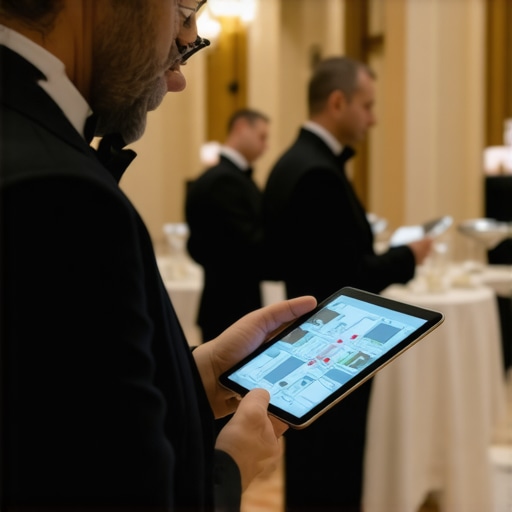
Maintaining the energy of a high-end event for twelve hours straight isn’t a matter of luck; it is a matter of having a technical safety net that doesn’t sleep. I’ve seen too many planners focus on the initial ‘wow’ factor only to have the entire experience deflate by the time the late-night snacks arrive. To avoid this, I personally swear by digital floor-planning tools like AllSeated to map out guest flow before a single chair is moved. This helps me visualize the ‘traffic jams’ that inevitably happen near the bar. If you aren’t optimizing server efficiency to enhance event satisfaction through a pre-calculated layout, you are essentially planning for a bottleneck. I also never run a large-scale event without a real-time communication app like Voxer. Traditional walkie-talkies are too loud and intrusive for a black-tie environment, but a discreet earpiece and a dedicated channel for the ‘server captains’ ensure that if a water carafe is empty at table twelve, it’s refilled before the guest even looks up.
How do I maintain peak catering quality over a ten-hour day?
The secret lies in ‘thermal management’ and staggered production. You cannot cook 500 steaks at 4:00 PM for a 7:00 PM dinner and expect them to be anything but rubber. This is why the ultimate guide to corporate event catering logistics always emphasizes the use of high-grade insulated transporters—commonly known in the industry as ‘Cambros.’ I use these not just for heat, but to maintain the specific humidity levels required to keep fish from drying out. A study by the Cornell Center for Hospitality Research highlights that server fatigue peaks exactly 4.5 hours into a shift, which is usually when your main course is being cleared. To combat this, I implement a ‘shift-overlap’ strategy where a fresh ‘closer’ team arrives just before the dinner service begins. This ensures the people handling your delicate plated service aren’t the same ones who spent the morning lugging heavy crates of glassware. It’s about preserving the human capital so the service feels as fresh at midnight as it did at noon.
Looking ahead, I predict we are moving toward a ‘smart-table’ era where sensor-integrated linens will discreetly alert the kitchen to guest needs, but for now, we rely on the eyes of a well-briefed team. You must know how to brief your server team on complex dietary restrictions in minutes because the landscape of guest needs is becoming increasingly granular. If your team is still guessing which guest is the ‘nut-free vegan,’ your logistics have already failed. I recommend using a ‘silent-cue’ system—discreet color-coded place cards or subtle stickers on the underside of wine glass bases—to signify dietary needs. This prevents the awkward ‘who had the gluten-free meal?’ shout that ruins a sophisticated atmosphere. My advanced tip for you: next time you walk your venue, physically measure the distance from the kitchen to the furthest table. If it’s more than 100 feet, you need a satellite ‘plating station’ or your food will be cold before it hits the cloth. Go ahead and audit your current floor plan for that three-foot safety buffer today; it is the simplest change that will immediately save your servers from a collision disaster.
The Costly Lessons I Learned About Trusting a Single Hero Shot
Reflecting on my years in the industry, the most painful lesson was realizing that talent without technical discipline is a recipe for heartbreak. I used to think a photographer’s ‘vibe’ was enough, but I’ve since learned that visual consistency is a product of rigorous workflow, not just artistic flair. If they can’t explain their color science, they can’t guarantee your results. Similarly, I’ve seen that the best service isn’t about grand gestures; it’s about the top server tips to elevate your event experience that happen when no one is looking. A truly professional team operates like a silent machine where every movement is intentional. I also realized that you cannot leave the kitchen to its own devices; you need an essential checklist for successful corporate event catering to ensure the quality stays high from the first appetizer to the final espresso. Never assume a vendor ‘just gets it’—the magic is always in the manual.
My Go-To Toolkit for Perfect Event Coordination
When you are planning the ultimate wedding reception meal, you need more than just a good menu; you need a strategy. I always recommend The Art of Gathering by Priya Parker for anyone looking to understand the psychology of their guests. For technical layout, I rely on digital mapping tools like AllSeated to ensure we never have those awkward ‘clack-clack’ plate clearing moments near the speaker. I also swear by a strict training regimen for any additional help; knowing how to train temporary server staff on high-end table manners is the only way to maintain a five-star feel when scaling up for a large guest list. These resources are my safety net, ensuring that the luxury experience remains consistent throughout the entire day.
Build a Celebration That Lives Up to the Highlight Reel
Your wedding or corporate gala deserves to be more than just a collection of lucky moments. By demanding visual consistency from your photographer and technical precision from your catering team, you are protecting the emotional weight of your memories. Don’t be afraid to ask the hard questions about backups, color grading, and server synchronization. When you hire experts who value the ‘unseen’ work as much as the ‘hero shot,’ you can finally relax and actually enjoy the day you’ve spent months perfecting. Have you ever noticed a major shift in photo quality or service speed halfway through an event? Let me know in the comments below.