

Picture this: it’s three hours before a 300-guest gala, the florist is panicking because their van is wedged in an alleyway two blocks away, and the ice sculpture is currently a very expensive puddle on the sidewalk. This wasn’t a freak accident; it was my first big professional heartbreak. I had toured the venue, fallen in love with the velvet curtains, and checked the [essential checklist for successful corporate event catering](https://gourmetcateringsco.com/essential-checklist-for-successful-corporate-event-catering), but I never once asked to see where the trucks actually pull in. That day, I learned that the prettiest ballroom in the world is a nightmare if your team can’t get inside. Today, I’m going to show you how to look past the fancy linens and vet a venue based on the one area that actually makes or breaks your timeline: the loading dock. [image placeholder]
Stop staring at the chandeliers and start looking at the driveway
I spent years [mastering corporate event planning secrets](https://gourmetcateringsco.com/mastering-corporate-event-planning-secrets-to-seamless-success) only to realize that the most [elegant wedding venues](https://gourmetcateringsco.com/elegant-wedding-venues-and-catering-inspiration-for-2025) are useless if your [best corporate event servers](https://gourmetcateringsco.com/best-corporate-event-servers-for-2025) are stuck carrying heavy crates up a flight of stairs because the service elevator is too small. Early in my career, I booked a stunning historical library for a corporate lunch without checking the delivery route. We ended up paying four hours of overtime because the [top-tier servers](https://gourmetcateringsco.com/top-servers-for-a-seamless-wedding-reception) had to hand-carry every single chair through a narrow front door. It was a logistical disaster that ate my entire profit margin. Now, I tell every neighbor and peer I know: the loading dock is the heart of your [corporate event catering strategies](https://gourmetcateringsco.com/corporate-event-catering-strategies-for-success). If the dock is shared with three other businesses or lacks a proper ramp, your ‘seamless’ event is already behind schedule before the first guest arrives. According to a report by the Logistics Bureau, poor site access is one of the leading causes of service delays in the hospitality industry.
Does the back entrance actually matter more than the view?
I know what you’re thinking. You’re worried that focusing on the ‘dirty’ parts of the building makes you look like a killjoy rather than a visionary planner. You might even fear that by being too demanding about the [ultimate guide to corporate event catering logistics](https://gourmetcateringsco.com/the-ultimate-guide-to-corporate-event-catering-logistics), you’ll miss out on a ‘vibey’ space. But trust me, a sunset view won’t matter if the [wedding catering trends](https://gourmetcateringsco.com/wedding-catering-trends-to-impress-guests-in-2025) you’ve planned are ruined by cold food. Have you ever been stuck in a loading dock nightmare where the catering van was a mile away? I’d love to hear your horror stories in the comments so we can all learn together.
Walk the same path your catering team will take
To ensure a smooth delivery, you need to physically trace the journey from the truck bumper to the final plating station. Don’t let the venue manager just point at a door; walk it. I learned this the hard way at a skyscraper event in Chicago. Everything looked perfect on paper, but the service elevator required a physical key held by a single security guard. When that guard went on an unscheduled 45-minute lunch break exactly at our load-in time, my team was left standing on a hot sidewalk with three hundred portions of sea bass. It didn’t matter that we knew the logistics of running a 3-course dinner for 800 people; we were paralyzed by a single human gatekeeper. Now, I always ask about security protocols and ‘buffer’ keys. If you are learning how to prep your venue for a high-security executive guest, these back-of-house bottlenecks are your biggest vulnerability.
Measure twice or pay for the extra labor later
Your delivery truck is like a puzzle piece, and the loading dock is the slot it has to fit into. If the dock height doesn’t match the truck, or if the turn into the alley is too tight for a 24-footer, your ‘seamless’ setup turns into a manual labor marathon. I once worked a gala where the elevator was three inches too shallow for our hot boxes. We had to unload every tray, carry them in by hand, and reload them on the other side. This is why most corporate buffets fail the temperature test; the food spends too much time in ‘transition’ rather than in the oven. If you don’t check these clearances, you’ll need to account for the math behind hiring extra servers just to act as human conveyor belts. 
Identify the power and water hurdles before they stop your clock
A loading dock is just a hole in the wall if there isn’t a functional staging area nearby. You need to know exactly where the ‘hot’ outlets are and if the venue allows portable convection ovens. I’ve seen planners choose innovative wedding themes that required on-site frying, only to realize the back dock had zero ventilation and only one 15-amp circuit. If you are forced to figure out how to serve a hot meal in a venue without a kitchen, your success depends entirely on the infrastructure of that loading bay.
Organize your staff for the ‘Heavy Lift’ phase
Once you’ve vetted the physical space, you must align your human capital. Logistics aren’t just about doors and ramps; they are about why your server team needs a clear chain of command on site. On that disastrous day with the locked elevator, the only thing that saved us was a lead server who didn’t wait for instructions but immediately began re-routing the team to a side entrance we hadn’t planned to use. This is the hidden benefit of hiring a lead server for every ten guests; they handle the fires you don’t even see yet. When you how to choose the perfect servers for your wedding, ask them how they handle a loading delay. Their answer will tell you more about their professionalism than their ability to carry a tray ever could.
Stop hiring more people to fix a bad floor plan
Many planners believe that if a venue has logistical hurdles, the solution is simply to throw more labor at it. I see this mistake constantly: booking a 40th-floor penthouse with one service elevator and thinking a 20-person server team will save the day. In reality, overstaffing a restricted space creates a ‘human traffic jam’ that actually slows down service. According to a study by the Event Industry Council on operational efficiency, labor over-saturation in confined back-of-house spaces can reduce service speed by up to 30%. Instead of more bodies, you need server skills that make every event stand out through precision and timing. If you are struggling with a tight layout, you should focus on optimizing server efficiency to enhance event satisfaction rather than just increasing the head count. Have you ever fallen into the trap of thinking more staff would solve a bad layout? Let me know in the comments.
Why is your high-end steak arriving lukewarm?
The most common complaint at large-scale events is the food temperature, and it’s rarely the chef’s fault. The ‘hidden nuance’ here is the distance between the final plating station and the guest’s table. If that path includes a heavy fire door or a narrow hallway where guests are mingling, your heat index drops every second. This is why cold plates are the enemy of a perfect filet mignon. Advanced planners look for venues that allow for ‘satellite plating’—setting up a finishing station right behind a draped wall in the ballroom. It’s a riskier move for the carpet, but it’s the only way to ensure innovative catering ideas for modern weddings actually taste as good as they look. 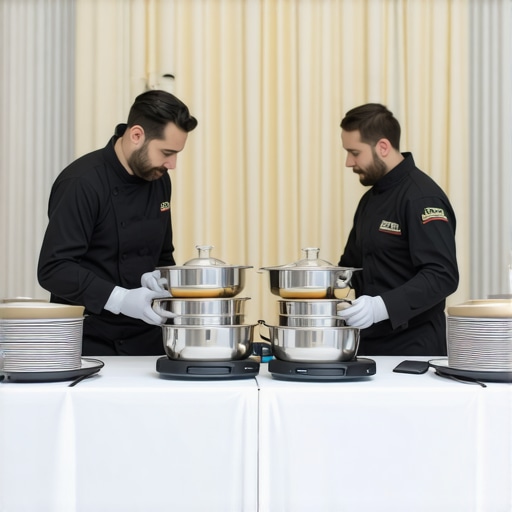
Don’t get fooled by the ‘Luxury’ label on a resume
We’ve all seen teams that look the part—crisp white shirts, polished shoes, and perfect posture. But there is a massive difference between a server who can carry a tray and one who understands the flow of a high-stakes gala. You need to know how to spot a fake luxury server team before they ruin your gala. I once hired a ‘premium’ agency that sent me 15 students who had never seen a 3-course set. It was a disaster. Since then, I’ve realized the hidden risks of hiring student servers for high-end events often outweigh the cost savings. True expertise lies in knowing how to train temporary server staff on high-end table manners in a 15-minute pre-shift briefing.
The ‘Ghost Requirement’ that can shut down your load-in
Here is a professional tip that most beginners miss: the COI (Certificate of Insurance) bottleneck. You might have the best corporate event catering strategies for success, but if your catering van driver doesn’t have a specific ‘Additional Insured’ line for the venue’s third-party parking management company, they won’t even let the liftgate down. I’ve seen 500-person lunches delayed by two hours because of a paperwork error at the security desk. Always ask for the venue’s specific ‘Loading Dock Rules and Regulations’ document—not just the general contract. This is a key part of mastering corporate event planning secrets to seamless success. If you want to boost your corporate event with expert server techniques, you have to ensure the team actually makes it into the building on time.
Digital blueprints are your only real insurance policy
I learned early on that relying on a venue’s PDF floor plan is a recipe for a 10 PM meltdown. Those documents are rarely updated and often hide ‘ghost’ pillars or electrical boxes that aren’t where they should be. Now, I personally use cloud-based spatial design tools to build a 1:1 digital twin of the room. This isn’t just for show; it’s how you handle effective catering strategies for corporate event impressiveness when the CEO decides to add two last-minute VIP tables. By using software that allows for real-time collaboration, my floor leads can see exactly where a table has moved on their tablets before a single linen is draped. This level of precision is the backbone of optimizing server efficiency to enhance event satisfaction because it eliminates the ‘where does this go?’ confusion that kills the load-in momentum.
Stop shouting and start whispering in the back of the house
If you see a catering team huddled in a corner whispering frantically, it’s a sign that their communication system has failed. I made the switch to discrete ‘whisper’ headsets years ago, and I will never go back to standard walkie-talkies. The noise of a radio crackling in a quiet ballroom during a toast is an amateur move. High-fidelity, multi-channel earpieces allow me to talk to the kitchen, the bar, and the front-of-house leads simultaneously without the guests ever hearing a word. This tech is vital for why your server team needs a clear chain of command on site. If a guest at table 14 has an allergy we weren’t told about, I can relay that to the chef and have a custom plate moving before the server even leaves the table. According to the Professional Convention Management Association (PCMA), real-time digital communication can reduce response times to on-site service issues by nearly 40%.
How do I keep these logistical systems from falling apart?
Maintenance isn’t just about polishing silver; it’s about auditing your digital infrastructure. I treat every event like a stress test. Once a quarter, I perform a ‘tech audit’ on our gear, but I also audit the venues we frequent. This includes how to vet a venue for corporate wifi stability and speed, because if the venue’s network goes down, my cloud-based floor plans and guest lists become useless. Long-term results come from having a ‘fail-safe’ backup for everything. I always keep a local, offline copy of every document on a tablet and a physical ‘Run of Show’ binder. This ensures that even in a total blackout, my team knows exactly what their server skills that make every event stand out should look like during the service. I predict that within the next three years, we will see real-time staff tracking via low-energy Bluetooth, allowing us to see ‘human traffic jams’ on a dashboard before they actually happen.
The ghost walkthrough method for ultimate scaling
To truly scale your operations without losing quality, you have to master the ‘Ghost Walkthrough.’ This is a technique I use where I walk the venue 48 hours before the event with zero staff present, mentally simulating every single movement from the first appetizer to the final coffee service. It’s during these walks that I realize things like a swinging kitchen door that might hit a server’s tray, which is a classic sign of how to spot a server who has not been trained in French service or general awareness. I challenge you to try this for your next event: don’t just look at the room—simulate the most difficult plate-clearing route. If you find a bottleneck now, you won’t have to fix it while 500 guests are watching. Don’t wait for the crisis to happen; use these tools to build a wall between your guests and the chaos of the loading dock. Boost your corporate event with expert server techniques by investing in the tech that works behind the scenes so you can focus on the people in front of the curtains.
The Unfiltered Realities of Back-of-House Management
Over the years, I’ve realized that the most powerful person at the venue isn’t the owner; it’s the security guard who controls the service elevator key. Learn their name early and always bring them a hot coffee if you want a smooth load-in. I’ve also learned that true luxury is a feeling created entirely by logistics. If your team is sweating and sprinting through a crowded guest lobby with heavy crates, the ‘luxury’ vibe is instantly shattered. Real top server tips to elevate your event experience actually begin with a calm, hidden arrival that guests never see. Finally, never assume the loading dock will be empty just for you; if you aren’t thirty minutes early to your slot, you’re likely an hour late to the party.
My Non-Negotiable Kit for Complex Events
I never step onto a property without a laser measure. A three-inch discrepancy in a service door can stall your entire timeline. To stay organized, I rely on cloud-based spatial tools to keep my corporate event catering strategies for success adaptable when the client decides to add tables at the last second. Additionally, I follow wedding catering tips from industry experts by keeping a physical ‘Run of Show’ binder; technology is great, but paper doesn’t need a Wi-Fi signal to work during a blackout. [image placeholder]
Build a Foundation of Certainty for Your Guests
Logistics might not be the most glamorous aspect of the job, but they are the invisible skeleton that supports every beautiful toast and perfect meal. When you master the chaos behind the scenes, you give yourself the freedom to be present for the magic happening in the ballroom. Start small, physically walk every delivery route, and watch how your confidence transforms the energy of the room. Your commitment to optimizing server efficiency to enhance event satisfaction will be felt by every guest, even if they never see the loading dock that made it possible. What’s the weirdest loading dock obstacle or back-of-house mystery you’ve ever had to solve? Let me know in the comments below!