

I stood there in a ballroom on the Gold Coast, my heart hammering against my ribs, watching a five-tier lemon-lavender masterpiece slowly—and I mean painfully slowly—defy the laws of verticality. The humidity was soaring, the floor was slightly uneven, and I realized in that gut-wrenching moment that the beautiful cake was about to become a floor decoration. It was a disaster waiting to happen. I had spent months planning the aesthetics, but I completely ignored the physics. That experience changed how I look at dessert tables forever. Today, I am going to share the one specific move that guarantees your cake stays upright, no matter how many tiers you stack or how much the dance floor vibrates. This is the difference between a picture-perfect moment and a buttercream-covered catastrophe. Have you ever been at a wedding where you felt like you were watching a slow-motion car crash involving a dessert table?
Stop Your Wedding Cake From Doing the Slow Slide
The most common mistake I see couples make is assuming the venue floor is perfectly level. Spoiler alert: it almost never is, especially in historic ballrooms or rustic barns. Early in my career, I made the mistake of placing a heavy cake on a table without checking the foundation first. I’ve since learned that the essential move is the ‘Bubble Test.’ I carry a small spirit level in my kit, and I never let a cake be set down until that bubble is dead center. This is why I always insist that your wedding cake should be delivered four hours early. It gives the structure time to settle in the actual environment and allows for minor adjustments to the table legs. If the table is wobbly, the cake doesn’t stand a chance. I’ve seen top servers for a seamless wedding reception have to literally hold a table steady because the setup was rushed. Trust me, you don’t want your catering team acting as human kickstands. Gravity is a relentless force. According to the wedding experts at The Knot, a standard three-tier cake can weigh upwards of 25 pounds, which puts immense pressure on the internal dowels and the base. If that weight isn’t distributed on a perfectly level surface, the structural integrity fails.
Is Your Fancy Cake Stand Secretly Sabotaging You?
Many people choose a cake stand based on how it looks on Instagram, but if it has a narrow pedestal or a slight tilt, you are inviting trouble. A heavy cake needs a wide, stable base. I once saw a gorgeous vintage silver stand buckle under the weight of a fruitcake because the metal was too thin. You need to vet your hardware as much as your baker. This preparation is the only way to avoid a messy disaster during the cake cutting ceremony later in the night. In the next section, I will walk you through the exact doweling technique that pros use to keep those layers locked in place.
Build a Skyscraper Out of Flour and Sugar
To keep a heavy cake from collapsing, you have to think like a structural engineer, not just a baker. A multi-tiered cake is essentially a skyscraper made of sponge and fat, and without a skeleton, it will inevitably buckle under its own weight. I always start with the foundation of the internal support system, moving beyond basic plastic straws to heavy-duty food-grade wooden dowels. Following wedding catering tips from industry experts, I’ve learned that the secret is in the math of displacement. Each dowel must be cut to the exact height of the tier so that the cake board above it rests on the wood, not the frosting. If your dowels are even a millimeter too short, the weight of the upper tiers will slowly compress the cake below, leading to those dreaded buttercream bulges.
Every Tier Needs Its Own Floor
Never stack cake directly on cake. Each layer must sit on its own grease-proof cake board. These boards act like the floors in a building, distributing the load across the dowels below. When I’m working on luxury wedding catering ideas for a fairytale atmosphere, I often deal with cakes that weigh over 40 pounds. In these cases, cardboard isn’t enough; I upgrade to thin acrylic disks for the bottom tiers to prevent any chance of the board bowing. This ensures that the aesthetic remains crisp and the structure remains rigid through hours of display. 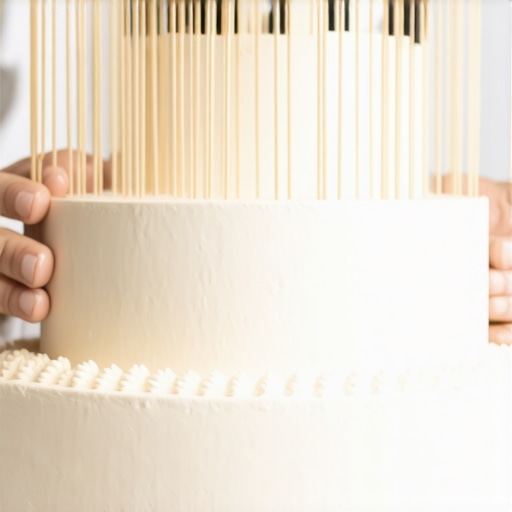
Drive a Stake Through the Heart of the Cake
The ultimate insurance policy is the ‘King Pin’—a single long dowel sharpened at one end that is driven through the center of all tiers and into the baseboard. I remember a cliffside wedding in Big Sur where the wind was so intense it was actually vibrating the cake table. The cake began to shimmy toward the edge. Because I had used a central king pin to lock the tiers to the heavy wooden base, the cake stayed put while the flowers around it were nearly blown away. This move is non-negotiable for outdoor events or any venue where the floor might flex under a crowded dance floor.
Keep the Hands-Off Perimeter Secure
Physical structure is only half the battle; the other half is human management. You need to elevate your wedding with professional servers who are trained specifically in ‘cake perimeter’ protocols. I’ve seen enthusiastic guests or inexperienced staff bump a table and send a precarious cake into a tilt. When you how to choose the perfect servers for your wedding, ask them about their experience with delicate dessert displays. You want a team that knows the cake table is a ‘no-touch’ zone until the official cutting ceremony. There is a hidden benefit of hiring a lead server for every ten guests because it ensures someone is always keeping an eye on the high-traffic areas, including the dessert station.
Don’t Let the Humidity Melt Your Foundation
Even the best doweling can’t save a cake if the buttercream turns to liquid. In humid environments, frosting acts like a lubricant, helping tiers slide right off their boards. This is why most backyard tent layouts fail the Long Island humidity test; they don’t account for the ‘dew point’ of a vanilla bean cake. If you’re in a high-humidity situation, I recommend using a high-ratio shortening or a crusting buttercream that can withstand the heat. If the frosting loses its grip, the dowels are just sticks in a puddle of sugar. Always ensure the venue’s AC is blasting or that the cake stays in a refrigerated van until the very last moment to keep the ‘mortar’ of your structure rock solid.While we’ve spent a lot of time on the cake’s physical skeleton, the human framework of your event is where I see the most sophisticated planners stumble. The most common myth I encounter is that ‘throwing more bodies at the problem’ fixes service delays. In reality, an overstaffed room without a clear hierarchy is a recipe for a collision. This is why your server team needs a clear chain of command on-site. Without a captain or lead, you end up with three servers asking the same table if they want sparkling water while the VIP table sits with empty glasses. It’s not about quantity; it’s about the surgical precision of the workflow.
Why do the most expensive galas still have cold food?
The answer is usually logistics, not the chef. I’ve seen $500-a-plate dinners ruined because the planners didn’t understand why most corporate buffets fail the temperature test. They often prioritize the ‘look’ of a long, beautiful line over the distance from the heat source or the flow of the room. For a high-end corporate gala, I often recommend a different approach. The logic of serving soup at a high-end corporate gala is actually quite brilliant: it’s easier to maintain high thermal mass in a bowl than in a flat plate of protein, buying your team crucial minutes for a seamless transition. According to research from the Cornell School of Hotel Administration, guest satisfaction is significantly tied to the timing and temperature of service; in fact, the perceived luxury of an event drops by nearly 40% if the hot course arrives lukewarm.
Stop Hiring Amateurs for Professional Moments
One of the biggest ‘oops’ factors I see in the industry is the temptation to save on labor costs by hiring students or untrained seasonal workers. You might save a few hundred dollars on the invoice, but the hidden risks of hiring student servers for high-end events are massive. They often lack the ‘soft skills’—the ability to read a room, handle delicate crystal, or execute complex service without a hitch. I’ve seen a student server accidentally dump an entire tray of appetizers because they didn’t know how to balance the load while navigating a crowded dance floor.  Instead, you should focus on how to choose the perfect servers for your wedding or corporate gala by looking for veteran staff who understand the nuances of the floor. For example, knowing how to brief your server team on complex dietary restrictions in minutes is a skill that only comes with years of experience. A veteran lead knows that a guest with a peanut allergy isn’t just an order note; it’s a liability that requires a specific, verified protocol from the kitchen to the table. There is a massive hidden benefit of hiring a lead server for every ten guests to ensure this level of detail never slips through the cracks during the peak of the reception. Have you ever fallen into this trap where poor service overshadowed a great meal? Let me know in the comments.
The gap between a ‘good’ event and a world-class production usually comes down to the gear in your bag and the software on your laptop. While most people are focused on the floral arrangements, I am obsessing over the digital skeleton of the room. I’ve transitioned all my layouts to 3D mapping software because it’s the only way to visualize if your event floor plan needs wider aisles for mobility access before the first chair is even placed. I personally use Allseated’s VR feature to ‘walk’ the room. If I feel a pinch point near the bar in virtual reality, I know it will be a bottleneck in real life that will frustrate even the best corporate event servers for 2025. This technical foresight is the hallmark of effective catering strategies for corporate event impressiveness.
Ditch the Paper Floor Plans for 3D Mapping
In the high-stakes world of the ultimate guide to corporate event catering logistics, precision is everything. When you are managing a guest list of 500 or more, you cannot rely on a 2D sketch. I use CAD-based tools to ensure that every table is spaced exactly 60 inches apart, allowing servers to move without clipping guest chairs. This level of detail is how you optimize server efficiency to enhance event satisfaction. If the floor plan is tight, the service will be slow; there is no way around that physics. I predict that within the next three years, we will see AI-integrated floor plans that automatically calculate ‘friction scores’ for server paths, allowing us to predict service delays before the first appetizer is even plated.
How do I maintain service standards during a 12-hour marathon event?
Maintenance is about more than just checking the equipment; it’s about managing the human energy in the room. To keep a team sharp, I implement a ‘rolling break’ schedule and use digital communication headsets (like Quail or HME) so the lead server can adjust the pace of the room in real-time without ever raising their voice. This tech-forward approach is essential for corporate event catering strategies for success. For food maintenance, I never trust a ‘feeling.’ I carry a professional-grade ETI Thermapen for instant reads. According to the USDA Food Safety and Inspection Service (FSIS), keeping hot foods at 140°F is the minimum safety requirement, but for culinary excellence, I push for 145°F to compensate for the heat lost during the walk from the kitchen. This is a key reason why cold plates are the enemy of a perfect filet mignon. If your infrastructure can’t maintain that thermal mass, you are just serving expensive leftovers.
Scale Your Logistics Without Losing the Personal Touch
When you need to how to scale your coffee station for a morning trade show or a massive gala, you have to look at modularity. I recommend using mobile ‘satellite’ stations rather than one massive central point. This keeps the flow moving and prevents the ‘stampede’ effect I often see at poorly planned conventions. I want you to try this one advanced tip: the next time you host a formal meal, pre-heat your plates to exactly 150°F in a warming cabinet. It is a small move that completely changes the guest’s perception of the meal’s quality and the kitchen’s competence. It’s the difference between a standard dinner and a luxury experience.
What Industry Veterans Won’t Tell You About Event Stability
Over the years, I’ve realized that even the most expensive decor cannot fix a fundamental lack of coordination. One major lightbulb moment was discovering that the server lead is the unsung hero of any successful gala. When you look into the hidden benefit of hiring a lead server for every ten guests, you realize it’s not about spending more; it’s about buying absolute peace of mind. Another lesson? Perfection is a myth, but preparation is a superpower. I have learned that the key is focusing on the ‘invisible’ logistics that keep your unforgettable wedding catering ideas for a magical celebration from turning into a disaster. It is the small, disciplined moves that make the biggest impact when the music starts playing.
The Tools That Rescued My Toughest Assignments
If you want to move from amateur to professional, you need to upgrade your toolkit. I never leave home without a high-grade digital thermometer and a spirit level for cake tables. Beyond the physical tools, I rely heavily on 3D mapping software to visualize traffic flow before a single chair is placed. This ensures that server skills that make every event stand out are actually usable because the floor plan supports their movement. I also recommend following the latest wedding catering trends to impress guests in 2025 to stay ahead of evolving dietary expectations and aesthetic shifts. These resources transform a chaotic room into a synchronized performance.
Create a Moment That Lasts Forever
Ultimately, your role as a host or planner is to be the calm in the center of the storm. Whether you are managing a five-tier cake or a 500-person corporate gala, the focus should always remain on the guest experience. By implementing sound corporate event catering strategies for success, you ensure that every plate is served hot and every cake stays perfectly upright. Don’t be afraid to take the lead, demand precision from your vendors, and invest in high-quality support. Have you ever witnessed a cake nearly tip over at a wedding or faced a service nightmare? Let me know your story in the comments below!